Eligible Edinburgh businesses who have seen a minimum 20% shortfall in their income as a result of Covid-19 restrictions since the start of the pandemic can now apply for a one-off £4,000 grants.
This fund is aimed at reaching businesses who have otherwise ‘slipped through the cracks’ in terms of funding initiatives, meaning those who have not already been eligible for other financial support from central government since October (other than the furlough scheme, the self-employed income support scheme or the newly self-employed hardship fund).
To apply for a £4,000 grant, businesses must submit a self-declaration of their business’s income in January and February 2020 as well as January and February 2021. A 20% decrease in the average income over the two time periods will be required in order to be eligible.
In addition, businesses with employees that have successfully applied for Discretionary Grant funding, either in this or the earlier tranche in February, will have access to extra funding specifically to help them retain their staff. This will be applied through a tiered approach, depending on the number of people they employ, and for those businesses with employees on PAYE (not owners, directors or partners).
Councillor Kate Campbell, Housing, Homelessness and Fair Work Convener, said:“This year has been incredibly difficult for businesses in our city, and we know how hard people have had to work to keep going. We now have £10 million available to help businesses in Edinburgh and we just want to get the funds out to them as quickly as possible.
“We want to make sure nobody’s missing their chance at accessing financial support so I’d encourage anyone who hasn’t already applied to visit the application page on our website, check the eligibility criteria, and apply today.”
Councillor Mandy Watt, Vice Convener said: “We know businesses have been hit desperately hard in this pandemic and it’s crucial that we’re able to get this funding into the accounts of everyone who’s eligible and who hasn’t been able to access previous schemes due to not meeting the criteria. Please apply today and let us give you the money you’re entitled to.“
Yesterday’s launch of online applications marks the second phase of Discretionary Fund awards in 2021.
On 3 February, the Council invited applications for grants from the first tranche of Discretionary Funding allocated to the city, totalling just under £2.8m.
At that stage, grants were for £2,000 and aimed at businesses that could show a significant drop in income due to Covid restrictions introduced since October. Any businesses who successfully applied for this amount earlier in the year will now have this sum topped up to £4,000 to bring them in line with recipients in this second round of funding. They do not need to reapply.
During the first tranche the criteria was initially set at a 30% income loss, however this was later revised to 20% following ongoing dialogue with businesses. It is hoped more businesses will apply and enable themselves to benefit from funding in this second round in light of the revised income reduction threshold.
Applications will be open for a period of four weeks, or until all the funding has been allocated, and will be processed in the order they are received.
Sir Lenny Henry has written an open letter to encourage Black Britons to take the COVID-19 vaccine, signed by some of the most high-profile names in the UK.
Actor Chiwetel Ejiofor, actor Thandie Newton, radio personality Trevor Nelson, musician KSI and author Malorie Blackman, among the signatories on Sir Lenny Henry’s open letter
Short film based on the letter by BAFTA award-winning director Amma Asante stars Adrian Lester, David Harewood, and Bridgerton’s Adjoa Andoh, and will be aired across Sky, BT Sport, Viacom, Discovery, A&E and ROK and Channel 5 tonight from 8pm
Letter comes as 30 million people have had their first dose of the vaccine – over half the UK’s adult population
12 Years a Slave actor and Oscar nominee Chiwetel Ejiofor, author Malorie Blackman, actor Thandie Newton, football pundit Garth Crooks, performer George the Poet and musician KSI, radio personality Trevor Nelson and Bridgerton star Adjoa Andoh are among those who have put their names to the letter which encourages Black adults in the UK to make informed decisions about the vaccine and protect themselves and the people they care for by getting vaccinated when their turn comes.
Sir Lenny’s letter, supported by the NHS, has also been turned into a powerful short film, directed by BAFTA award winner Amma Asante, which features Lenny alongside Adrian Lester, David Harewood, Naomie Ackie, Rt Rev Rose Hudson Wilkin, Bishop of Dover and Adjoa Andoh. The film will be aired across Sky, BT Sport, Viacom, Discovery, A&E and ROK between 8pm and 9.30pm.
Sir Lenny Henry said: “I felt it was important to do my bit and so I wrote this letter to Black Britain asking people not to get left behind, to not continue to be disproportionately impacted and to trust the facts from our doctors, professors and scientists, not just in the UK but across the world, including the Caribbean and Africa.
“I hear and understand the concerns which people of all backgrounds are wrestling with, but which are particularly concerning in Black communities. I want people to be safe, I don’t want people to die or end up in hospital because of COVID-19. So I’m saying, when your turn comes, take the jab.
“I want to thank everyone who has signed the letter and dear friends who took part in Amma’s beautiful film.”
More than 30 million people have now received their first COVID-19 vaccine dose, meaning over half of the UK’s adult population have been vaccinated and will soon develop strong protection from serious illness, saving lives and significantly reducing pressures on the NHS.
Television veteran Sir Lenny says he understands the concerns of many in the Black community but tells them he does not want their concerns about the jab to leave them disproportionately impacted by the pandemic.
An Office for National Statistics (ONS) survey taken from 13 January to 7 February shows that less than half (49%) of Black or Black British adults reported that they were likely to have the vaccine and NHS data shows that only 466,000 Black of Black British adults have had a first dose of the vaccine so far.
Amma Asante, who directed the film, said: “Creating something for the community I come from was important to me, particularly on a health issue that is as life and death as coronavirus.
“I wanted to make a film that acknowledges the concerns of Black people while sharpening the lens on why the vaccine is so important, and why we deserve to have our lives and the lives of our loved ones protected.
“I hope the film can contribute to making a difference.”
Professor Kevin Fenton, London’s Regional Director for Public Health England, said: “We know our Black communities have been among the hardest hit during this pandemic, but we also know there are some among us who are less likely to come forward for the life-saving vaccine.
“We can all play a role in encouraging our friends and family to take it up when offered, whether that’s answering questions or concerns they may have, pointing them towards information and advice from trusted sources, sharing our own experiences of getting the vaccine or declining to pass on myths and misinformation circulating on social media.
“Getting back to normal life in the UK will mean every one of us joining the over 30 million people across the UK who have already taken up the vaccine. So I am fully behind Sir Lenny’s call to our Black communities. Let’s all do our bit, keep our loved ones safe and end this pandemic sooner rather than later.”
People who have received a letter inviting them for a jab can log on to the national booking service and choose from 1,700 vaccination sites. Anyone unable to book online can call 119 free of charge, anytime between 7am and 11pm 7 days a week.
Signatories to the letter have come from across the spectrum of British society. From the business world, signatories include Karen Blackett OBE, Ric Lewis, Sonita Alleyne OBE, Eric Collins, and Wilfred Jones.
Names from the arts and entertainment include Malorie Blackman, Lemn Sissay, Roy Williams, Reni Eddo-Lodge, George The Poet and KSI and from sport – Garth Crooks and Chris Hughton. Names from science and medicine have also supported the campaign, including Professor Kevin Fenton and Dame Donna Kinnair.
Baroness Valerie Amos, Baroness Doreen Lawrence and Trevor Phillips have also added their names.
The government is working with the NHS, local authorities, charities and faith leaders to provide advice and public health information in over 13 languages to people from all communities and backgrounds to ensure they come forward for the vaccine.
Sir Lenny Henry’s letter in full
Dear mums, dads, grandparents, uncles, aunties, brothers, sisters, nephew, nieces, daughters, sons and cousins,
We love you!
We know we don’t say it often enough and sometimes we have our disagreements, like all families do, but wherever you are we love you from the bottom of our hearts and we know you love us.
And we want to see you again. COVID-19 has kept us apart for far too long. We want to hug you, we want to celebrate with you, we want to go out for dinner with you, we want to worship with you, we want to go and watch football and cricket with you, we want to beat you at video games – in the same room so we can see the look on your face when we do.
But in order to do all that – we all need to take the COVID-19 jab. It’s all of us in this together.
Things will slowly get back to normal. Well what people are calling the new normal. The reality is the new normal may mean needing a vaccine to do many of the things we now take for granted.
Because we love you – we want you to be safe and we don’t want you to be left out or left behind. While other communities are rushing to get the vaccine and millions have already been vaccinated, some Black people in our community are being more cautious.
You have legitimate worries and concerns, we hear that. We know change needs to happen and that it’s hard to trust some institutions and authorities.
But we’re asking you to trust the facts about the vaccine from our own professors, doctors, scientists involved in the vaccine’s development, GPs, not just in the UK but across the world including the Caribbean and Africa. Many of whom are our relatives, many of whom have made the ultimate sacrifice to protect the people of this country from this pandemic.
And the thousands who volunteered to be part of the vaccine trials so that we know it’s safe and works for people of all ethnicities.
Don’t let their sacrifice be in vain. Don’t let your understandable fears be what holds you back. Don’t let your concerns be the thing that widens racial inequality in our society. Don’t let Black people continue to be disproportionately impacted by this terrible disease. Many in our community say they do not want to take the vaccine, much more than other groups. But the fact is we have been disproportionately affected by the virus, many of our loved ones have died. Don’t let coronavirus cost even more Black lives.
We love you. We don’t want you to get sick. We don’t want you to die.
We know you love us too so please hear us and when your turn comes, take the jab.
And once you do, tell cousin Mo to do the same (is he really my cousin?)
PM Boris Johnson’s statement at yesterday’s Coronavirus press briefing:
Good afternoon and welcome to this press conference on what has been a big day for many of us – with the first chance to see friends and family outdoors, whether as six people or two households.
And I want to congratulate the members of Ilkeston cycling club in Derbyshire that set off at midnight, the swimmers who broached the chilly waters of the Hillingdon Lido at the crack of dawn, and more than anything I know how much it will have meant to millions of people to have joined someone else for a cup of tea in the garden.
And I must stress that it is only because of months of sacrifice and effort that we can take this small step to freedom today. And we must proceed with caution.
It is great to see that yesterday we recorded the lowest number of new infections for six months, deaths and hospital admissions across the UK are continuing to fall.
But that wave is still rising across the Channel and it is inevitable as we advance on this roadmap that there will be more infections, and unavoidably more hospitalisations and sadly more deaths.
So what we need to do is continue flat out to build the immunity of our population, build our defences against that wave when it comes.
And now that we have vaccinated more than 30 million adults across the United Kingdom it is more vital than ever to protect the most vulnerable.
The evidence seems pretty clear that vaccinating the elderly and vulnerable has helped to drive down rates of hospitalisation and death and now we want to reinforce that protection with a second dose so for many people April will be the “Second Dose Month” – and please take up your appointment when it’s your turn.
And at the same time as we push forwards with our programme to offer a vaccination to all adults by the end of July we’re building up our own long-term UK manufacturing capabilities.
I’ve already told you that Novavax – a potentially significant new weapon in our armoury against Covid – is going to be made at Fujifilm in the North East.
And I can today announce that the Vaccine Task Force has reached an agreement with GlaxoSmithKline to finish and bottle this precious fluid also in the North East giving us between 50 and 60 million doses of UK made vaccine subject to the right approvals from the MHRA.
And then, of course, there is one other way we can all build our own individual defences against Covid and enjoy ourselves at the same time – and that is to take more exercise.
So I am personally thrilled that I will be able to play tennis for instance, and without being remotely preachy I do hope that we can take advantage of this moment and the beautiful weather – to play sport, to take exercise, to have fun and build our national resilience in that way too.
And remember that outdoors is generally much safer than indoors and the way to continue on our cautious but irreversible roadmap to freedom is to follow the rules and remember hands, face, space and fresh air.
In Scotland, lockdown restrictions will ease from Friday with a move from Stay at Home to Stay Local
Stay at Home regulations will be lifted on 2 April and replaced with guidance to Stay Local, with more services including hairdressers, garden centres and non-essential click and collect services able to open from 5 April.
More college students will also return to on-campus learning and outdoor contact sports will resume for 12-17 year olds on 5 April if progress on vaccination and suppression of Coronavirus (COVID-19) continues.
The Scottish Government then hopes to lift all restrictions on journeys in mainland Scotland on 26 April.
New TUC analysis of official statistics shows BME youth unemployment rate has increased at twice the speed of young white workers during the pandemic
Union body calls on ministers to create good new jobs, extend and widen Kickstart scheme and boost universal credit
The unemployment rate for young black and minority ethnic (BME) workers has risen at more than twice the speed of the unemployment rate for young white workers, according to new TUC analysis.
The analysis of ONS figures reveals that the unemployment rate for young BME people aged 16-24 years old soared from 18.2% to 27.3% between the final quarter of 2019 and the final quarter of 2020. This is a 50% increase in the rate over the period, and a rise of 9ppts.
Over the same period the unemployment rate for young white workers rose from 10.1% to 12.4% – an increase of 22% of the original rate, or 2.3 percentage points.
These unemployment figures measure the proportion of young people who want to work who are in a job, and do not include young people who are inactive such as students. They tell us that BME young people who choose to work, rather than study, have a more difficult time in the labour market than their white peers.
Youth unemployment
Previous TUC analysis found that young workers generally have suffered a bigger hit to their job prospects than any other age group.
More young workers were made redundant during summer 2020 than in all of 2019. And the number of pay-rolled employees aged under 25 fell by 437,000 between February 2020 and February 2021. This accounts for 63% of the nearly 700,000 payroll jobs lost over the pandemic.
The TUC says this is largely the result of Covid-19 hitting sectors of the economy where young people tend to work, such as accommodation and food services.
But the union body is concerned that the disproportionate effect on young BME people is further evidence of racism within the labour market.
Government action needed now
The TUC is calling on the government to:
Create good new jobs. We could create 1.8 million new jobs in the next two years in green transport and infrastructure, and by unlocking public sector vacancies.
Improve and extend the Kickstart scheme. The scheme is not effective as it doesn’t guarantee a high-quality sustainable job on a decent wage for every young unemployed person. Ministers should also ensure that ethnic monitoring is built into the scheme so it is clear who is taking part and whether they are getting jobs at the end. In addition, Government should encourage employers to use positive action measures permitted by the Equality Act.
Give more financial support for people who have lost their jobs. Without a boost to universal credit, many will be pushed into poverty.
Provide dedicated careers advice for young workers who have lost their jobs.
TUC General Secretary Frances O’Grady said: “Covid has removed any doubt that racism exists in our workplaces – and in wider society. And our new analysis shows that it starts as early as age 16.
“All our young people need opportunities as they start out on their careers – but they’ve been hit hardest by job losses in the pandemic. And some are facing additional obstacles because of their race. That’s wrong.
“Ministers must stop delaying and challenge the racism and inequality that holds back BME people from such an early age. And start creating good new jobs so that all of our young people have a fulfilling future to look forward to.”
Chair of the TUC Young Workers Forum Alex Graham said: “Young workers have experienced first-hand the impact of the pandemic. Many have lost jobs and others are concerned that without help from government, they will be out of work too.
“The disproportionate impact on young BME workers is another reminder that racism exists in the labour market as in wider society. More work is needed to tackle discrimination in the labour market and make racism it a thing of the past.
“The government must act to protect and create jobs and provide careers advice to help young people find work. We’ll be talking at our conferences about the all the action needed to stop the mass unemployment of young workers.”
Donations total £1m and 18 million hours of volunteering
Faced with the greatest global pandemic in living memory, Freemasons came together in 2020 and donated a total of £1m as well as their time to help those in need.
The donations were used to help communities in various critical areas, including foodbanks, support for unpaid carers, personal protective equipment (PPE), supplies for hospitals and hospices, support for women’s refuges, and funds for NHS workers, ambulances and equipment.
Freemasons also worked 18 million hours as volunteers in a range of different areas, where there was a need, including driving vulnerable people to hospital, preparing meals, taking care of people at risk, organising care packages, producing scrubs, PPE and hand sanitiser.
At the start of the crisis in April 2020, some Freemasons adapted their businesses’ production lines to produce nearly 5,000 visors for use in healthcare settings. Since then, Freemasons have produced or procured tens of thousands of pieces of additional PPE.
Meanwhile, to help protect women and children from domestic abuse, Freemasons donated more than £165,000 in 2020. The donation helped more than 2,000 women during the lockdown, who received more than 1,000 parcels containing essential items for women fleeing domestic abuse.
Freemasons also focused their efforts on hospitals and care homes, donating nearly 1,000 tablets to provide vital contact between coronavirus patients and their loved ones. The tablets were provided to more than 50 hospitals, care homes and hospices. In London, hospitals including The Royal London, Queen Mary’s and St Thomas’ received approximately 115 tablets; while in Kent, Surrey and Sussex, some 200 tablets were donated.
Elsewhere, to support thousands of families struggling during the crisis, Freemasons donated 300,000 meals and 38 tonnes of food to homeless people, women’s refuges and vulnerable people, supporting more than 120,000 people in total. Moreover, £560,000 was donated to provide meals and help numerous foodbanks.
Dr David Staples, chief executive of the United Grand Lodge of England (UGLE), said: “No one in this day and age should have to worry where their next meal is coming from.
“We are so glad that we were able to provide thousands of families across the UK with a hot meal or food donations to help get them through this current crisis. Freemasons have achieved all of this in just a few months and have also given their time to produce and deliver food to the vulnerable.”
The UGLE is also encouraging its members to roll up their sleeves and volunteer to help vaccinate the population. “More than 18.5 million hours of volunteer work were undertaken by Freemasons. Now it is crucial that we help in every way we can to protect the population. If the NHS needs volunteers, then we are happy to emphasise the importance of this to our members,” said Dr Staples.
He continued: “Our response to the Pandemic shows what Freemasonry is all about; supporting those in need, giving back to our communities and volunteering where it can make a real difference.
“Freemasons have been doing this for over 300 years and I am proud of the time and commitment that our members have given to support the nation in its fight against Covid-19.”
In addition to the £1m donated in 2020, the Freemasons have committed a further fund of £2.1m to support the ongoing Covid-19 crisis response. Of that £2.1m, £850,000 has been allocated to support homeless people through several charities with which UGLE partners.
More than 40,000 homeless individuals are being provided with food and essentials, transport, help with accessing services such as counselling and healthcare, as well as employment and training opportunities.
After being kept out of venues, clubs, bars and restaurants for the best part of a year, Brits are being offered an etiquette guide to keep in mind when out and about this summer.
The team at Groubook have put together top tips on how to navigate social events once the hospitality sector reopens to the public.
Physical distance, hand sanitiser and masks are likely to still be common practice until the whole country has been vaccinated. The pandemic has changed our social behaviour and whilst the idea of dancing in a field at a festival or in a club with mates seems miles away, there is definite hope ahead.
Drinkers in bars and diners in restaurants will still be expected to keep to social distance measures and a few friends may not feel comfortable socialising for a while, so it is essential to be mindful in the months ahead.
Founder of Groubook, Bradley Gough said: “As we start to look forward to sunny days spent in beer gardens and nights out with our friends, it is important to be conscious of how alien the first few trips out might feel.
“The measures we saw during the tier system over the summer felt super awkward and at times impolite, but everyone is in the same boat, figuring out pandemic protocols as they go.
“Some people will be rearing for a night on the town, whilst others will be more cautious. The social etiquette guide is a reminder to people as the world starts opening up again.”
Post-lockdown etiquette
1.Distance
Physical distancing is likely to stick around for some time and whilst most people will be used to it, it is easy to forget when out and about enjoying quality time with family and friends. As the public head back into venues, be considerate of any distancing guides that have been put in place, whether it’s capacity restrictions, marked areas to form a queue in, sit down at or for directing the flow of traffic.
2.Cover your mouth
Covering a cough or sneeze is common practice and basic manners, but when living in a post-lockdown society the public has new etiquette to consider. When we inevitably get back inside boozers, it will be a good idea to get everyone to cover up their mouth when singing, or shouting in the direction of others.
3.Be kind
A lot of people working in the hospitality sector have only been in to do a couple of shifts over the last year, meaning they might be a little out of practice and may need more patience than usual. The pandemic has also taught us that no one truly knows what strangers are going through privately. Hopefully being stuck in the house for such long periods has made everyone check their manners, but in case it hasn’t… he is a reminder!
4.Greetings
Everyone is desperate for that first hug with a family member or a high five with a friend, but the etiquette on greetings has obviously shifted. Experts are predicting that the traditional ritual of a clink of glasses, over dinnertime with people outside of our household, will become popular again post-pandemic. However, for the foreseeable small party-goers and pub drinkers will have to settle for cheery waves, mini dances and elbow bumps.
5.Protection
Whilst it’s not the usual night out protection most people have in mind, the regular use of hand sanitiser is likely to stick around long after the pandemic, so it will always be sensible to have some on you. The same can be said for mask-wearing, which is likely to stick around for those not seated and moving through venues. The biggest complaints around masks are not being able to see facial cues and voices becoming muffled, so get used to using eyes to portray a smile, hand gestures to compensate for facial expressions and talk up when in louder spaces.
6.Be prepared
Sharing pretty much anything on a night out is a thing of the past, so it is best to be prepared. Pack the essentials, because sharing a lip balm in the loos or grabbing a mate’s gum will be pretty socially unacceptable. Bring plenty of layers so coats don’t have to be shared if it’s cold, or when people are sneaking out to a smoking area.
7.Be understanding
When making plans in a post-lockdown climate it might be tricky to fully firm plans up, especially with friends or family members that have been shielding. Is so important that each party feels as comfortable and safe as possible. Certain demographics are known to be at a higher risk regarding COVID, and there is often no way of telling this unless they disclose it. Be understanding and accepting of people who may hesitate to join you in activities that may put their health at risk.
8.Book in advance
When the day finally does come, and restaurants and bars reopen, they will be trying to gauge how busy they will be and how much stock they will need. A great way to alleviate the pressure on staff and avoid long waits is to tell a venue the plan way in advance. Take advantage of online booking systems and apps like Groubook, which lets groups of friends, families or colleagues book and arrange their nights in one place, while taking advantage of discounts and rewards.
The team at Groubook believe the app will give independent bars and restaurants a head start when they’re finally able to open for business and help them recoup some of the losses from the pandemic.
The app was launched in Nottingham in August 2020, as restrictions began to ease and saw rapid initial take-up with numbers growing by 250% in the first six weeks.
With the pandemic driving interest rates into the ground, it’s only natural that people are searching for a more lucrative return on their investments.
Research by insurance and personal finance comparison experts Quotezone.co.uk reveals that 85% of those looking for landlord insurance own just one property – suggesting this is a buy-to-let investment rather than their full-time job.
The data, which covers a sample of landlord insurance quotes from 2019 to 2020, suggests redundancies and furlough has perhaps created an emerging trend of small and first-time landlords.
Although the majority of the 19,000 landlords Quotezone.co.uk sampled have owned their property for five years or more, there is a recent spike emerging, with properties owned for ‘less than 1 year’ in Scotland seeing a 14% year-on-year increase during the pandemic.
The data also showed that the average age of a landlord in the UK is 51 – these people are likely at least a decade from retirement and looking to invest their skills and savings in a more long-term asset that may offer higher returns than other investment options out there.
And with only 52% of landlords using cash to purchase during 2020, the lowest figure on record* – buy-to-let is an increasingly viable option for many UK buyers, even those with a relatively modest amount of capital to invest.
The average rent landlords can expect from their investments differs dramatically across the UK, with data from Statista revealing that Greater London has the highest average at £1,556, while the cheapest region is the North East where the average rent is just £539. The UK average is currently £832.
The best interest rate available from savings accounts currently stands at just 3%. By contrast, the average rental yield in the UK is currently 5.2%***, and buy-to-let property in some parts of the country even offers rental yields in excess of 7%.
However, there are overheads a landlord needs to consider such as a managing agent, utilities inspection reports and certificates, landlord licence (£500 every 5 years), safety equipment such as fire alarms and extinguishers and routine maintenance to the property. Landlord insurance is another vital element but by comparing policies on comparison platforms, there are competitively priced policies available.
The research also showed that the majority of tenants were employed professionals followed neck-and-neck by short-term Airbnb lets and DSS / unemployed occupants.
Founder of Quotezone.co.uk, Greg Wilson, comments: “It is interesting to see that 85% of people in our data, who class themselves as landlords, own just one property – suggesting that actually first-time landlords with other occupations could be adding this asset to their portfolio as an additional revenue stream or an alternative to pension investments.
“Covid has created a temporary shopping spree within the housing market with the government’s stamp duty holiday, however I fear this temporary boost in sales may be short-lived as the economic aftermath of the pandemic is yet to be revealed and the stamp duty holiday is due to expire at the end of next month.
“However rental properties haven’t gone untouched by the crisis with many tenants on furlough or facing redundancies and social distancing creating physical barriers to the properties making routine maintenance and repairs difficult.
“It is perhaps more important than ever to ensure landlord insurance policies are thorough, accurate and up to date so that landlords are fully protected should a claim be needed.”
Policies vary from one landlord insurer to another, but in general can cover any damage to the building caused by insurable events like fire, flood, storms, subsidence, theft and vandalism.
Landlord contents insurance, landlord liability and unoccupied property insurance can also be added as well as extra tailored features such as rent guarantee insurance, landlord home emergency cover and legal expenses.
Recommended by 97% of reviewers, Quotezone.co.uk helps around 3 million users every year, with over 400 insurance brands across 60 different products
Seven new private sector jobs will be needed to create one viable job post-pandemic
Cities will lead economic bounce back but most new jobs are expected to be low-skilled and low-paid.
Government must upskill workers and encourage higher-skilled businesses to invest in cities – particularly in the North and Midlands.
New Centre for Cities’ research in partnership with HSBC UK reveals that Britain’s jobs crisis is bigger than realised as the economy will need to create almost ten million new private sector jobs just to reverse the damage done by the pandemic.
Analysis of Britain’s ‘jobs miracle’ from 2013 to 2019 – when the national economy created 2.7 million net new jobs – finds that 19.3 million private sector jobs were created during this period and 16.6 million were lost. This meant that seven new private sector jobs were needed to create one viable job.
If this pattern repeats post-Covid then 9.4 million new private sector jobs will be needed to get the 1.3 million people who lost their jobs during the pandemic working again.
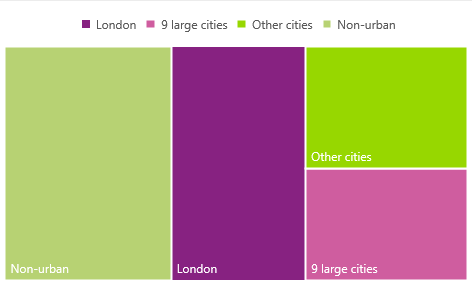
After the financial crisis big cities created the vast majority of new jobs and are expected to do so again post-Covid. London created one in four of all new private sector jobs (790,300) – equal to 17 Scarboroughs, or 25 Hartlepools. Other big cities also played an outsized role: in Manchester, 152,100 new jobs were created; in Birmingham 99,100 were; and in Glasgow 40,800 were.
In total, Britain’s ten largest cities created almost half (45.6%) of jobs during the ‘jobs miracle’, despite accounting for just 3.5% of land. In contrast, smaller towns and rural areas created 36% of new jobs. These findings underline the important role that big cities will play in helping the country recover from Covid-19.
Contribution of cities and non-urban areas to job creation, 2013-19
Source: ONS, Business Structure Database (BSD)
Many of the jobs lost in the pandemic were in sectors such as hospitality and tourism. While they are expected to recover quickly once the economy reopens, with an estimated three quarters of new jobs likely to come from sectors such as these, relying on them for new jobs will not address years of poor productivity and pay stagnation, particularly outside London and the Greater South East.
After the pandemic, the productivity problem that UK cities face will need to be addressed.
To do this the Government should invest in adult education to train people for higher-paid jobs in emerging industries. It should also recognise the crucial role that cities will play in building back better from the pandemic. It should invest £5 billion in a new City Centre Productivity Fund to make struggling city centres more attractive places for high-skilled businesses to locate.
The paper’s other proposals to help the country build back better from the pandemic include reforming business rates, which in their current form are a tax on business investment, and devolving more economic powers and resources to local government – particularly England’s metro mayors.
Centre for Cities’ Chief Executive Andrew Carter said:“Britain’s biggest cities will play a central role in our recovery from the pandemic, as they did after the last economic crisis when London alone created a quarter of all new jobs.
“We must use Covid-19 as an economic reset and address many of the long-standing problems that the economy has faced in recent years such as stalled productivity and stagnant pay. To do this the Government will need to focus on investing in adult education to train people for higher paid jobs.
“Addressing these problems will be be essential if the Government hopes to attract higher-skilled businesses in emerging industries to cities and large towns in the North and Midlands and meet its levelling up objectives.
Ian Stuart, CEO, HSBC UK said:“The employment challenge ahead for the country’s economy cannot be underestimated.
“Beyond the sheer volume of new jobs required, the UK will need to create high value, export-led employment across all regions, if it is to address the age-old productivity puzzle.
“Coming out of the Covid-19 pandemic, we will only truly succeed in levelling up the country if the challenge is shared between government and the private sector with a focus on reskilling our people and attracting new business growth and international investment in the sectors where we have a real competitive advantage.”
On the day that the nation reflected on one year since the first stay-at-home order of the Covid-19 pandemic, the British Psychological Society calls for the psychological needs of healthcare staff to be front and centre of the nation’s recovery.
Coronavirus has cost more than 140,000 lives in the UK over the last year, and we fell silent at 12pm yesterday to remember those we have lost. The toll is unimaginable, and the effects so wide reaching that there is no one in the country whose life has not been profoundly affected by the pandemic.
There are few groups that have been impacted as significantly as the healthcare staff working on the frontline to treat Covid-19 patients and keep the NHS functioning during an unprecedented period.
Psychologists have played a central role in developing the NHS’s early initiatives on staff support in response to the pandemic, including new wellbeing hubs, and it is vital that psychological expertise is incorporated into all future developments.
The recent NHS staff survey results showed a further increase in work-related stress levels in the NHS, and likelihood of staff burnout is only going to rise as the effects of working through the pandemic become more apparent.
Risks are particularly high for the 40.3 per cent of NHS staff who were already experiencing stress at work before the pandemic hit, and for those working in intensive care units with the sickest Covid-19 patients.
It is key that the focus is now on rebuilding the NHS as psychologically healthy and resilient, supporting staff wellbeing on a cultural and organisational, as well as individual, level.
Dr Julie Highfield, consultant clinical psychologist in Wales’ largest critical care unit and wellbeing project director for the Intensive Care Society, said: “One year on, I welcome the progress in involving psychologists in staff wellbeing initiatives, however much of the focus is on individual mental health.
“Although this is helpful in part, it’s not the whole picture. When I meet with staff what they describe does not fit neatly into common mental health pathways, it is the way chronic excessive workload has changed their relationship with work.
“If we just focus on mental health provision and individual resilience, we miss the systemic factors that contribute to the experience of work such as workplace culture, leadership and sufficient staffing, education, equipment, and facilities. As psychologists, we should also support workforce sustainability for a future healthier NHS and social care sector.
“We need to utilise the skills, knowledge and evidence base of Psychologists to help organisations to understand how to provide the core conditions to thrive at work, therefore reducing the risk of psychological harm.”
Dr Adrian Neal, chair of the BPS Division of Clinical Psychology’s Leadership and Management Faculty, added: “As we mark the first anniversary of the UK’s pandemic lockdown, it seems a natural opportunity to reflect, take stock of the impact and look forward.
Right now we are seeing an exhausted workforce, an increase in grief, burnout and more acute mental health difficulties (though less than we had expected), as well as changes in how people are relating to their work, peers, communities, and employers.
It is widely recognised that employee and organisational wellbeing is going to be vital to the sustainability of our public sector systems, and resources have been mobilised at pace in an attempt to mitigate perceived needs.
Perhaps the most useful thing we can do as psychologists is to encourage a calm and evidenced approach to fully understanding and formulating the psychosocial impact the pandemic in all of its unfolding complexity.
If we can do this, psychologists will play an important role in supporting both individuals and organisations in how they recover, adapt and grow in the years to come.”
Publicly funded researchers and businesses in Scotland are making a huge difference in tackling COVID-19, helping us to better understand the disease and combatting the impact of the pandemic on people’s lives
These projects are just a snapshot of work carried out by people and businesses in Scotland, funded by UK Research & Innovation (UKRI)
Over the past year, up and down the UK, thousands of research and innovation projects have been publicly funded to tackle the pandemic.
Researchers and businesses in Scotland are playing a key role in how the UK is combatting COVID-19. Their work forms part of a £550 million COVID-19 rapid investment programme by UK Research and Innovation (UKRI) – the largest public funder of research and development in the UK.
The diversity of UKRI-funded projects is vast – from the world’s first COVID-19 treatments and vaccines, to projects that help us understand and mitigate the impact of the pandemic on our economy, environment, education, arts sector and mental health. This funding builds on decades of public investment and research expertise which have provided the backbone to our national COVID-19 response.
Scotland’s biggest universities have received significant UKRI funding for a number of projects.
The Universities of Edinburgh, Strathclyde and Aberdeen have come together to track COVID-19’s progression across Scotland in real-time by using patient data, which allows them to rapidly assess the impact of new treatments and vaccines.
The University of Edinburgh is also working on a separate project that looks to answer key questions about the characteristics of new diseases such as COVID-19.
The University is collecting data and samples to create a bank available to researchers and industry and an open-access platform to evaluate treatments and diagnostics. The project has already led to the recent identification of a key protein found in the blood of patients with severe COVID-19.
The University of Glasgow has also been awarded UKRI funding to develop a new interactive tool to evaluate the risk of infection by COVID-19 indoors. Adapting their unique expertise and using state-of-the-art AI, they are modelling what happens to droplets and aerosols when people breathe, talk, cough and sneeze in indoor spaces, as well as how face masks, ventilation or room size affect infection risk.
Dr Andrea Cammarano from the University of Glasgow said:“Our funding from UKRI was integral to the development of our project.
“Thanks to our engineers a new intelligent tool using state-of-the-art AI will enable government, industry and business to find ways to safely manage people in indoor spaces during the pandemic and post-lockdown.”
Another project at the University of Stirling aims to gain a greater understanding of attitudes towards COVID-19 vaccines by surveying 5,000 people. Findings will be shared with key people involved in vaccine policy in the UK to help shape campaigns and interventions that are trusted and support high uptake.
Professor Charlotte Deane, COVID-19-Response Director at UKRI said:“Looking back over the past year, it’s clear that the pandemic has had a devastating impact on so many aspects of our lives, but I take more than a glimmer of hope from the extraordinary work being undertaken by researchers and businesses across the UK.
“These projects are just the tip of the iceberg. They show the tenacity and creativty of our research and innovation communities in Scotland and beyond, who have stepped up in the most challenging of times to come together and fight back against this devastating disease.”
These projects are among 3,600 new COVID-19 projects, totalling over £554 million, being funded by UKRI across the country in response to Covid-19.