A fire starting at night while you’re asleep means less warning to escape.
Your smoke alarms should wake you if a fire does break out but you can further reduce your risk by carrying out these simple checks before you go to bed.
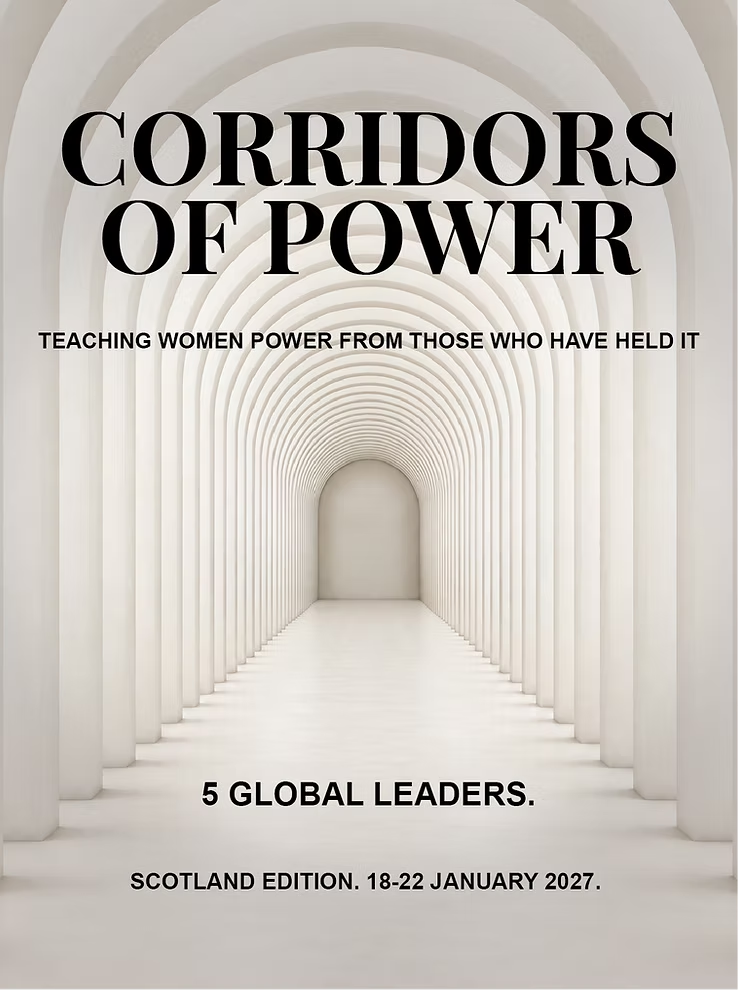
Former First Minister is first faculty leader announced for Corridors of Power, a new leadership programme for women in business and politics
Former First Minister of Scotland Nicola Sturgeon is to teach women from around the world how to lead under pressure, in a new masterclass. Launching in Edinburgh next January, the programme will feature several Prime Ministers and global leaders as faculty leaders.
Sturgeon is the first faculty leader announced for Corridors of Power, a five-day leadership programme including created by The Power Diaspora Forum (TPDF), the international platform founded by Scottish entrepreneur Veenoo Sharma to connect women to capital, influence and decision-making power.
Her full-day masterclass, Leadership Under Pressure: Lessons for Women in Power, will draw on her eight years as First Minister to show women in politics and business how to hold their ground when the stakes are highest.
Participants will learn how pressure shapes leadership at every level: in the decisions leaders make, in how they deal with others, and in the extra scrutiny women often face.
The masterclass will explore how political and institutional decisions are really made, the difference between formal authority and informal influence, and how to build coalitions and win over people who fundamentally disagree with you. It will cover negotiation and compromise, including knowing when to concede and when to stand firm, and how to maintain relationships through disagreement.
It will also examine the particular pressures on women leaders: establishing credibility in powerful environments, exercising authority where women are often judged more harshly, and carrying the responsibility of decisions with genuine consequences.
Nicola Sturgeon is Scotland’s longest-serving First Minister and the first woman to hold the role.
Nicola Sturgeon said: “We need more women in leadership across all walks of life. However, in our traditionally male-dominated world, women aspiring to or holding positions of power face unique challenges.
“I am delighted to be taking part in the Corridors of Power TPDF Masterclass to help a new generation of female leaders overcome these challenges. I am looking forward to sharing the skills and experiences I gained over many years of political leadership, and as well as an insight into the lessons I learned along the way.”
Veenoo Sharma, Founder of The Power Diaspora Forum, said: “Corridors of Power is built on a simple idea: who better to teach women about leadership and power than former First Ministers, Prime Ministers and leaders who have actually led countries?
“These are people who have made decisions at the highest level, navigated crisis, scrutiny and challenging circumstances, and carried the responsibility that comes with leading a nation.
“Bringing that lived experience directly to women is incredibly powerful. At TPDF, we believe women should be empowered through experience, not simply through discussion, and Nicola Sturgeon embodies exactly what this programme is about.”
Corridors of Power is open to women around the world working in, or aspiring to, senior roles in business and politics. Further faculty leaders including Prime Ministers and global leaders will be announced in the coming weeks.
Two Edinburgh-based Scots are among nine recipients of Scottish International Education Trust (SIET) Fellowships supporting international study, research and professional development.
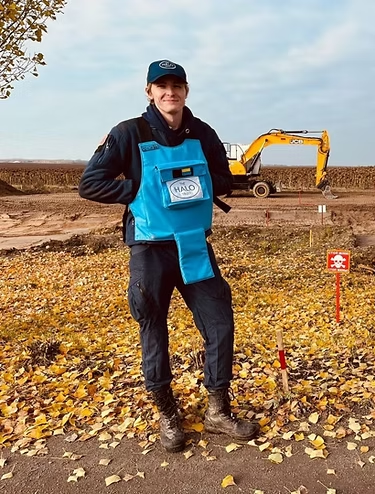
Edinburgh-based researcher Andro Mathewson has been awarded a Fellowship to undertake final-stage doctoral research in Ukraine, while Edinburgh flautist Clio Scott will use hers to continue her advanced musical studies in Vienna.
Andro, who was born in Illinois and brought up in Scotland, is completing a PhD at King’s College London examining unmanned systems in the Russia-Ukraine war. His Fellowship will support a 10-day final-stage research visit to Ukraine, allowing him to undertake research on the ground as he completes his doctorate.
As part of his research, Andro has created the Unmanned Systems Tracker, an open-source, publicly available website showing some of the data behind his research and helping to raise awareness of the importance of unmanned systems in modern warfare.
Andro Mathewson said: “Being funded by the Scottish International Education Trust is a great privilege and honour for me. Beyond the financial award, which will help me to finish my PhD research, including on-the-ground in Ukraine, it means a lot that a Scottish organization is supporting research in the realm of defense and emerging military technologies.
“As part of my research I have already created the Unmanned Systems Tracker (unmannedsystemstracker.com), an open-source, publicly available website showing some of the data behind my research to help raise awareness about the importance of unmanned systems in modern warfare.”
Clio Scott has been awarded a Fellowship to study for a Master’s in Instrumental Studies (Flute Performance) at MDW – University of Music and Performing Arts Vienna.
The award will help Clio meet the costs of her advanced musical training and allow her to focus on her studies with an internationally recognised teacher in Vienna.
Clio Scott said: “Being given an award by the Scottish International Education Trust feels like a huge vote of confidence in me. Training to be a classical musician is a long, arduous path and is also incredibly expensive.
The assistance offered by the SIET will help me to be able to fully immerse myself in my studies without worrying about financial barriers. I am beyond excited to be beginning the next stage of my education in Vienna, where I’ll have the opportunity to study with an incredible teacher in a city that’s renowned for its classical music as well as its beauty!”
The Fellowships are two of nine awarded by SIET in its Autumn 2026 awards round, supporting Scots to pursue international study, research and professional opportunities.
SIET Chair Nick Bibby said:“We are delighted to support another group of talented Scots as they take the next step in their education, research and professional development.
“What unites our Fellows is not a particular subject or career path, but their ambition, drive and the potential of the international opportunities they have chosen to pursue. We are proud to play a part in helping Andro and Clio take these important next steps in their respective fields, and look forward to seeing where their international opportunities lead.”
SIET Director Ken Thomson said:“Our Fellows demonstrate the many different ways in which international education and experience can change the course of a life.
“These awards are about recognising ability and potential, but also about helping to remove financial barriers that can prevent talented people from taking up exceptional opportunities.
“We wish all nine Fellows every success as they embark on the next stage of their journeys, and hope that their experiences overseas will ultimately benefit not only their own careers but Scotland more widely.”
The Scottish International Education Trust was established in 1971 by founders Sir Sean Connery and Sir Jackie Stewart. For more than 50 years, the Trust has supported Scots to access transformative international educational experiences, particularly where financial circumstances might otherwise prevent them from doing so.
SIET typically supports postgraduate education overseas, but also funds musicians, artists, craftspeople and other professionals where education involves developing specialist skills outside a conventional academic setting.
Members of the University and College Union (UCU) Scotland at Edinburgh University will strike for 25 days over five weeks from today (28 September) in a long running dispute over £140m cuts and 1,800 job losses.
Staff at Edinburgh have already taken multiple days of strike action and participated in a marking and assessment boycott because of the refusal of management to rule out compulsory redundancies. The latest action starts today and will continue through to 30 October.
The dispute centres on £140m cuts announced by the principal, Professor Sir Peter Mathieson, in early 2025 and an estimated 1,800 job losses. The scale of cuts are the largest cut in staff seen in Scottish higher education and is happening at one of the wealthiest institutions in the country and which, earlier this year, confirmed that there was no deficit.
Hundreds of staff have already lost their jobs through hidden redundancies including by fixed term contacts not being renewed as would normally happen and hourly-paid staff having their hours reduced.
Despite 18 months of campaigning and industrial pressure, including three ballots and strikes, the threat to jobs and student education remains while staff continue to face increased workloads because of ongoing restructures.
UCU members voted to undertake the five-week strike earlier in the summer. Since then the union has been pressing senior management to make a serious proposal that could avoid the strike.
The union has called for management to commit to no compulsory redundancies; to address hidden redundancies and workloads; engage in meaningful negotiation to avoid redundancies; and to reconsider the balance between staff and non-staff cuts.
UCU Edinburgh branch co-president Lena Wånggren said: “Our members have been clear that compulsory redundancies must not be the university’s answer to its financial challenges.
“Five weeks of strike action is not what anyone wants, but members are prepared to take action to protect jobs. UCU members are prepared to take action for our colleagues and our students – we want to safeguard students’ education not just for five weeks in Autumn but for the future.”
UCU Edinburgh branch co-secretary Nik Matheou said: “Staff are facing increased workloads, the threat of redundancies, and continuing uncertainty created by restructures and cuts.
“We have given management another opportunity to avoid the strikes. We need a commitment to no compulsory redundancies, meaningful consultation and action to address hidden job losses and increased workloads. We are ready to continue to negotiate and hope management will now come forward with a serious proposal.”
UCU general secretary Jo Grady said: “The unprecedented cuts and job losses at Edinburgh are forcing members to take five-weeks of strike action.
“I previously called the cuts at Edinburgh ‘academic vandalism’ and nothing I’ve seen during this dispute gives me any reason to change that view. Even at this late stage, it’s not too late for the principal to rule out compulsory redundances, engage meaningfully with the union and take action to end this dispute.”
The Scottish Landscape: Romance to Reality Dovecot Studios, 10 Infirmary Street, Edinburgh, EH1 1LT Friday 5th February – Saturday 22nd May 2027
Dovecot Studios and The Fleming Collection present another major new exhibition that unpacks public and private images of Scotland from the 16th century to the present day. Through painting, print, photography, sculpture and textile, The Scottish Landscape: Romance to Reality explores the role artists have played in creating, challenging and changing perceptions of the Scottish landscape.
At a time when 70% of tourists say Scottish scenery is a key reason for their visit, this exhibition brings together more than 80 key works and looks beyond the picturesque to question how contemporary artists are highlighting the impact of capitalism and the climate emergency on the landscape for future generations.
The exhibition features work by Pieter Bruegel, Alexander Nasmyth, J.M.W. Turner and Joan Eardley with contemporary artists Peter Howson, Frances Walker, Thomas Joshua Cooper and Victoria Crowe, among others.
It is the third exhibition in a highly successful partnership between the world-renowned Dovecot Studios in Edinburgh and The Fleming Collection, the finest collection of Scottish art outside public institutions, which saw record breaking visitors to the exhibitions Scottish Women Artist in 2023 and The Scottish Colourists in 2025.
Theo Albano, Director of the Fleming Collection comments: “Few nations have shaped the artisticlanguage of landscape as profoundly as Scotland. From the Enlightenment and Romanticism tocontemporary environmental practice, this new exhibition is an opportunity to question and explore how far artists have created a myth of Scottish beauty or a compelling vision of how ourfuture landscape might evolve.
“The exhibition is organised in six sections: The Birth of a Myth; The Romantic and the Sublime;Whose Land; Changing Tides; Scotland Abroad; and Our Changing Landscape.
“Visitors will beencouraged to bask in the beauty of the Scottish landscape while questioning whether artistshave played, and whether they continue to play, a responsible or a dangerous role in promotingScotland’s untamed beauty.
“Within each broadly chronological section, the curators TheoAlbano and Heather Carroll, Dovecot Exhibitions Manager, juxtapose one or more works fromother periods to highlight recurring themes of environmental change, artistic intervention,political memory and cultural imagination.”
Celia Joicey, Director of Dovecot Studios, comments: “The Scottish Landscape: Romance toReality exhibition is a rich opportunity to look through the eyes of artists at the detail of our physical surroundings and, through the process of looking, to develop our own imaginative and emotional response.
“This collaboration with the Fleming Collection is an urgent call forengagement with art and landscape, comparing artwork across four centuries and in a range ofmedia, to protect them for future generations.”
The Scottish landscape has seen itself play a starring role in the arts for over 400 years.
From Pieter Breughel’s idealised engraving of the Bass Rock in 1560 to the Highlands setting for the latest reality series of Celebrity Traitors, Scotland’s natural beauty is a calling card to artists, tourists and cinemagoers the world over.
The Scottish Landscape: Romance to Reality exhibition will be accompanied by an events program featuring curator-led tours and talks by artists and historians including James Knox, andAlice Strang.
A fully illustrated book accompanying the exhibition will also be available.
Young people in England will be able to access specialised support in their community, as the government makes largest investment into youth services in a generation
Young people will be able to access specialised support in their community, as the government makes largest investment into youth services in a generation.
In addition, a £450 million programme will also help build and improve youth facilities and fund enriching activities in England’s most underserved areas.
Young people across England are set to benefit from specialised support outside of home and school, as the government launches a major drive to support the training and employment of 1000 new youth workers.
It comes as the government makes the largest investment into youth services in a generation following a drop of local authority spending of 73% between 2010 and 2023, which led to the loss of vital youth worker roles and youth services across England.
The 1000 new youth workers announced today is the first step in rebuilding the youth workforce. The first workers are set to be in position by spring 2027, as part of the government’s plan to support young people ahead of the social media ban for under 16s coming into force.
The youth workers will work with young people aged 11 plus, within community spaces and through outreach to ensure the most vulnerable young people have access to support, including those at highest risk of becoming NEET (not in education, employment or training).
The specialist youth workers will collaborate with multi-agency teams across education and training, health and crime prevention to support young people to engage in a range of activities including sport, arts, mentoring and wider youth services.
This initiative will provide a significant step towards meeting the Government’s ambition for 500,000 more young people to have access to a trusted adult by 2035.
The number of youth facilities is also set to increase thanks to a £450 million programme. The new ‘Youth Matters’ Fund will open for applications soon and will help build, improve and expand spaces for young people to connect, while funding more youth work and enriching in-person activities, such as sports, music and volunteering, ahead of the upcoming social media ban.
The survey highlighted that many young people have been left without access to safe, supportive environments or a community to belong to, while reliance on online interaction has grown in the absence of face-to-face opportunities.
In response the National Youth Strategy set out how young people will benefit from over £500 million of government investment, with an ambitious delivery plan to rebuild youth services over the next decade.
The move is designed to hand power back to local communities, and allow young people to design services around the skills and opportunities they need to shape their futures.
Foysol Choudhury MBE, former member of the Scottish Parliament, has called for urgent action to tackle racism and hate crime following the alleged racially motivated assault of Bangladeshi man Iftekhar Ul-Islam in Glasgow:
I am extremely concerned and deeply saddened by the alleged racist assault on Iftekhar Ul-Islam in Glasgow on 16 September.
I have spoken personally with Iftekhar and his wife. He has sustained injuries to his head and face, he has been left traumatised by the event, and now is too frightened to leave his home.
Nobody should have to feel unsafe travelling to work or walking through our streets because of the colour of their skin or their ethnic background.
I am attaching the joint statement from the Scottish Bangladeshi Organisations Network, representing organisations from across Scotland. The statement calls for justice and accountability and urges Police Scotland to conduct a full, thorough and timely investigation.
According to the statement, Iftekhar was approached in Glasgow city centre, near the bus station, before being attacked in broad daylight. It states that racist language was used during the alleged assault and that his calls for help went unanswered.
This is extremely serious, and I am deeply worried that things are going from bad to worse.
As a former MSP, I am particularly concerned about the wider spread of racism and racial hostility in our communities. Political rhetoric matters. When politicians use divisive issues or language for political advantage, we need to consider the impact this can have on minority communities and the atmosphere in which people live.
I am not suggesting that political statements directly cause individual crimes. Those responsible for criminal acts must be held individually responsible. However, we must also recognise that public discourse can influence how communities feel about one another.
We cannot allow racism to become normalised.
I raised these issues repeatedly in Parliament
During my five years in the Scottish Parliament, I repeatedly raised racism, Islamophobia, anti-racist education and the need for stronger action.
In October 2023, I asked the Scottish Government how it intended to implement Scotland’s anti-racist curriculum principles. (Scottish Parliament)
In June 2025, I raised the issue of racism and racist bullying in schools, including concerns about whether anti-racist policies and toolkits were actually being implemented and whether racist incidents were properly recorded and followed up. (Scottish Parliament)
In March 2025, I questioned the First Minister about the rise in anti-Muslim hate incidents and asked about progress in implementing recommendations from work on Islamophobia in Scotland. The First Minister acknowledged that the rise in anti-Muslim hate incidents was a serious concern. (Scottish Parliament)
I also raised the importance of education about racism and colonialism, including the role museums can play in helping young people understand these issues. (Scottish Parliament)
I have consistently argued that education must be part of the solution. Unfortunately, I do not believe anti-racist education has always been taken as seriously as it should have been.
What needs to happen now?
We need action, not simply statements.
There must be a thorough investigation into what happened to Iftekhar. Victims of racist attacks must receive appropriate support, and racist incidents must be properly recorded and followed up.
We also need to ask whether enough is being done to prevent racism before it becomes violence.
Are schools receiving the resources and support needed to tackle racism effectively?
Are racist incidents being properly recorded and acted upon?
Are politicians and public figures doing enough to challenge racism rather than allowing division to grow?
And are we doing enough to educate young people about racism, prejudice and the contribution of Scotland’s diverse communities?
The Bangladeshi community is an important part of Scotland. During my time in Parliament, I established and convened the Cross-Party Group on Bangladesh to strengthen Scotland-Bangladesh relations and provide a forum for Scotland’s Bangladeshi community. (Scottish Parliament)
I have always believed that Scotland should be a country where everyone can live, work and raise their families without fear because of their race, ethnicity or faith.
Racism is not somebody else’s problem. It is a problem for all of us.
I stand with Iftekhar, his family and the Scottish Bangladeshi community in calling for justice, accountability and urgent action.
Something has to be done now. We cannot wait for another victim.
Joint statement from the Scottish Bangladeshi Organisations Network:
The Scottish Prostate Cancer Initiative is bringing its prostate cancer testing programme to Royal Bank of Scotland’s Gogarburn campus in Edinburgh this weekend.
Prostate cancer is the most common cancer affecting in men in Scotland*. To help promote early detection, members of the public and employees of the bank are being offered the opportunity to take a free Prostate-Specific Antigen (PSA) tests which can help identify potential signs of the disease.
Royal Bank of Scotland offered colleagues the opportunity for testing yesterday (Friday, September 25) and then open its doors to the public on Saturday, September 26 for a day of testing at its Scottish HQ.
Launched in March by Sir Chris Hoy, Kenny Logan, Professor Sir Chris Evans and Sir Tom Hunter, the Scottish Prostate Cancer Initiative was established to improve the early detection and diagnosis of prostate cancer.
The programme, providing free PSA tests to men aged between 40 and 80, also explores how existing pathways for detecting and treating prostate cancer can be improved.
Since testing began in March, the Initiative has provided free PSA tests to more than 17,000 men across Scotland. Demand for appointments has consistently exceeded expectations, with most testing events becoming fully booked within days of being announced, demonstrating the strong public appetite for accessible prostate cancer testing and greater awareness of men’s health.
Participants provide a simple blood sample to measure PSA levels and, in selected cases, additional samples to support advanced diagnostic research aimed at improving understanding of genetic risk factors and other biomarkers associated with prostate cancer.
Professor Sir Chris Evans, founder and Chief Scientific Officer of EDX Medical, the diagnostics company which is delivering the Initiative, said: “The response to the Scottish Prostate Cancer Initiative has been extraordinary. Prostate cancer can develop silently, often without symptoms in its early stages which is why early diagnosis is so important.
“I would like to thank Royal Bank of Scotland for hosting these testing sessions at Gogarburn and for their support of the Initiative. By helping us bring free PSA testing to both employees and the wider community, they are playing an important role in raising awareness and helping more men take control of their health.”
Judith Cruickshank, Chair, Scotland Board, Royal Bank of Scotland, said: “Directly or indirectly, prostate cancer is an issue that impacts the lives of so many of our colleagues and customers across the country.
“We are delighted to be working with the Scottish Prostate Cancer Initiative to offer free PSA testing here at Gogarburn. Royal Bank plays an important role in the lives of the customers and the communities which we serve and this is an opportunity to make it easier for the public to get themselves tested and guard themselves one of the most common form of cancers here in Scotland.
“We are proud to support an Initiative that can make a positive difference to men’s health across Scotland.”
The Initiative is delivered by EDX Medical in conjunction with the Graham Fulford Charitable Trust.
Testing takes place at Gogarburn TODAY Saturday 26 September from 0930 – 1700.
Details of other upcoming testing events can be found at:
Police Scotland has released images of six males officers believe can assist with ongoing enquiries into a serious assault in Edinburgh.
The incident happened around 10.55pm on Saturday, 29 August, 2026, on Rodney Street at the junction with Broughton Road.
A 34-year-old man was injured and required hospital treatment.
The males are all described as aged 16 to 18.
The first one has brown hair and was wearing a black hoodie with a white motif on the arm and chest, black trousers and black and white trainers.
The second is described as having black hair and was wearing a black hooded top and black trousers.
The third has brown hair and was wearing a grey t-shirt, black trousers and black trainers with a white line.
The fourth has blonde hair and wearing black rimmed glasses, a long sleeve grey top, grey shorts and white trainers with a black sole.
The fifth was wearing a black puffer style jacket and black trousers.
The sixth was wearing a black jacket and black trousers.
Detective Constable Rebecca Curtis said: “We believe the males pictured can assist with our investigation and we are keen to speak to them.
“I would urge the males, or anyone who knows them, to get in touch with us.
“Anyone who can assist is asked to contact Police Scotland on 101, quoting incident number 3971 of Saturday, 29 August, 2026, or call Crimestoppers anonymously on 0800 555 111.”
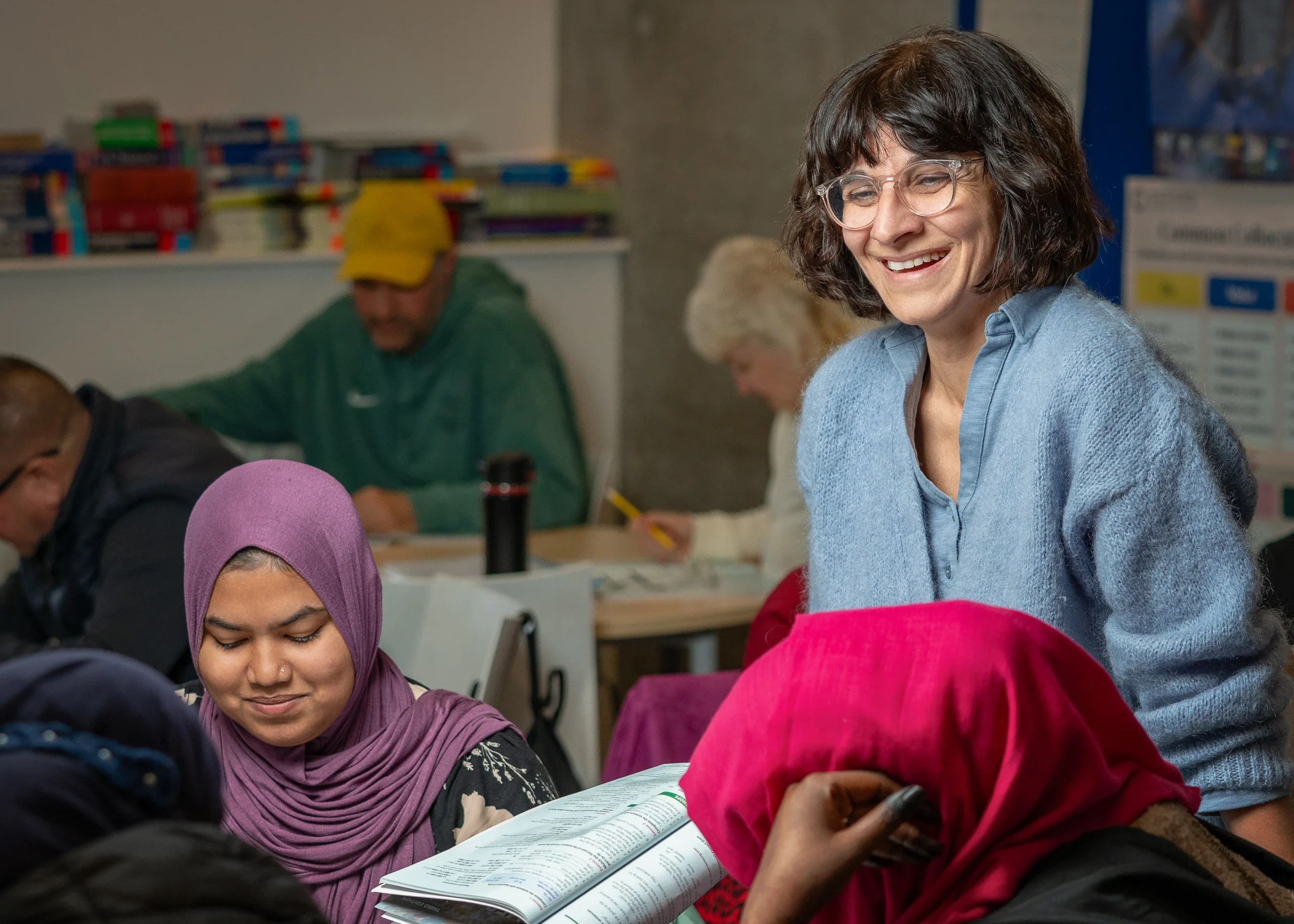
Edinburgh College has established a new National Centre for Modern Languages and English for Speakers of Other Languages (ESOL), bringing together its expertise in language education to support students, employers and communities across Scotland and beyond.
The Centre will act as a hub for the College’s Modern Languages and ESOL delivery with a focus on developing the language skills Scotland needs for the future.
The College delivers one of the largest and most diverse language portfolios in the UK. Its award-winning online Modern Languages provision spans 95 schools across 20 local authorities, while more than 1,000 students study ESOL at the College each year.
More than 300,000 people in Scotland reported challenges with speaking, reading or writing English in 2022, highlighting the scale of the need for accessible language support.
The launch of the Centre brings together the College’s significant ESOL provision, both college and community-based, recognising the role English language skills play in helping people access employment, progress in their careers and participate fully in society.
Earlier this year, the College published a research report – Addressing Language as a Barrier to Work and Progression – which identified a lack of English language skills as an overlooked contributor to economic inactivity.
It is now building on this work through its employment-focused ESOL for Work provision, helping learners to develop the practical English skills they need for the workplace alongside their wider language development.
Edinburgh College Principal and CEO Audrey Cumberford said: “Language skills are increasingly important to Scotland’s future. They strengthen our workforce, help businesses connect with international markets and enable people from different backgrounds to participate fully in our economy and society.
“Edinburgh College has a strong track record in both Modern Languages and ESOL delivery, and the launch of our National Centre brings that expertise together to create a hub for language education and innovation.
“We want to use our scale, research and partnerships to support language education across Scotland and help ensure learners have the skills they need for further study and employment.”
The Centre’s provision will also support refugees and people seeking sanctuary to access education. The College was awarded College of Sanctuary status in June 2025.
The College also has extensive international experience, having delivered specialist English language teacher training in more than 30 countries over the past decade.
Alongside its work in Scotland, the College will use its international partnerships and experience to support language education globally, building on specialist teacher training.
The new Centre aims to strengthen the role of Modern Languages and ESOL within Scotland’s skills infrastructure and help more people access the opportunities that language learning can provide.