Loganair, the UK’s largest regional airline, will support six community projects through its 2026 GreenSkies Community Fund, sharing £23,472 between organisations from the Isle of Lewis to Winchester – and Stockbridge charity LifeCare is one of the recipients.
The fund helps charities, community groups and small businesses across its network reduce their carbon footprints and improve long-term sustainability.
Borve Maritime Museum on the Isle of Lewis receives £5,000 to install a rooftop solar photovoltaic system, cutting electricity use at the community-run venue, while the Community Tree Planting programme, based in Inverness, receives £5,000 to create new woodland and restore habitats through volunteer-led work at sites across Scotland.
In Aberdeen, Beannachar receives £3,757 to replace an ageing electric vehicle charging point used to support adults with learning disabilities across the community, and in Edinburgh, LifeCare receives £2,715 for a charging point that will lower emissions from its community outreach and Meals on Wheels services.
Winchester Cathedral receives £5,000 to fit solar panels to its buildings, generating renewable power and reducing operational emissions at the historic site. On the Isle of Man, the Thie My Shee community orchard receives £2,000 to plant fruit trees and build accessible growing spaces for local food production.
Together the six projects span renewable energy, sustainable transport, food growing and biodiversity across Scotland, the Isle of Man and England.
Rebecca Borresen, director of safety and sustainability at Loganair, said:“The GreenSkies Community Fund sits at the heart of Loganair’s commitment to the communities we connect.
“This year’s projects show what that support makes possible, from solar power on a remote island to greener transport for older people in our cities.
“These six organisations are turning local ambition into measurable environmental change. We’ll keep backing the groups across our network who are building a more sustainable future for the places we serve.”
The GreenSkies Community Fund forms part of Loganair’s wider environmental programme, which includes carbon offsetting, investment in sustainable aviation technologies and a target of reaching net zero by 2040.
Since its launch, the fund has supported community projects and businesses across the UK in adopting greener practices.
Sir Chris Hoy’s stage four prostate cancer diagnosis has highlighted the importance of understanding the often-silent nature of the disease, after the six-time Olympic gold medallist revealed his cancer had spread to his bones.
Hoy has previously spoken about how he had no obvious symptoms of prostate cancer and initially sought medical advice after experiencing shoulder pain. A scan subsequently revealed a tumour, with further investigations finding that the primary cancer was in his prostate and had spread to his shoulder, pelvis, hip, ribs and spine.
In response, Dr Karen Faulkner, Associate Medical Director at Panthera Clinic, says Hoy’s experience is a powerful reminder that men should not wait until they feel unwell before taking their prostate health seriously.
Comment from Dr Karen Faulkner, Associate Medical Director at Panthera Clinic: “Chris Hoy’s diagnosis is a powerful reminder that prostate cancer does not always announce itself with obvious symptoms, and by the time symptoms develop, the disease can already be advanced.
“One of the most dangerous misconceptions about prostate cancer is that you will know when something is wrong. Chris Hoy’s experience demonstrates why this isn’t necessarily the case. He had no clear warning symptoms and initially sought medical advice because of shoulder pain, only for investigations to reveal that the cancer had originated in the prostate and had already spread to his bones.
“While every patient’s circumstances are unique, his story highlights why men shouldn’t use feeling fit, healthy or symptom-free as reassurance that everything is fine.
“Prostate cancer can develop silently, particularly in its earlier stages, which means men need to be aware of their individual risk rather than simply waiting for their body to tell them something is wrong.
“Symptoms men should speak to a healthcare professional about include:
Needing to urinate more frequently, especially at night Difficulty starting or stopping urination A weak or interrupted urine flow Feeling that the bladder doesn’t fully empty Blood in the urine or semen Pain or discomfort when urinating Persistent pain in the lower back, hips or pelvis
“However, it is important to stress that prostate cancer may not cause any noticeable symptoms in its early stages. The absence of symptoms should not necessarily be taken as reassurance, particularly for men who have other risk factors.
“Age remains one of the biggest risk factors for prostate cancer, with the likelihood of developing the disease increasing as men get older. Family history is also important. Having a father, brother or son who has been diagnosed with prostate cancer can increase an individual’s risk.
“Ethnicity is another important factor, with Black men statistically more likely to develop prostate cancer and often at a younger age.
“These risk factors do not mean that someone will definitely develop prostate cancer, but they can help healthcare professionals assess an individual’s level of risk and determine whether further investigation or discussions about testing may be appropriate.
“For men who are over 50, have a family history of prostate cancer or belong to a higher-risk group, Chris Hoy’s story is an important reminder not to wait until something feels wrong before speaking to a healthcare professional.
“It is also important to remember that prostate cancer is not one single disease and that a diagnosis does not automatically mean the same outcome for every patient. Treatments and outcomes vary depending on factors including how advanced the cancer is, where it has spread and how it responds to treatment.
“Chris Hoy has also spoken openly about continuing to live his life and finding hope despite his stage four diagnosis. His experience is an important reminder that even when cancer is advanced, patients should have open conversations with their healthcare team about treatment, symptom management, support and their individual options.
“For anyone who has been prompted by Chris Hoy’s story to think about their own health, this is a good opportunity to speak to a healthcare professional rather than waiting for symptoms to appear.
“The key message is simple: feeling healthy does not necessarily mean you are free from prostate cancer. Knowing your risk, understanding the potential symptoms and having conversations with a healthcare professional can all play an important role in detecting and managing the disease.”
City of Edinburgh Council Has Passed The Most Extensive List of Firework Control Zones So Far
Animals and vulnerable residents in Edinburgh will benefit from protections from fireworks noise, as the city has confirmed an extension of the successful Firework Control Zones policy, championed by Greens.
Five FCZs for two years were confirmed for Corstorphine, Longstone, Gracemount, Moredun and Sighthill/Broomhouse with a further five at Lochend, Liberton, Stenhouse/Gaskell, Wester Hailes and West Pilton. These join existing Zones in Balerno, Calton Hill, Niddrie and Seafield.
14 Zones will operate in total.
Edinburgh Green spokesperson for Culture and Communities Dan Heap welcomed the move saying: “Fireworks noise an be extremely distressing for vulnerable residents and also pets, as almost any dog and cat owner will tell you, and we also have strong evidence that they pollute the air and water.
“That’s why it is so crucial we have today extend FCZs further, encompassing a large part of the city.
“I am proud of the role Greens have played in championing these essential protections for people, paws and planet.”
Màiri McAllan Cabinet Secretary for Education, Culture and Gaelic has announced that a new initiative for the global media and creative industries will be developed for Edinburgh’s August festivals.
The new initiative will build upon Edinburgh’s unique position as a global shop window for talent, content, and creative ideas, bringing together the city’s creative ecosystem with international media industries and audiences.
Thursday’s launch event was also attended by Baby Reindeer and Half Man creator and star Richard Gadd who spoke on the importance of Edinburgh during August, as a place for new talent discovery, for ambitious work, and to progress careers.
Initial development work towards the new event was funded by Screen Scotland and completed in early summer 2026.
This work was undertaken to consider, with fresh eyes, how Edinburgh’s August festivals partner to present a new offer to the global content industries, in response to the increasingly blurred boundaries between the different creative artforms and the way creative talent, IP and ideas move fluidly between them.
Independent consultant Rowan Woods has now been appointed to lead the next stage of development, which will again be funded by Screen Scotland and delivered through The Fringe Society.
Working with the Fringe Society, Screen Scotland and a broader advisory group, Woods will consult widely across the August festivals and with producing venues, broadcasters, platforms, content creators, publishers and other potential participants and audiences to establish the shape of the new initiative and how it can best support the connection of new talent and IP to content commissioners worldwide.
The consultation will inform the shape and intent of the new initiative, including audience, dates, venues, programme and participants. This consultation phase is expected to conclude in early Spring 2027, with an initial pilot planned for August 2027.
The new initiative will build on the strong relationships that already exist between the screen industry and Edinburgh’s August Festivals, including the work of Screen Fringe, an ongoing collaboration between Screen Scotland and the Fringe Society, which supports hundreds of television and film executives to make the most of their time in the city each year.
Screen Fringe is expected to remain part of the August festivals offer to the global screen industry.
Separately, Screen Scotland has confirmed that it will establish the Lynda Myles Debate as a keynote element of the August festivals from 2027.
The debate will honour the contribution of Lynda Myles, formerly Director of the Edinburgh International Film Festival and co-creator of the Edinburgh TV Festival, and her long-standing belief in Edinburgh as a place for ambitious and rigorous debate about the future of the screen industries and wider media landscape.
The Scottish Government is providing funding support for the new event’s development via Screen Scotland, and more details will be announced in 2027.
Culture Secretary Màiri McAllan said: “We are so proud of Scotland’s screen sector and this exciting addition to the August festivals line-up will provide a new way to embrace the creativity and cultural innovation which makes our capital unique.
“As a global hotbed of emerging talent, where new voices are heard and fresh stories are told, Edinburgh will continue its world-leading offer for the television industry with the support of the Scottish Government – and will do so alongside our other Edinburgh festivals, showcasing brilliance across artforms.”
David Smith, Director of Screen Scotland said: “Edinburgh has a unique role to play in bringing together the people, ideas and creative work that will shape the future of the screen and wider creative industries.
“Every August, the city becomes a remarkable meeting place for talent from around the world, alongside audiences, producers, commissioners, artists and creative thinkers. We have an opportunity to build on that extraordinary concentration of talent and energy and create something new, ambitious and genuinely distinctive for the global industry.”
Tony Lankester, Chief Executive at the Edinburgh Festival Fringe Society said: “Edinburgh’s August festivals create an unparalleled environment for discovering new talent, ideas and creative work.
“We know there is a strong appetite from people working across the global screen and creative industries to connect with that ecosystem, and we are excited by the opportunity to explore what a new offer could look like, particularly in a rapidly evolving media landscape. The development of this initiative gives us a chance to think afresh about how Edinburgh can serve the sector in August and to create something compelling for the future.”
On the announcement of the Lynda Myles debate, Lynda Myles said: “I’m deeply touched and honoured to have the debate named after me.
“It’s exciting to see the importance of ideas and discussion being recognised in the plans for the new event, especially as this was the initial intention of the creation of the Edinburgh Television Festival in 1976.”
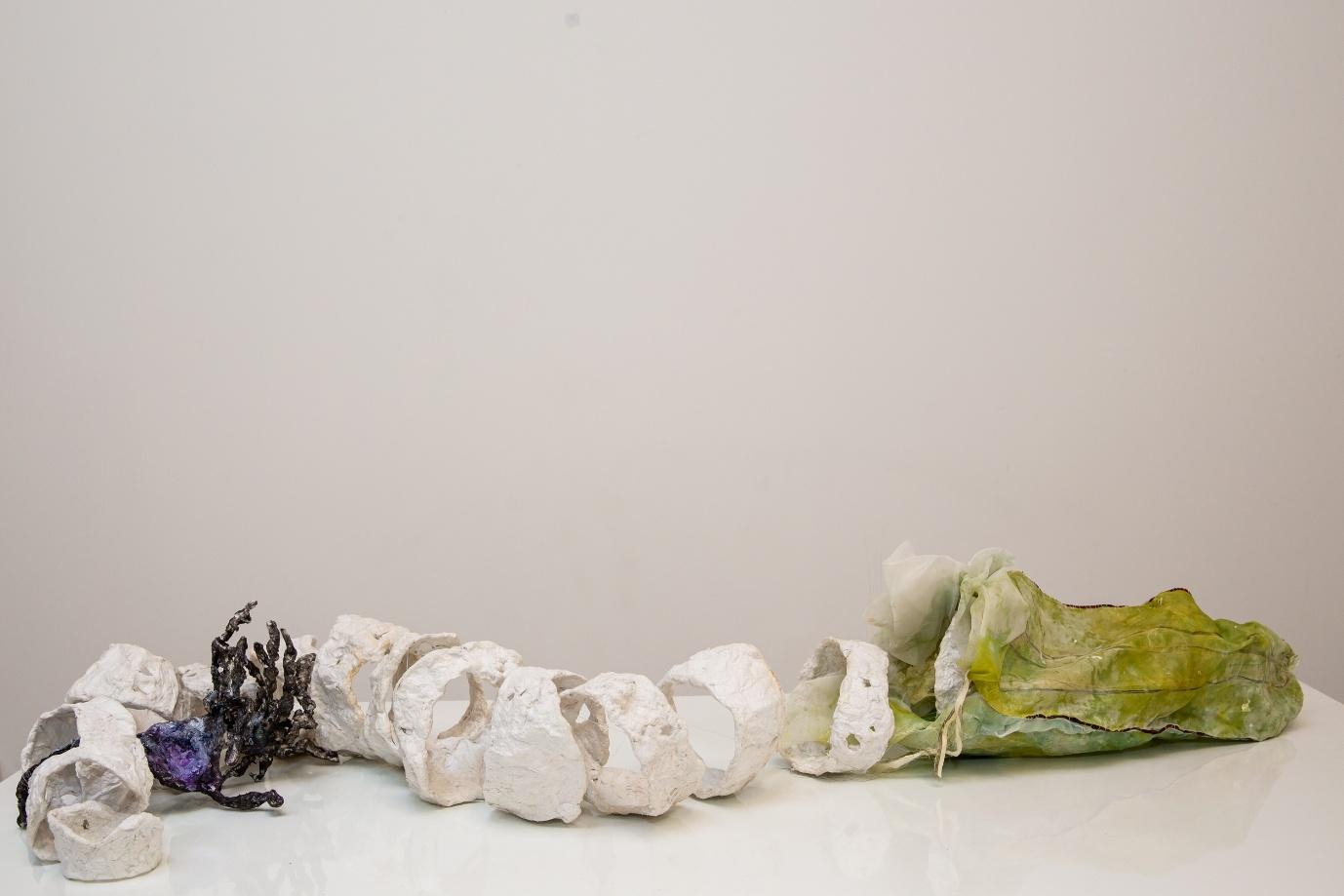
Polly Thelwall is a British painter and sculptor whose practice centres on small-scale casting, modelling, stitching, papier-mâché, found natural objects and paint.
She grew up on the Atlantic North Coast of Northern Ireland, an environment where raw landscape and weather formed an early sensibility for the meeting point between the human body and the natural world. Alongside her sculptural work, she maintains an active practice of drawing, sketching and painting.
Over the last 55 years she has been growing and developing her artistic career from childhood drawing and plasticine modelling through studying sculpture at Edinburgh college of Art in the 90s, and on, now, to her current broad and mature practice.
During that time, she sketched, drew, painted and sculpted, honing her practice in the landscapes of Scotland, especially the waters of the landscape: sea, streams, lochs and rivers.
The artist was invited by the owners of 197 Portobello High Street basement to consider putting in a proposal to Artwalk Weekends. This exhibition is on the theme ‘shift and flow’.
This installation represents a first site specific sculptural work of a large piece involving many smaller elements. It is also the first time the artist has used sound she recorded as part of the work.
The basement happens to be well supplied with excellent audio equipment strengthening the collaboration between the venue owners and the artist
Thelwall works intuitively and experimentally, navigating the threshold where human experience and the more-than-human world intersect. Her process invites the soft, scarred animal of the body to speak alongside the mind, often inclined to assume its own perfection. Through an internal and external alchemical process, she allows these dualities to interact, transform and reconfigure. Opening herself to the unknown, she creates conditions for unexpected forms, ideas and emotional registers to emerge.
Thelwall’s practice is ultimately an exploration of transformation: material, emotional and perceptual. Through making, she seeks to articulate the subtle, shifting relationship between body, landscape and imagination, allowing new forms of understanding to surface.
Polly Thelwall said: “This has been an opportunity to sit with the ephemeral. Each time in rising and lower tides, the creatures will be different, the beach will be different, the specific drops of water will be different, the conditions will be different etc.”’
This Art Walk Weekend, centred around the shift and flow of the intertidal zone, comes at a moment when we have been grappling with forest fires and warming seas.
It is a time that needs space to evolve new ways like the one created by this artist who works in transformation, opening a gap for us to find our own answers.
Polly Thelwall’s relationship with the sea began as a baby living by the sea on the Atlantic coast of Northern Ireland. A childhood in and out of the water grew into a long-term love of waters and wild swimming.
The artist also volunteers in Marine conservancy, helping by cleaning oysters for repopulating the Forth and as a litter picker. As a means of exploring this passion Polly Thelwall participated in a SailBritain Sailing residency in Scotland in 2019. This led to a first cast in the landscape of a water pattern on a beach, which was later used to create part of a sculpture.
WE (Granton& District Community Council) are aware of community concerns around the continuing occupation of Scottish Government land at Waterfront Avenue / Granton Park Avenue, which is earmarked for The Art Works development.
The Community Council acknowledges the frustration felt by local residents about the length of time it is taking for this complex issue to be resolved.
An appeal hearing in relation to the eviction order took place in early August, and the judgement was issued at the Court of Session on Thursday (27 August). It found in the Scottish Government’s favour, upholding the eviction order. However, it is worth noting that a further appeal is possible.
As a Community Council, we hope to receive further updates on next steps once available, and will do our best to communicate this to residents in good time.
Children and young people aged three to 26 will be able to take part in a range of free and low-cost activities thanks to funding from the Summer of Sport initiative in partnership with sportscotland.
Inspired by the 2026 FIFA World Cup and the Glasgow 2026 Commonwealth Games, the programme aims to encourage more children and young people to get active, try new sports and enjoy the physical, social, and mental wellbeing benefits of participation.
Delivered by the Council, Edinburgh Leisure, the University of Edinburgh, local sports clubs and community organisations, the funding supports free and subsidised holiday and regular activities that began during the summer holidays and are taking place until the end of March 2027.
This includes swimming, tennis, football, rugby and opportunities for children and young people with additional support needs. It will also expand community sport programmes, provide more opportunities in areas experiencing higher levels of poverty, and support young people who are care experienced, unaccompanied, or learning English.
Investment will also help develop the city’s sport and physical activity workforce through new coaching opportunities, qualifications, and training. The investment includes a £170,000 grant for local sports clubs and community organisations to deliver activities for young people at greater risk of poverty.
Cllr Margaret Graham, Culture and Communities Convener, said: “This is a great opportunity for children and young people to get active, try something new like lawn bowling or cricket and enjoy the benefits of taking part in sport.
“Through the Summer of Sport programme, we’re working with partners across Edinburgh to provide more free and affordable opportunities that are inclusive, accessible, and shaped around the needs of local communities.
“This investment will help more young people take part in sport, while also strengthening local partnerships, developing skills and creating a lasting legacy beyond the summer.”
Cllr James Dalgleish, Education, Children and Families Convener, said: “Every young person deserves the opportunity to be active, build confidence and develop new skills, and cost shouldn’t be a barrier to that.
“By working with schools, community organisations, and sports clubs across Edinburgh, we’re creating more opportunities for children and young people to stay active, make new friends and discover sports they can continue to enjoy for years to come.”
Perrotine Orr, Operations Director of Edinburgh Leisure, said: “This investment is helping us create more opportunities for children and young people across Edinburgh to take part in sport and physical activity, regardless of their background or circumstances.
“We have already seen strong engagement throughout the summer, and the real opportunity now is to build on that momentum over the coming months.
“By continuing to provide free and affordable activities until March 2027, we can help more young people develop confidence, make connections, improve their wellbeing and establish healthy habits that last a lifetime.”
Edinburgh Conservative Group says nobody is surprised by where the Greens and SNP stand on immigration — the real story is that the Liberal Democrats supplied the votes needed to get the motion through
A Green Party motion to pass a Council position stopping action supporting illegal immigration enforcement was passed at Thursday’s Full Council only after the Liberal Democrats struck a deal with the Greens, who accepted part of a Lib Dem amendment in order to secure their support. The SNP group also backed the motion.
Labour’s administration moved a position of no action, which the Conservative Group supported.
Without Liberal Democrat votes, the motion would not have passed.
Cllr Iain Whyte, Leader of the Edinburgh Conservative Group, said:“Nobody is surprised that the Greens and the SNP voted the way they did on this — everybody knows where they stand on immigration, with an open-borders approach that is completely out of step with public opinion.
“What will shock people is that it was the Liberal Democrats who made this happen. Faced with a motion to stop Council action supporting enforcement against illegal working, trafficking and modern slavery, they didn’t block it — they negotiated with the Greens to help pass it.
“Most migration raids target illegal working, a crime that harms the vulnerable people caught up in it, from exploitative practices through to human trafficking and modern slavery, often run by serious organised crime groups.
“This week a retired senior police firearms commander wrote to me describing a single joint operation that had targeted over 50 business premises across Scotland, involving criminals with access to firearms and links to people trafficking. That is the reality the Liberal Democrats have chosen to make harder to tackle.
“Labour, to their credit, found the resolve at the last minute to back their own UK Government’s policy and support our call for no action. The Liberal Democrats did not. They have shown themselves willing to row in with the Greens on this issue, and voters in Edinburgh will draw their own conclusions.”
The Conservative Group is calling on the Liberal Democrats to explain why they chose to help pass the motion rather than back a straightforward no-action position, and will press for any policy brought back to Council to preserve enforcement against illegal working, trafficking, exploitation and organised people smuggling.
Despite the SNP having the biggest number of councillors, The City of Edinburgh Council is currently led by Labour through support by the Lib Dems (who hold more seats than Labour) and the Conservatives. A wee family spat in the run up to next week’s by-elections, maybe? – Ed.
Green Councillors are proposing that Edinburgh Council should pursue a lifeguard station on Portobello beach, along with a suite of other measures aimed at enhancing the safety of people using the water.
The motion, discussed at a meeting of the Council yesterday, also asked for beach safety and hygiene to form part of the ongoing Portobello Promenade regeneration project which will see improvements to the beachfront.
Green Councillor for Portobello/Craigmillar, Alys Mumford, who brought the motion, said: “The last time Portobello Beach had a safety audit was almost a decade ago.
“In that time, we have seen visitor numbers explode and with it, increased potential for danger as we see more people using the water to swim, sail, and enjoy everything the water has to offer. Edinburgh currently has no lifeguarded beaches, and from conversations with the RNLI, it seems clear that there might be a case for Portobello to be the place to host lifeguards for the city.
“Portobello beach is one of Edinburgh’s jewels, but issues around safety and water quality mean it isn’t able to be enjoyed equally by everyone. This is an issue that is raised with me repeatedly by residents and visitors alike, and I hope this motion goes some way towards making progress.”
The motion also highlights the concerns about sewage incidences impacting on the water and the beach.
Lorenzo Martinico, Scottish Green Party Candidate in the upcoming by-election in Portobello/Craigmillar, has pledged to do more to inform residents about water quality, and endorsed the motion from Cllr Mumford.
Lorenzo Martinico said: “Part of the problem is our ancient sewage system, which the council can’t upgrade on its own without government funding, butin the short-term, we need to make sure that people know when it isn’t safe to go in.
“Currently we have two electronic noticeboards, but they are not necessarily in the places where people are going to go into the water – and even if you do remember to check, SEPA doesn’t test the water often enough for them to be accurate.”