Stay at Homers turn to new interests

Bored Britons are switching off their TVs and finding new ways to entertain themselves during lockdown with a new study revealing the nation’s most popular isolation hobbies.

Penny pinching experts from NetVoucherCodes.co.uk used Google trends data to research which affordable new hobbies the UK public are adopting from their homes.

They found increasing numbers of us are turning away from our screens and finding new ways to stay entertained as the lockdown continues.

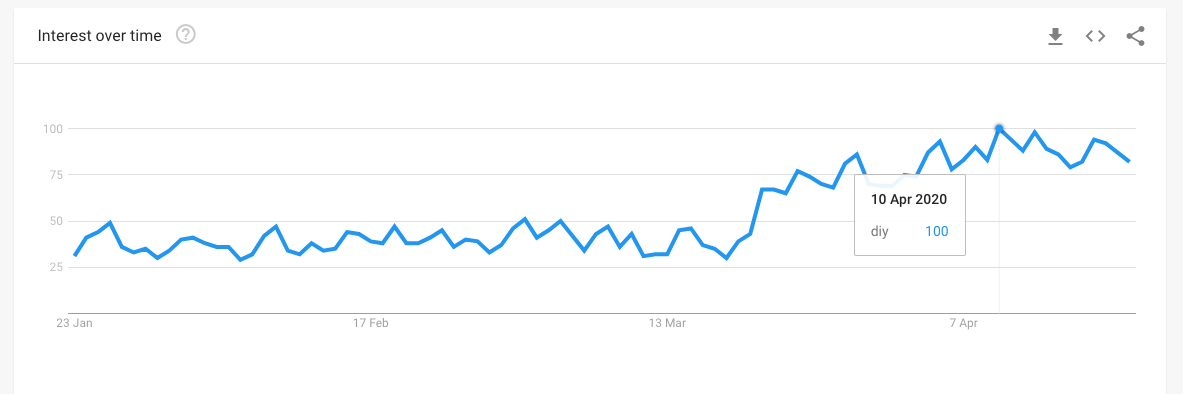
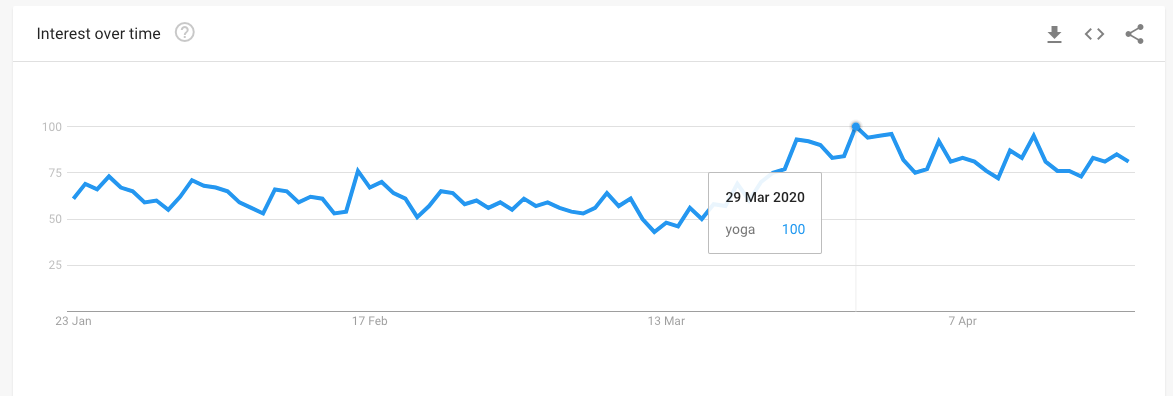
As well as classic hobbies such as baking, gardening and DIY, many of us are using the lockdown to learn a new language or get fit with home workouts or yoga sessions.

A spokesperson from NetVoucherCodes said: “Many people have a lot more time on their hands right now than they are used to and as the lockdown continues increasing numbers are switching off their televisions and finding more interesting ways to keep themselves entertained.

“The perfect hobby is one that lets you tap into some of your energy and creativity but doesn’t tap into your wallet in a significant way. Families up and down the UK need a break, and hobbies provide them the chance to have fun and relax.

“Immersing yourself in a new hobby can be really good for mental health and helps reduce stress, which is really important at the moment.

“Using Google Trends’ search data in the UK over March and April, many hobbies had increased search interest. Using this we calculated the percentage increase in interest in those topics, and identified the date of peak popularity.

“Alongside ‘How to make a facemask at home’ and ‘How to claim 80% of wages’, here are the results of the UK’s most searched isolation hobbies, along with tips for getting started with each.”

  1. Learn a Language

The UK population doesn’t have to give up on their dreams of becoming fluent in a second language. As we are all in lockdown, many Brits are prioritising learning a new language.

With the most searches occurring on 29 March, the great thing about learning a new language is you can set your own pace and milestones. Consequently, you won’t get a failing grade if you don’t reach your goals.

There are many apps that are free which give great introductions to a new language, whether it be Italian or German. You may not have spoken French or Spanish since school, but there’s no reason why you can’t finally master speaking a new language this year.

  1. Training With Resistance Bands

With gyms and health clubs closed due to COVID-19, the UK is looking for alternative ways to keep up with their fitness and training programmes. In the world of weight training, resistance bands tend to fly under the radar. But due to current circumstances, they are perfect for home workouts for all levels.

With peaked interest for both weight training and resistance bands on the 22nd March, using resistance bands can hit all muscle groups and you can progress difficulty really easily. Not to mention they are lightweight, easy to store and relatively inexpensive.

  1. DIY

DIY is always a popular pastime for Brits, but we have seen a steady increase in interest throughout April as lockdown measures are continuing. This is a perfect time to pick up those jobs you’ve been putting off for ages, and if you are unsure on how to do something, buy a book on DIY, or research through YouTube.

You can still get deliveries and do click and collect to buy the tools you need. It’s a good opportunity to start a new project and you’ll learn a new skill while improving your home!

  1. Yoga

With mental health and wellbeing at the forefront of the UK’s minds, it is no surprise to learn that interest in Yoga peaked in March. Studies have shown practising Yoga regularly can help with anxiety, improve your concentration, ease pain, and boost your cognitive health overall.

Before you dive into a sun salutation or downward dog, have a look through YouTube videos to learn the basics. Starting small is actually a good idea if you want to make yoga a part of your regular routine.

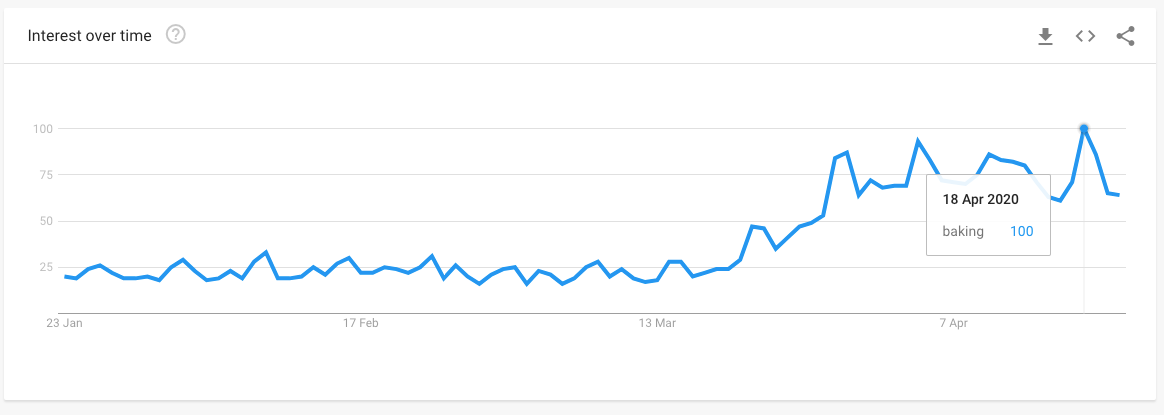
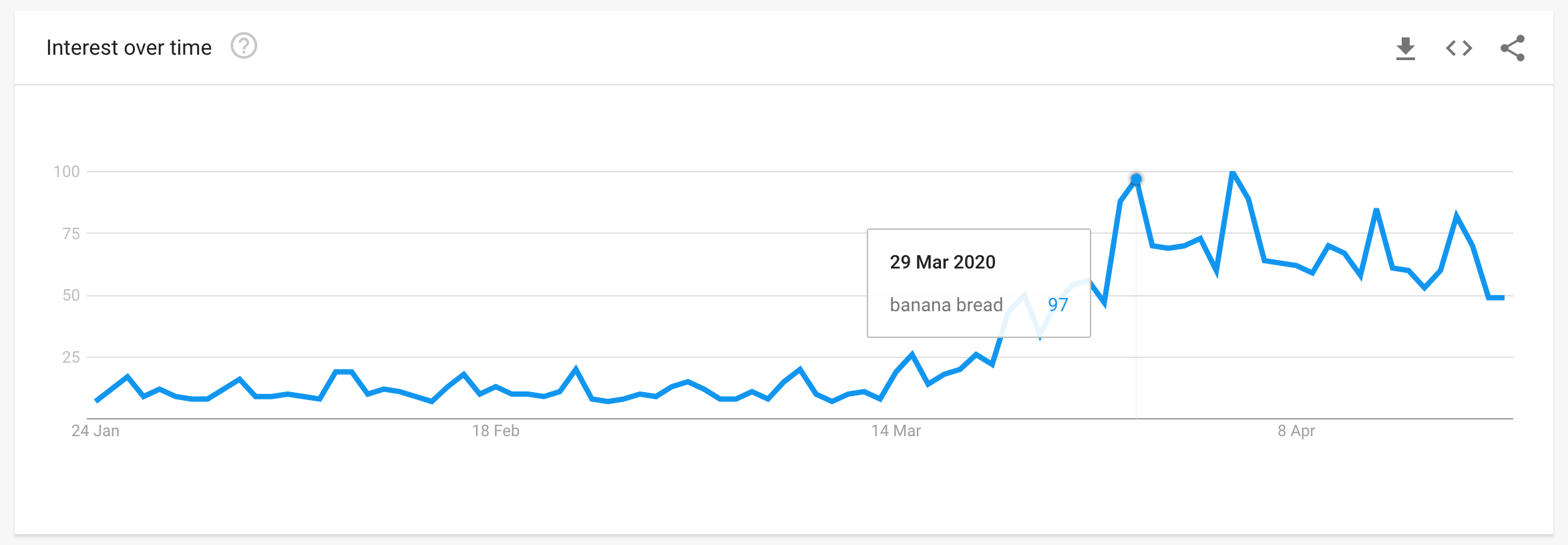
  1. Baking

Baking might seem a little intimidating for first-timers out there, which is why many are starting with basic recipes such as Banana Bread. The UK has seen a remarkable peak in searches for both baking and more specifically Banana Bread in March and April.

Alongside Banana Bread, there are a wealth of beginner bakes for Brits to start out on; Victoria Sponge, Brownies and Cupcakes are all relatively straightforward household favourites.

  1. Gardening

Gardening is a great exercise for both the body and the mind. Usually associated with the older generation, interest in gardening is now peaking.

Whether we’re planting new flowerbeds, nurturing an allotment (following Government guidelines) or simply tending to indoor plants, the UK is finding that gardening is more than a hobby and can provide food for the family at a fraction of the cost. Online gardening centre Gardening Express has seen a huge rise in sales since lockdown began.

Growing your own vegetables also eases concerns over food availability as lockdown has slowed distribution of some crops.

Campaigners welcome funding for active travel infrastructure

Living Streets has warmly welcomes the announcement of £10m funding for active travel infrastructure from the Scottish Government. 

Michael Matheson MSP, Cabinet Secretary for Transport, Infrastructure and Connectivity, yesterday announced a new active travel infrastructure programme, funding pop-up walking and cycling routes, and temporary improvements to existing routes.

The programme will also support local authorities to make improvements such as widening pavements and cycle lanes.

Stuart Hay, Director of Living Streets Scotland, said: “Space for physical distancing when walking and cycling is a vital part of long-term strategies to tackle COVID-19. It’s important councils are bold in terms of reclaiming road space and removing redundant parking spaces to create the space that is urgently needed in towns centres.

“Filtered neighbourhoods, banning cars from certain roads and tackling pavement parking can all help make our daily exercise easier and safer.”

“As we approach National Walking Month, we echo Mr Matheson’s calls for local authorities to “come forward with bold and ambitious plans for implementing temporary active travel measures.

“We strongly encourage members of the public to contact their local councils and call on them to take up these measures.”

Further expansion of access to coronavirus testing

Anyone in England with coronavirus symptoms who either has to leave home to go to work or is aged 65 and over will now be able to get tested.

  • Everyone in England aged 65 and over with coronavirus symptoms can now get tested, along with symptomatic members of their household
  • Symptomatic workers who are unable to work from home also eligible for testing
  • Testing of all asymptomatic NHS and social care staff and care home residents also being rolled out
  • New expansion of testing made possible due to rapidly increasing testing capacity

Anyone in England with symptoms of coronavirus who has to leave home to go to work, and all symptomatic members of the public aged 65 and over, will now be able to get tested, the UK government has announced.

This will mean people who cannot work from home and those aged 65 and over can know for sure whether they have coronavirus and need to continue isolating.

Members of their households with symptoms – a new continuous cough or high temperature – will also be eligible for testing.

Anyone eligible can book a test using an online portal.

The government also announced that NHS staff, care home staff and care home residents will be eligible for testing whether or not they have symptoms.

Working with Public Health England, the Care Quality Commission and the Association of Directors of Adult Social Services, the government is piloting sending packages of ‘satellite’ test kits directly to care homes across England to enable testing of residents.

So far, 4,760 tests have been delivered to more than 4,300 locations. In addition, over 25,000 care staff have already been tested.

Secretary of State for Health and Social Care Matt Hancock said: “Expansion of our testing programme protects our most vulnerable and keeps people safe.

“Testing is now available to all over 65s and members of their households, if they have symptoms.

“Any worker who needs to leave their home in order to go to work, and their households, if any of them have symptoms can also get a test. This means construction workers to emergency plumbers, research scientists to those in manufacturing – can now be tested.

“All they need to do is go on the internet and apply for a test.”

Testing for coronavirus helps the government and scientists understand its current spread and plan how to manage the pandemic.

As capacity has increased, testing has been offered to different groups in a phased approach, prioritising NHS workers. However, the ultimate aim is that anyone who needs a test will be able to have one.

Yesterday’s announcement marks a further step towards that goal. It follows the announcement last week that all essential workers with symptoms can now book a coronavirus test, or order a home testing kit, using the new online portal.

There are now more than 40 drive-through testing sites across the country, and, by the end of the week, 25,000 home testing kits will be available for ordering every day.

A network of mobile testing units is also travelling the country to reach care homes, police stations, prisons and other sites where there is demand for testing. The network is expected to reach over 70 units by the weekend.

Since the beginning of April, the government has significantly increased the UK’s coronavirus testing capacity, which currently stands at 73,400 tests per day and is on track to reach 100,000 tests daily by the end of the month.

The response to coronavirus is a national effort. Each of the devolved administrations will have their own eligibility criteria and testing priorities, however the government is working closely to align approaches.

Disability groups call for urgent changes to benefits system

The Disability Benefits Consortium (DBC), a network of over 100 organisations, have written an open letter (below) to Thérèse Coffey, Secretary of State for Work and Pensions to call for urgent changes to the benefits system to ensure we protect disabled and seriously unwell people from further physical and financial harm during the covid-19 emergency.

Full details of these proposals can be found in the DBC reports section.

“Dear Secretary of State,

Covid-19 – the Disability Benefits Consortium’s proposals for additional short-term measures to protect disabled people’s incomes

The Disability Benefits Consortium (DBC) is a network of over 100 organisations with an interest in disability and social security. For our full list of members, see https://disabilitybenefitsconsortium.wordpress.com/dbc-members/

Using our combined knowledge, experience and direct contact with millions of disabled individuals, people with long-term health conditions and carers, we seek to ensure that Government policy reflects and meets the needs of all disabled people.

The DBC welcomes the recently announced measures designed to protect the incomes of large numbers of people whose livelihoods have been adversely impacted by the Covid-19 crisis. But we believe that these support measures need to go further.

People living with a disability and those with long-term health conditions tend to have lower real incomes and higher costs than the general population and we are calling on the Government to produce a more comprehensive package of support, to better protect these individuals and their families, at this difficult time.

1. One of the most pressing issues is the current level of demand on the system due to the unprecedented number of new claims. This is causing extremely long waiting times and problems with the digital claims process. We welcome the commitment to expand the Department’s capacity, but the challenge remains considerable. We believe that the Government should give high priority to resolving urgently the technical and capacity issues involved.

Also, clear guidance must be made available (to the public and to staff) regarding the correct process to make both a digital claim for Universal Credit (UC) and a non-digital claim, including how the verification call is to be made – that is, if outbound from the DWP rather than inbound from the claimant.

2. The increase in the UC standard allowance is very welcome, helping to cushion the financial shock, which many will experience. However, other claimants likewise face financial challenges, especially after several years of a benefit freeze. We recommend that the Government should give a corresponding uplift of “legacy” and similar benefits – including, for Employment and Support Allowance (ESA), the restoration of the Work-Related Activity Group (and UC equivalent Limited Capability for Work) addition.

3. We believe that artificial limits that keep many households (mainly with children) below basic benefit levels are particularly inappropriate at this time. We recommend that the Government should suspend the benefit cap and the “two-child policy”.

4. Any Working Tax Credit (WTC) claimant who loses their job over the coming few months will not be able to continue claiming WTC and will have to claim UC instead. This means they will lose Transitional Protection (TP). As you know, this is a temporary top-up payment that would have been added to their UC to offset any losses, when the DWP eventually transferred them from WTC – but it is not payable when you move to UC because of a change of circumstances, such as job loss.

Disabled people in work and parents of disabled children stand to lose far more than most people if they lose TP – sometimes amounting to thousands of pounds a year. This will make it even more difficult for them to recover from the economic shock of the next few months.

The recommendation above to restore the Limited Capability for Work Addition to UC will help, as long as these claimants can retain it in their UC calculation up to and after they return to work.

Also, we recommend that the lower rate of the disabled child element of UC should be restored to its level in the legacy system.

5. New claimants for UC will have to wait at least five weeks until they receive their first payment. We know that this can mean people face a significant reduction in income, leading to worry about how to pay bills and buy food. The DWP offers an “advance payment”, in effect a loan deducted from future payments, which can leave people struggling to make ends meet. We recommend that the Government should make all UC advances for disabled people non-repayable grants.

6. There has been no formal indication that work-related conditionality has been suspended, although it is difficult to see how it could be meaningfully applied in present circumstances. We recommend that the Government should explicitly suspend work-related conditionality and associated sanctions.

7. Currently, 1.3 million claimants have deductions made from their UC payments to pay debts – over half of them losing 20% or more of their basic allowance. We recommend that the Government should suspend all debt repayment deductions from UC, to ease financial hardship for the duration of the current crisis.

8. It is very important that, during this epidemic, people living with a terminal illness have swift access to benefits via the Special Rules for Terminal Illness. It is our understanding that under UC, people with a terminal illness will temporarily be able to apply via the Special Rules without the DWP needing sight of a DS1500 form (a form signed by a medical professional to say that the person has a reasonable expectation of death within six months). If this is the case, then this is a very welcome step. We recommend that the Government should extend this provision to other benefits which can be applied for under the Special Rules: ESA, Personal Independence Payment and Attendance Allowance.

There are further measures that the Government could take that are likely to have an impact on those living with a disability and in need of benefit support at this time, including:

9. As medical professionals come under more pressure over the coming weeks it is unreasonable to expect they will be able to provide medical evidence to support a claimant’s benefit application. We recommend that the Government should extend the time requirements for claimants to return paperwork and to gather medical evidence where necessary.

10. Similar pressures are likely to slow down the Mandatory Reconsideration (MR) process. This will mean people could be receiving less financial support than they are entitled to. We recommend that the Government should pay the basic/ standard rate to claimants whose benefit is suspended pending MR, until the process is completed – and also, fully reinstate a benefit that has been wholly or partly withdrawn and is awaiting MR or an appeal.

11. Help to pay council tax is also crucial at this time of acute financial pressure. We recommend that the Government should encourage Local Authorities to remove features such as the two-child policy and the self-employed claimants’ Minimum Income Floor from their local Council Tax Support/ Reduction schemes. Some have simply copied these rules automatically from DWP benefits, possibly without fully appreciating their adverse impact where claimants are struggling.

We hope that, when something like a normal life returns, the support package as outlined above, which suggests achievable and positive temporary improvements, to be introduced in response to a crisis, might prove a focus for longer-term policy discussion.

Meanwhile, we commend to the Government the above proposals to make immediate changes to complement the emergency measures already taken.

In view of the widespread public interest in the current emergency measures, we shall be releasing these proposals to the media.

Yours sincerely,

Disability Benefits Consortium”

Local help is available if you are experiencing problems with your benefits.

Granton Information Centre provides a free and confidential service. Telephone 0131 551 2459 or 552 0458 or you can email info@gic.org.uk

The office is closed to the public, but the service is very much running!

Which? launches tool to tackle profiteers

Which? has developed a simple tool for people to report coronavirus profiteering amid concerns that price-gougers are getting away with hiking the prices of essential items.

The consumer champion has uncovered widespread problems with basic products being sold for hugely inflated prices on online marketplaces such as Amazon Marketplace and eBay – and there are concerns that similar behaviour could be happening on other sites and in shops up and down the country.

These practices may have left key workers and charities struggling to get essential products they need or forced to pay extortionate prices.

Which? spoke to a charity that helps provide hundreds of meals to elderly and vulnerable people – demand for this vital service has gone up since the Covid-19 crisis. However the price of essential items to keep its employees and vulnerable clients safe, such as antibacterial probe wipes, which the charity has only been able to buy in the high quantities they need from eBay, has more than doubled since the crisis.

The Competition and Markets Authority has set up a dedicated Covid-19 taskforce, and reports shared using the tool will help the regulator to establish the scale of the problem and take action against the worst offenders. Which? is also calling for emergency legislation to give regulators the tools to swiftly crack down on price-gouging on certain essential products during this crisis, and any future ones.

The CMA and Chartered Trading Standards Institute have both raised serious concerns about problems with price-gouging and the Prime Minister has also warned traders against “exploiting people’s need” during a national emergency.

Which? has heard reports from hundreds of consumers that unscrupulous sellers have been taking advantage of the situation and its investigations have uncovered huge price hikes on products such as handwash, cleaning products and baby formula.

Which? experts have found Dettol bleach and cleaning sprays being sold by third-party sellers with price hikes of almost 1000 per cent more than the typical price on eBay with evidence of dozens of purchases being made at these prices.

Researchers also encountered sterilising fluid for baby bottles for more than 10 times the original price by a seller on Amazon and a bundle of one handwash and one antibacterial gel for £30 on eBay, instead of the £3.50 it would usually cost.

Some shoppers have felt pressured into buying these overpriced products because of a lack of alternative options available, including older and more vulnerable people who need access to vital hygiene products such as hand sanitiser.

One told Which?: “I’m disabled and struggle to leave my home, but the current crisis is forcing me to go out and struggle to get essentials when I normally get as much online as I can.

“My trust in buying from online marketplaces has been shattered, some items are fine if I find it at a reasonable price, but others I can’t trust as they’re either gouged, possibly diluted and therefore useless, or it’s a scam listing and the item never existed to begin with.”

Another said: “I paid £19.80 plus £5.25 for post and packaging for 2 x 250ml of hand sanitiser from a seller on eBay. Outrageous price but we are a captive audience and it was the cheapest I could find. Someone is getting very rich from this pandemic.”

Which? has also heard numerous reports of price-gouging at bricks and mortar retailers including pharmacies.

Which? is calling for the government to introduce specific legislation to stop unjustifiable price hikes of essential items during times of emergency, as well as requiring online marketplaces to ensure compliance on their sites or face enforcement action.

New legislation would also give the UK a head start in tackling price-gouging during any future emergencies. The absence of legislation has made it harder to take action on this issue swiftly and left the UK trailing behind other countries that already have laws to combat price-gouging during crises.

In the meantime, Which? believes online marketplaces need to bring in stricter, more effective controls and policies to tackle price gouging, and is encouraging the CMA to take strong enforcement action using its existing powers where appropriate.

Sue Davies, Head of Consumer Protection at Which?, said: “It is unacceptable for people to be left at the mercy of unscrupulous sellers during a national emergency. We’re calling for people to report opportunistic coronavirus profiteers via our tool so that we can press home the need for swift action and put an end to price-gouging on basic goods.

“The government, working with the CMA, needs to step in with emergency legislation to crack down on price-gouging and keep the price of essential items reasonable during a crisis.”

Link for consumers to submit reports to Which?’s price-gouging tool: https://www.which.co.uk/pricegouging

Project Wingman takes off at Royal Infirmary Edinburgh

Staff at the Royal Infirmary Edinburgh are set to receive the first class treatment as the latest Project Wingman lounge opens on site.

The facility, which is run by pilots and crew from across every UK airline, will provide a space for staff to unwind, de-compress and de-stress before, during and after their shifts.

The lounge, the first of which to open in Scotland, takes inspiration from the ‘first-class lounge’ experience and will offer a relaxing and friendly environment where staff can be treated to refreshments such as teas and coffee, as well as light snacks.

The Edinburgh facility is part of a UK wide initiative spearheaded by British Airways pilot and captain Dave Fielding, Emma Henderson, an EasyJet pilot, and Prof Rob Bor, a psychologist at the Royal Free hospital in London.

While a light-hearted nod to the movie Top Gun, the initiative aims to provide support for staff who are busy providing first-class care for patients.

Furloughed, grounded, or made redundant by the COVID-19 crisis, the aircrews involved are all volunteering their time to put a smile on faces, while offering a much needed space for rest and relaxation.

Inga Cosway, Healthy Working Lives Co-ordinator, Royal Infirmary Edinburgh, said that across NHS Lothian, work has been ongoing to provide a range of facilities and support for staff. This has included the provision of a number of support helplines, as well as quiet spaces for staff to use.

Inga said, “We are delighted to welcome airline crew to our forces here at the Royal Infirmary. The Project Wingman lounge will provide a welcome space for colleagues to pause, reflect and unwind as together we respond to the COVID-19 pandemic.

“Most of us will never have experienced the luxury of a first-class lounge, but I know that staff are delighted to have this facility available to them and cannot wait to meet the captain and his crew.  We are grateful to the Edinburgh and Lothians Health Foundation who have provided essential funding to make this happen.”

The Edinburgh facility, is being run and managed by Captain Paul Singleton, a pilot with Virgin Atlantic. Paul said that he wanted to give something back to NHS staff after personally seeing the work that they do day in and day out.

Paul said: “Like many others I wanted to do something to help and support the NHS at this critical time. My son had a major operation at the Royal Hospital for Sick Children in Edinburgh and I cannot thank staff enough for the outstanding care that he received. I was in awe of NHS staff before the COVID-19 crisis hit, but now, more than ever I wanted to express my heartfelt thanks and admiration.

“As aircrew, we are highly trained, well organised & excellent communicators. Using these skills we hope to support every member of staff at the Royal Infirmary, who are working tirelessly as we navigate the uncharted territories that COVID-19 is presenting us with.”

The Project Wingman lounge is available for all staff and is open daily from 7am – 9pm.

Lothian MSP, Miles Briggs, said: “This is an excellent initiative run by pilots and crew from airlines across the UK to use their skills and experience to support NHS staff at this challenging time.

“NHS frontline staff are going above and beyond every single day, putting themselves at risk to care for everyone, and it is more important than ever to look after those who look after us.

“The incredible efforts made by all NHS staff during this period must be recognised not just now, but also in the future, by continuing to support those who are risking everything for us.”

“Some Promising Signs”: Jeane Freeman updates Holyrood

Statement given by the Cabinet Secretary for Health and Sport Jeane Freeman to Scotland’s Parliament yesterday:

Thank you very much Presiding Officer, and thank you for the opportunity to update the chamber on several key areas around our response to COVID-19, and to say something about our future planning.

Today is International Workers’ Memorial Day, and across Scotland many people observed a minute’s silence to particularly honour health and social care staff who have tragically died during this pandemic. A number of our own colleagues in Scotland have lost their life to COVID-19 and my thoughts, and I know those of members across the chamber, are with their families and loved ones.

In the last 24 hours, 70 deaths have been registered of patients who have been confirmed as having COVID-19 – and that takes the total number of deaths in Scotland, under that measurement, to 1,332.

As always, it is so important to remember that behind each one of those numbers is the loss of someone loved and now much missed and I offer my sincere condolences to their families and friends.

Presiding Officer, notwithstanding all of that, we are starting to see some promising signs that the efforts and the sacrifices that the overwhelming majority of people across Scotland have made are having an impact.

The number of patients in hospital with confirmed or suspected COVID-19 has been broadly stable in recent days, and the number of people in ICU with COVID-19 has shown signs of decline.

We should not read too much into all of this yet – these are early days – but these trends are both welcome and cautiously hopeful.

As of today, 50% of adult care homes have reported an outbreak of suspected COVID-19. Last week I set out a series of additional steps to support those who live and work in our care homes.

These steps increase the clinical support focussed on preventing COVID-19 infection and transmission in care homes. Our NHS Directors of Public Health are now providing enhanced clinical leadership and have contacted every care home in Scotland. They are assessing how each home is managing infection control, staffing, training, physical distancing and testing.

We have provided a direct delivery of PPE to care homes and have worked with local partners to significantly improve the operation of local PPE hubs. Whilst the supply of PPE is primarily the responsibility of care home providers in both the private and the public sector, we will continue to provide both top up and emergency provision to ensure staff have what they need and they and the residents have that protection.

Work is also underway to ensure that all COVID-19 patients being discharged from hospital should provide two negative tests before discharge, and that all new admissions to care homes, and all residents who are symptomatic should be tested and those new admissions should be isolated for 14 days.

Social Care and care home staff continue to be priority key workers for testing and I have written to all care homes reminding them of this and asking them to make sure that as employers they follow through where this testing is required.

As members know we also have over 21,000 returning health and social care staff alongside student nurses, student midwives, AHPs and newly graduated doctors, all willing to apply their skills and experience to the collective effort. Many of them are able to work in both the care and the primary care setting. And, as of today, 185 applicants have been matched into roles in care homes and care at home services, and a further 218 are ready and available. I expect the number of matches to increase rapidly in the coming weeks.

As well as those working in care homes to protect our most vulnerable people, I know there are many carers – both paid and unpaid – who are supporting people to stay in their own homes and they, too, must be protected. So we have extended the provision of PPE to Personal Assistants and unpaid carers.

From the start of this week, the local PPE Hubs for the registered social care sector are receiving enhanced supplies and support so that they can distribute to the whole of the social care sector where normal supply routes have failed.

We have published advice for unpaid carers on the appropriate use of PPE and how to access it, and will be publishing equivalent guidance for Personal Assistants shortly.

I have asked the National Carer Organisations and local carers’ centres to discuss with carers their needs, and help us with directing them to their local Hub where they need PPE.

We will ensure Hub locations are clearly signposted on the Scottish Government website and Health and Social Care Partnerships are working with local carers’ centres to make clear how individuals can get the necessary Personal Protective Equipment.

Throughout this difficult time, it is critical that social care support is maintained to ensure the safety, dignity and human rights of people who already receive that support.

In addition to the funding directed towards social care from the 2020-21 budget, I reached agreement some weeks ago with COSLA that we would meet additional costs incurred because of the impact of the pandemic.

That agreement was specifically reached to ensure that both existing and new demand and need could be met. Alongside this, those additional returning staff I mentioned a moment ago are also available for deployment to these services to ensure staffing resilience.

So it is not acceptable to me that care packages are cut – in some instances by 100%.

I expect the steps I have already taken to be used and if there is more that needs to be done to ensure existing packages are not cut and new demand is met, then I hope that colleagues in the sector know that my door is always open and I expect them to come to me with those additional requirements.

I want to turn now to testing. By 22 April, 17,800 health and social care staff, or symptomatic household members, had been tested. 21 per cent of those tested were social care staff.

By the end of April, all 14 Health Boards should have local testing capacity. In terms of testing capacity, we are on track to reach at least 3,500 tests available per day by the end of this month, making steady progress from the start of this pandemic, where capacity was 350 tests per day, from two labs.

We also continue to work with the UK Government on its testing programme, which is expanding both capacity and access in Scotland.

Four UK Government drive-through testing facilities are already operational, with a fifth due to open in Perth this Thursday.

Five mobile testing units manned by army personnel are going live in Scotland this week, and it is anticipated that a further eight units will be live in Scotland within the next week or two.

This increased capacity in our own NHS labs and through that participation in the four nation testing exercise has ensured that we are able to expand the areas and the groups whoa re being tested. So we have increased availability to key workers beyond the Health and Social Care sector using the categories that we have outlined before, and have today also increased testing to all 70-year-old and over admissions to a hospital setting.

In terms of access to the UK four nation exercise, this is controlled through the queueing system managed by the UK Government and through their digital portal.

I want to touch on now on two other issues before I conclude: research and ongoing changes to healthcare delivery.

The pandemic has required fundamental change to how health and care is accessed and delivered. This has involved a significant reorientation of resources, and the incredible support and efforts of local leaders, planners, clinicians – in fact the entire workforce. The work has included:

  • preparing to quadruple ICU beds and ensuring there is sufficient hospital bed capacity
  • significant increases in digital access for health services – with around 60% of GPs now using “Near Me”, and weekly digital consultations increasing from around 300 to over 9,000
  • the reshaping of primary care to support COVID-19 hubs with 24/7 access
  • shielding almost 150,000 clinically vulnerable people and focusing multi-disciplinary teams working on anticipatory care planning with them
  • and expanding mental health support by moving towards a 24/7 NHS24 mental health hub and digital therapies

What is clear is that, in line with our framework for decision making that was published last week, we need to achieve a careful balance in managing our healthcare capacity going forward including our commitment to continue to treat emergency, urgent and maternity cases. 

So we will continue to work closely with Health Boards and their partners to ensure there are robust plans in place to safeguard local resilience and responsiveness, whilst we also consider how and when we can increase the business as usual work of our NHS.

The incredible levels of compliance with social restrictions that we’ve seen show a clear willingness on the part of the people of Scotland to think beyond individual health to population health. As we move to introduce the test, trace and isolate measures required, we will need that focus on population health to continue.

Finally, I want to update you on research proposals for COVID-19 that we launched on 25 March.

139 proposals were received from across Scotland’s Universities and Research Institutes.

Following an independent expert review process, 55 projects have been selected for funding.

This has resulted in a Pan-Scotland portfolio of research, with 15 different institutions leading on projects.

In summary, the outcome of the call is a programme of projects meeting the aim of establishing a broad Scottish programme of high quality research on COVID-19 that will be delivered rapidly and inform policy and clinical practice in responding to the pandemic.

Presiding Officer, I continue to be grateful for the tremendous resilience of our health and social care staff, our key workers, and most importantly people all across Scotland.

Together, we are making progress, we are suppressing the virus, we are saving lives and we are showing that we can continue to rise to the challenges of this pandemic.

Thank you.

Banks urged to clear up confusion over refunds for coronavirus cancellations

The banking industry is taking an inconsistent and confusing approach when dealing with refund claims for customers who have reached a stalemate with a business over refunds for coronavirus cancellations, new Which? research has revealed.

With huge numbers of consumers deeply dissatisfied with travel companies and other businesses asking them to accept credit notes or rebooking instead of offering refunds, Which? has heard reports from frustrated bank customers who have had claims turned down.

This includes one customer who was denied a refund of a £2,200 payment split between Halifax and Metro Bank cards for a cancelled ski trip and another left £750 out of pocket after RBS rejected her claim. In both cases the customers were told a refund was not possible because they were being offered credit notes or vouchers.

The cases prompted the consumer champion to investigate how banks are handling claims under two forms of consumer protection.

The first of these protections is chargeback, which covers all card payments. While not a direct consumer right, it is a process provided under card schemes which reverses a transaction if a customer is not able to resolve a dispute with a business for a variety of reasons.

The second is Section 75 of the Consumer Credit Act 1974, a legal protection for credit card users on purchases of more than £100 and less than £30,000, which gives the customer a claim against the card issuer as well as the retailer or trader for the goods or service supplied.

Despite guidance issued by Mastercard and Visa stating that customers are able to pursue the chargeback route if they are offered a voucher or the option to rebook, when Which? asked banks to confirm if they would attempt to process refunds, MANY STATED THAT CLAIMS WOULD NEED TO BE HANDLED ON A CASE BY CASE BASIS. The same applied to Section 75.

Which? is concerned that a failure to provide even general information about the circumstances where a claim could be successful risks leaving consumers unaware of vital consumer protections that could help them get their money back at a time when people’s finances are significantly stretched.

However, some banks did provide clearer information about the prospects of consumers getting their money back. In relation to chargebacks, Virgin Money (Mastercard) made it clear that if the alternative arrangements are not covered in the terms and conditions, they would normally expect a chargeback to be successful.

Starling Bank (Mastercard) and Lloyds Banking Group (Mastercard and Visa) said that they will initiate a chargeback where the offer of vouchers or free rebooking is not deemed suitable by the customer.

But Which? has also heard from a Halifax customer who was turned down for a chargeback request for a cancelled holiday based on these circumstances, despite the bank being part of Lloyds Banking Group – raising fears that the rules are not being applied evenly.

The number of people using the free Which? chargeback and Section 75 tool has shot up to 10,000 in March and April so far, compared to 1,000 in January and February of this year.

This highlights how many people are getting nowhere with businesses on refunds, often in cases where a significant amount of money is on the line. Amid confusion over the protections the banks offer in these circumstances, Which? is calling for the industry to be more upfront about the situations where chargeback and Section 75 are likely to be appropriate for consumers in relation to coronavirus-related cancellations. It believes banks should follow the lead of those in the industry who have committed to providing customers with the best prospect of getting their money back.

Gareth Shaw, Head of Money at Which?, said: “While it is a very difficult time for businesses, the coronavirus outbreak has also put people’s finances under considerable pressure, and they deserve to get their money back if they want a refund for a cancelled event or trip, rather than a voucher or the option to rebook.

“However, there is clearly confusion about the circumstances which allow banks to help their customers achieve this. There needs to be greater clarity and consistency about claiming through banks, and the industry should ensure that all bank customers have a fair chance of getting their money back.”

Scots encouraged to use face protection in enclosed public places

Coronavirus update: First Minister’s speech Tuesday 28 April 2020:

Good afternoon. Thanks for joining us for today’s briefing.

I want to start – as I always do – by updating you on some of the key statistics in relation to Covid-19 in Scotland.

As at 9 o’clock this morning, there have been 10,721 positive cases confirmed – an increase of 200 from yesterday.

A total of 1,754 patients are in hospital with Covid-19 – that is an decrease of eight from yesterday.

A total of 126 people last night were in intensive care with confirmed or suspected Covid 19. That is also a decrease of 8 since yesterday.

These figures continue to give us cause for cautious optimism.

I am also able to confirm today the positive news that since 5 March, a total of 2,448 patients who had tested positive for the virus have been able to leave hospital.

On a much sadder note, I have to report that in the last 24 hours, 70 deaths have been registered of patients who have been confirmed through a test as having Covid-19 – that takes the total number of deaths in Scotland, under that measurement, to 1,332.

Tomorrow of course will see the publication of National Records of Scotland weekly statistics that cover not just those who have die having had a positive test,  but those where Covid-19 is a presumed factor in the deaths.

These numbers, as I stress every day, are not just statistics. Behind each of these numbers is a unique and irreplaceable individual whose loss is a source of grief to many. So once again, I want to send my deepest condolences to everyone who has lost a loved one to this virus.

I also want to thank – as I always do and consider it important that we always do – our health and care workers. Everyone across Scotland is grateful to you for the extraordinary work that you are doing.

Many of us will have joined the minute’s silence at 11 o’clock today to honour the frontline workers – including, of course, health and care workers – who have sadly lost their lives while working to tackle this pandemic.

It was a reminder of the selflessness of our health and care workers – choosing to treat and care for others during a time of crisis – and it was also a reminder of the government’s duty to do everything we can to keep those workers safe.

I have two issues I want to update you on today.

The first relates to testing. We have been making steady progress on increasing our testing capacity over the last month – from an initial starting capacity that could cope with 350 tests a day to a capacity of at least 3,500 by the end of this month.

We will give a further update on testing capacity at the end of the week.

As a result of the work we have been doing so far to build capacity, we have already been able to expand testing in some priority areas.

Tests are currently made available and processed within NHS labs for:

  • people in hospital with symptoms of Covid-19 and all those in intensive care
  • people who have been referred for testing by their local Covid hubs
  • people in care homes who have symptoms
  • people who are being admitted to care homes
  • and key workers in our health and care services and where appropriate their family members. More than 20,000 people in that category have now been tested.

In addition, of course, key workers in other sectors – for example the prison service – are now able to book tests online for the drive through centres established at different locations around the country.

We are today expanding testing further.  All NHS Boards are now being asked to put in place procedures to test all those over 70 who are admitted to hospital for any reason – not just those with Covid symptoms.

As we know, the virus can have an especially severe impact on older people. And so although we don’t usually test people without symptoms – because the test isn’t totally reliable in those cases – we do think that there could be a benefit in testing older people both on their admission to hospital and then at intervals thereafter.

So patients in this category will be tested on admission, and then every four days throughout their stay in hospital.

This will help us identify if the virus is being transmitted in hospital, and if so, how and where. It will also help us provide better care for older people in hospital and therefore contribute to our wider efforts to slow the spread of the virus.

The second issue I want to address relates to face coverings, an issue which has attracted lots of attention recently. Guidance on this has just been published on the Scottish Government’s website.

I want to stress at the outset that I am talking here about face coverings made of cloth or other textiles, such as a scarf. I am not talking about medical grade face masks that health and social care workers wear.

The guidance makes clear that the most important step we can all take to prevent transmission of the virus is to comply with the current stay at home, social distancing and hygiene rules.

Face coverings are not – I repeat not – a substitute for any of that.

The guidance also makes clear that the evidence on use of face coverings is still limited.

However, it recognises that there may be some benefit in wearing a face covering if you leave the house and enter an enclosed space where you will come into contact with multiple people and safe social distancing is difficult – for example on public transport or in shops.

Of course just now, most shops are closed so this would apply in particular to food shops.

To be clear the benefit comes mainly in cases where someone has the virus but isn’t aware of that because they are not experiencing  symptoms and therefore not isolating completely – so wearing a face covering in these circumstances may reduce the chance of that person transmitting the virus to others.

The Scottish Government is now recommending the use of face coverings in these limited circumstances as a precautionary measure.

Given that the evidence is relatively weak, we are not at this stage making this mandatory or suggesting that it will be enforced, though we will keep that under review as we go into future phases of managing and tackling the pandemic.

And of course it is worth bearing in mind that there are some people – people with asthma, for example – may have very good reasons for choosing not to cover their mouth and nose when they are out and about.

And we are not recommending the use of face coverings for children under the age of two.

However, to repeat we are recommending that you do wear a cloth face if you are in an enclosed space with others where social distancing is difficult, for example on public transport or in a shop.

Let me emphasise the key point here which is that you should not really be in situations very often like that right now if you are complying with the stay at home rules.

The guidance states that there is no evidence at this stage to suggest that there are benefits to wearing a face covering outside, except in unavoidably crowded situations. Again, we are keeping that aspect under review.

The guidance also includes some information on how to safely apply and wash coverings.

When you are applying or removing the face covering, you should wash your hands first, and avoid touching your face. And after each time you wear the covering, you must wash it at 60 degrees centigrade, or dispose of it safely.

The detailed guidance, as I’ve said, is available on the Scottish Government’s website, and the guidance on the NHS Inform website will also be updated very soon.

The most important point I want to stress is this one. The wearing of facial coverings is an extra precaution that you can and, we are suggesting, you should take. It may do some good in some limited circumstances. It is not – and must not be seen as – a substitute for the other rules and guidelines that we have been stressing. 

In particular, anyone with symptoms of Covid-19 – and all members of their household, regardless of whether or not they have symptoms – must self-isolate. Guidance on that is available on the NHS Inform website.

And physical distancing, hand washing and respiratory hygiene – covering up coughs with disposable handkerchiefs, or even with your sleeve – remain the most important and effective measures we can all adopt to prevent the spread of coronavirus.

So please, above all else, continue to follow the rules that we have set out.

Stay at home, except for essential purposes such as buying food or medicine, or exercising.

If you do leave the house, you should stay 2 metres apart from other people, and you should not meet up with people from other households.

And you should wash your hands thoroughly and regularly.

I know that sticking to these rules is really, really difficult but it is essential. It is how all of us can help to slow the spread of the virus, to protect the NHS, and continue to save lives. So thank you for sticking with it.

Brown bin collections back next month

Garden waste (brown bin) collections will resume in Edinburgh from week commencing 11 May.

The service was suspended in April as part of the city’s response to the coronavirus crisis, allowing us to divert resources to other, essential waste collections and helping crews observe social distancing measures.

The return of team members from absence, as well as the bedding in of new collection arrangements, means we will be able to reintroduce garden waste collections.

Anyone with a garden waste permit will be compensated for the break in service with an extension to their permit to cover this time. We will contact customers in due course with further information.

Council Leader Adam McVey said: “We’ve made every effort to continue to run core services, including waste collections, and I’m grateful to residents for their understanding of why we’ve had to make some temporary changes under these extraordinary circumstances.

“Its thanks to the enormous hard work of the Council’s waste team that we’re beginning to see those services returning to normal.

“I know many residents will be keen to get out and tend to their gardens and I’d like to thank them for their patience while brown bin collections were temporarily suspended to help us respond to the coronavirus outbreak.

“We will be extending the time period that the current payments cover to make sure residents get the number of collections they paid for and we’ll be writing to households with further details later in the year.

Depute Leader Cammy Day said: “Recent changes have helped to protect the safety of workers and I’m pleased to see that the service has adjusted to these. The crews who pick up our bins play a crucial role, and it’s thanks to their hard work that we can reintroduce brown bin collections.

“I hope residents help us to keep protecting crews’ safety by storing any excess garden waste for their next collection, as otherwise bins may become too heavy to lift.”

Residents should check their collection calendars to find out when their brown bins will next be picked up.

We’re encouraging people to store any excess garden waste that won’t fit in the bin until their next collection dates – overflowing bins, heavy bins or waste placed at the side of bins won’t be collected.

We are writing to and emailing all those who have signed up for the garden waste service with details of its reintroduction, as well as plans for compensation for the collections that have been missed.

From today, (Tuesday, 28 April), the council has also reintroduced kerbside glass recycling collections, which were suspended in March.

During the first weeks, residents are asked to put out only one blue box and to store any excess glass for the next collection, as boxes may become too heavy to lift, posing a health risk to crews.

Special uplifts are currently suspended while Household Waste and Recycling Centres remain closed but efforts are being made to reintroduce these services as soon as it is safe to do so.

Anyone with symptoms of coronavirus is encouraged to follow the guidance on how to dispose of waste correctly to help protect the safety of bin collection crews.

Further information on changes to bin collections and other services can be found on the Council website.