Coalition urges Online Safety Bill to protect people from an avalanche of online scams

A coalition of organisations championing consumers, and representing civil society and business, have today joined forces to warn that the UK risks failing in its ambition to be the safest place in the world to be online unless it uses new laws to protect people from an avalanche of online scams.

In a joint letter to the Home Secretary and Digital Secretary, 17 organisations have urged the government to include online scams in its proposed Online Safety Bill – which could be announced in next week’s Queen’s Speech – so that consumers are better protected against the devastating financial and emotional harm caused by these crimes.

The organisations that have signed the letter include Which?, the Money and Mental Health Policy Institute, Carnegie UK Trust, UK Finance, the Personal Investment Management and Financial Advice Association (PIMFA), the City of London Corporation, City of London Police, The Investment Association, Association of British Insurers (ABI), MoneySavingExpert and Age UK.

From using social media to stay in touch with friends and family to using search engines to research potential investments at a time of record-low interest rates – the coronavirus crisis has meant people are spending more time online than ever before.

However, scams have escalated in the past 12 months, with Action Fraud figures showing that £1.7 billion was reportedly lost to scams in the last year. Many criminals have shifted their activity online. Action Fraud estimates that in the year to June 2020, 85% of all fraud was cyber-enabled.

The actual financial losses are likely to be much higher and do not capture the devastating emotional impact on victims. Research also shows that vulnerable people, including those experiencing mental health problems, are more at risk of falling victim to these crimes online. 

In their letter, the organisations write: Online platforms play a pivotal role in enabling criminals to reach and defraud internet users through the hosting, promotion and targeting of fake and fraudulent content on their sites, including adverts that they make significant profits from.

Yet platforms have very little legal responsibility for protecting their users, despite often being the best placed to tackle harmful content. 

“While we recognise there are initiatives being progressed by the Government designed to tackle aspects of online fraud, there is a growing risk that current plans for future regulatory frameworks are not taking a comprehensive approach to the threats faced by consumers and do not reflect the extent or urgency of the problem.

UK Finance figures show a 32 per cent increase in investment scam cases in 2020, which are often promoted through adverts on search engines and social media offering higher than average returns.

One victim of such a scam was Maria Teresa Jackson, 63, a teacher. Ms Jackson was tricked by an advert she saw on a social media site, featuring a fake news story with fabricated quotes from celebrity adventurer Bear Grylls, who supposedly told how he had become a millionaire by trading in Bitcoin. 

She clicked the button and put in her details and soon received a phone call from a “financial advisor” who showed her around a professional looking website, and was very knowledgeable about trading. Over time she was persuaded to transfer increasing amounts of money to the scammer.

It later became clear that the Bitcoin did not exist. Scammers stole nearly £120,000 and First Direct, her bank, has so far refunded her half that amount. 

She said: “I felt completely sick. I’m overall better now but often I get flashbacks of certain events and that upsets me a lot. I usually get them at night when I’m in bed and when that happens, it sets the tone for a bad night’s sleep.” 

A spokesperson for First Direct said: “We would like to offer our sincerest sympathies to Ms Jackson, and fully appreciate how the situation has impacted her. Sadly, there are unscrupulous individuals who carry out criminal activities without any regard for the effect this will have on their victims.

“Although we believe Ms Jackson could have exercised more caution and carried out further checks before making the payments, we could also have offered more effective fraud warnings. So on that basis we’ve refunded 50% of the payments made.”

A wide-ranging consensus has emerged across industry, regulators and consumer groups on the urgent need for action to tackle scams and the critical role that online platforms must take in doing more to protect their users. 

The coalition of groups is calling for online platforms to be given a legal responsibility to protect users from fake and fraudulent content on their sites that lead to scams. The government now has a perfect opportunity to deliver this in its proposed Online Safety Bill, which could be announced as part of next week’s Queen’s Speech on 11 May.

Anabel Hoult, CEO of Which?, said: “The biggest online platforms have some of the most sophisticated technology in the world, yet they are failing to use it to protect scam victims who are suffering devastating financial and emotional harm due to the flood of fake and fraudulent content posted online by criminals.

“The time for self-regulation is over, as clearly it has not worked. The case for including scams in the Online Safety Bill is overwhelming and the government must take the opportunity to act now. Online platforms must be given a legal responsibility to prevent, identify and remove fake and fraudulent content on their sites so that their users are better protected.”

Martin Lewis, Founder of the Money and Mental Health Policy Institute and MoneySavingExpert.com, said: “It beggars belief that the government’s Online Safety Bill could ignore the epidemic of scams that the UK faces – but that’s the plan. Scams don’t just steal people’s money, they can take their self-respect too and those with mental health problems are three times more likely to be affected.

“The policing of scams is critically underfunded, leaving criminals to get away with these frauds with impunity. The government has a chance to at least deny them the ‘oxygen of publicity’ by making big tech responsible for the scammers adverts it is paid to publish.

“I plead on bended knee for the government to take that opportunity, by putting scams in the Online Safety Bill. Failing to do so will betray its promise to create world-leading online protection and will leave vulnerable people defenceless against online crime in the midst of a global pandemic.”

David Postings, Chief Executive at UK Finance, said: “Fraud has a devastating emotional impact on victims and even when the victim is reimbursed, the stolen cash is used to fund serious organised crimes which damage our society, including terrorism, drug trafficking, and child sexual exploitation. 

“The banking and finance industry is tackling fraud on all fronts, but we can’t do it alone. We need other industries including the online platforms exploited by criminals to join the fight and take responsibility for criminal activity that is happening on their doorstep.

It’s not right that online giants are effectively profiting twice – once from criminals marketing scams on their platforms and again from organisations having to advertise fraud warnings to consumers.

“We are strongly calling on the government to take a major step forward by including economic crime in the upcoming Online Safety Bill and helping ensure tech giants take responsibility for their part in protecting consumers from the scourge of online fraud.”

William Perrin, Trustee at Carnegie UK Trust, said: “Our work at Carnegie UK Trust has set out the case for a systemic, statutory duty of care that would make online platforms take responsibility for the design and processes of their services to reduce online harm.

“This new research underlines the urgent need for action to protect consumers from harms such as online fraud and scams – and the Online Safety Bill is the way to do it. Both the City of London Police and the National Economic Crime Centre have told Parliament that their current powers are not enough to limit the spread of online fraud and scams.

“It is vital that the Government reconsider their inclusion in the Online Safety Bill.”

Liz Field, Chief Executive of PIMFA, commented: “The financial services industry has along with our partners been calling for financial harm to be included in the Online Safety Bill for some time.

“It is now vital that the Government takes action to provide better protection for consumers online by ensuring online search and social media firms take greater responsibility for what we, their customers, see on their platforms.

“The Online Safety Bill could provide a clear legal framework that would protect consumers from ever more sophisticated online fraud, largely perpetrated by organised criminals. PIMFA and our partners in this campaign continue to urge the Government to include financial harm in the Online Safety Bill.

“Doing so would save thousands of victims suffering enormous financial and mental distress and would be one of the best possible ways to disrupt organised crime.”

Prepare Emergency Departments now for the next phase of challenges, says RCEM Scotland

The latest data released today by the Scottish Government for March 2021 show that attendances at Emergency Departments are beginning to return to pre-pandemic levels.

In March 2021 there were 90,833 attendances to major Emergency Departments across Scotland. This is a 30% increase compared to February 2021 and a 7% increase when compared to March 2020.

Despite this increase, 87.5% of attendances to major Emergency Departments in Scotland were seen within 4 hours, meaning one in eight patients are waiting for four hours or more before being seen. Although, this represents an increase of 1.6 percentage points compared to February 2021.

In March 2021, 315 patients spent 12 hours or more in an Emergency Department, this is down by one third compared to February 2021 and down by over one quarter compared to March 2020.

Data also show that 1,358 patients spent eight hours or more in a major Emergency Department, this is down by over 22% compared to the previous month and down six percentage points on the previous year.

Dr John Thomson, Vice President of the Royal College of Emergency Medicine, said: “We are beginning to reach pre-pandemic levels of hospital activity and demand for urgent and emergency care services. We fear a return of the pre-pandemic crowding that put patient safety at risk.

“The health service is in recovery, elective care waiting lists are growing, attendances at Emergency Departments are increasing, and the already depleted workforce is exhausted.

“As a result, some hospitals are beginning to face pressures with patients delayed for hours. We must rapidly assess and address our resources, capacity, and the way we deliver care.

“The College launched its campaign Summer to Recover: Winter Proofing the Urgent and Emergency Care system for 2021 which presents a series of actions the Scottish Government, NHS Boards and ED Leadership Teams can take to prepare their departments for the challenges ahead.

“There are threats of a further wave of covid in the late summer and a potentially gruelling winter with seasonal flu in the community. We saw how the NHS in Scotland was underprepared and under-resourced for the pandemic and the brutal winter which followed, now we have a chance to learn and do what we can to ready ourselves for the next phase.

“Staff are exhausted after a difficult year and are facing new challenges on every front, by preparing now and ensuring that departments are ready for this next phase, we may be able to manage demand and cope with system pressures.”

Skye’s the limit now for gentle Fort William donkey

Charities unite to provide life-saving surgery 

A donkey suffering from a form of cancer has received life-saving surgery, thanks to international animal welfare charities The Donkey Sanctuary and World Horse Welfare. 

The eight-year-old skewbald donkey called Skye, who was living on the grounds of a distillery in Fort William, in the Scottish Highlands, had a large growth on his chest that needed urgent veterinary attention.  

An independent vet examined the large growth on Skye’s chest, and diagnosed it as a sarcoid, a kind of skin cancer.  

The vet confirmed Skye would need specialist surgery and dedicated aftercare due to the severity of his sarcoid. It was suggested that the only option could be to put Skye to sleep. 

A local groom and volunteers looked after Skye and a pony he lived with, after their owner could no longer care for them.  

In a desperate effort to save Skye, Emma Norval, a local volunteer who helped look after him, contacted The Donkey Sanctuary to see if they could offer any support.  

The Donkey Sanctuary and World Horse Welfare worked together to explore other treatment options for Skye.  

Jenna Goldby, Donkey Welfare Adviser at The Donkey Sanctuary, said: “Due to the nature of Skye’s sarcoid, the only treatment option available was to remove it via laser treatment.

“It was not going to be possible to remove it on site, so World Horse Welfare transported him to the University of Glasgow, School of Veterinary Medicine for the operation.” 

John Burns, Field Officer at World Horse Welfare, said: “Because the sarcoid was on Skye’s chest the operation had to take place with him standing. Under the expert care of Professor David Sutton, the tumour was removed using laser treatment.  

“Everyone is really hopeful that Skye will continue to make a full recovery and go on to live in very good health.” 

Emma Norval said: “If it had not been for such a quick response from The Donkey Sanctuary I don’t think the lovely, gentle Skye would be here today. He is such a lovely boy.” 

Jenna added: “This is a great outcome for Skye and I hope he goes on to live a happy and enriched life. The Donkey Sanctuary has a team of Donkey Welfare Advisers around the country and we’re here to offer free support and advice to donkey owners.” 

Following surgery, Skye was moved to a holding base funded by The Donkey Sanctuary, where his health is continuing to improve. He has settled in well and is receiving the care that he deserves from his dedicated grooms.  

The Donkey Sanctuary is a global leader for equine welfare, research and veterinary care. The charity operates programmes worldwide for animals working in agriculture, industry and transportation. 

Millions with old routers at risk of being hacked in their homes

Millions of internet users could be at risk of hacking attacks due to using outdated routers from their broadband providers that have security flaws, a Which? investigation has found. 

Households across the country are using their home broadband more than ever, to work, educate their children or keep in touch with loved ones.

But many are unaware that old equipment provided by internet service providers (ISPs), including EE, Sky, TalkTalk, Virgin Media and Vodafone, could be putting them at risk of hackers spying on what they are browsing online or even directing them to malicious websites used by scammers.

Which? investigated 13 old router models and found more than two-thirds – nine of them – had flaws that would likely see them fail to meet requirements proposed in upcoming government laws to tackle the security of connected devices.

The legislation is not yet in force and so the ISPs aren’t currently breaking any laws or regulations.

The consumer champion’s lab testing identified a range of issues with the routers. These security risks could potentially affect around 7.5 million people, based on the number of respondents who said they were using these router models in Which?’s nationally representative survey.

Around six million people within this group of users could be using a router that has not been updated since 2018 or earlier. This means the devices have not been receiving security updates which are crucial for defending them against cyber criminals.

The problems uncovered by Which?’s lab tests on the old router models that failed were:

  • Weak default passwords, which in certain circumstances could allow a cyber criminal to hack the router and access it from anywhere;
  • a lack of firmware updates, which are vital for both security and performance;
  • a local network vulnerability issue with the EE Brightbox 2. This could give a hacker full control of the device, and for example allow them to add malware or spyware, although they would have to be on the network already to attack.

The survey also suggested that 2.4 million users haven’t had a router upgrade in the last five years.

Which? is concerned that many customers are being left using old kit, often with no guarantee of an upgrade, and is encouraging consumers in this position to talk to their broadband provider about getting an upgrade.

In contrast to the other ISPs, the old BT and Plusnet routers that Which? tested all passed the security tests – researchers didn’t find password issues, a lack of firmware updates or a local network vulnerability with these devices.

When Which? contacted the ISPs with its findings, most of them said that they monitor for security threats and provide updates if needed.

BT Group told Which? that older routers still receive security patches if problems are found – although Which? did find an unfixed vulnerability on the EE (part of the BT Group) Brightbox 2 router.

Aside from Virgin Media, none of the ISPs Which? contacted gave a clear indication of the number of customers using their old routers. Virgin said that it did not recognise or accept the findings of the Which? research and that nine in 10 of its customers are using the latest Hub 3 or Hub 4 routers.

However Which? notes that Virgin was counting just paying account holders, whereas Which?’s survey was of anyone using routers within a household.

Which? believes that ISPs should be more upfront about how long routers will receive firmware and security updates – one of the requirements of proposed government laws to tackle unsecure devices – and encourage people to upgrade devices that are at risk.

As part of its proposed legislation to tackle unsecure devices, Which? is also calling for the government to ban default passwords and also prevent manufacturers from allowing consumers to set weak passwords that may be easily guessable and hackable.

The consumer champion also believes broadband providers should be ready to respond when security researchers warn them about possible issues – and should make it easy for researchers to contact them. Only Sky, Virgin Media and Vodafone appeared to have dedicated web pages for this.

Consumers with routers that are five years old or more should ask their provider if the device is still supported with security updates and if it is not they should ask for an upgrade.

Kate Bevan, Which? Computing editor, said: “Given our increased reliance on our internet connections during the pandemic, it is worrying that so many people are still using out-of-date routers that could be exploited by criminals.

“Internet service providers should be much clearer about how many customers are using outdated routers and encourage people to upgrade devices that pose security risks.

“Proposed new government laws to tackle devices with poor security can’t come soon enough – and must be backed by strong enforcement.”

Utilita Hub Manager shares energy-saving tips

After over a year in and out of lockdown, many of us have turned to technology to keep ourselves entertained – from binging on hit Netflix shows such as Tiger King and Bridgerton, to making daily purchases via Amazon Prime.

But as things continue to ease up, and we edge ever closer to the Great British Summertime (and freedom!), we may be planning exciting days out with friends and family – many of whom we haven’t seen in several months, or even a year!

Before you step outside and enjoy the sunshine, take a moment to check around the home for any appliances which may be on standby. Doing could save you £30 a year – not bad!

Debra Clason, Hub Manager at the Utilita Energy Hub in Leith, Edinburgh, has shared her top tips for saving energy during this time:

  1. Dust off the clothes horse

As the days get warmer, pull out the clothes horse from the back of the cupboard and dry freshly washed items quickly in the sun without the need of the tumble-dryer.

  1. Check your heating

When the weather heats up, check your heating and make sure it’s either off because it’s warm enough outside, or that it set lower to save you in the long run.

  1. Stay cool with cross ventilation

Create a cool breeze through the home by opening a window at the font and another at the back, to let air free flow through rooms – and save the fan until things really heat up!

  1. Make the most of the great outdoors

As the weather improves after being cooped up inside for several months, make the most out of the great outdoors. Less time in the home enjoying ourselves means less energy used.

Debra comments: “Our research reveals on average, British homes have 10 unused items plugged in and switched on at any time. Across the UK’s millions of homes, those with at least one TV waste a staggering £432 million on unnecessary energy every year by leaving the set on standby. 

“By simply switching your appliances off at the power source after using them, you could save £30 a year.”

“Find other tips on how you could save £163 each year on energy bills with our Energy High 5 movement.”

Pennywell bus attack: Police follow a positive line of enquiry

Around 7.10pm last night (Wednesday 5 May), police received a report of a bus window being smashed in Pennywell Gardens, after a stone was thrown by a group of youths.

Enquiries are continuing and officers are following a positive line of enquiry.

Edinburgh children bloom in Pocket Garden challenge

Pupils from eight Edinburgh schools have shown their budding design skills by winning the nationwide Pocket Garden Design Competition, run by environmental charity Keep Scotland Beautiful.

The eight schools are: Cowgate Under 5s Centre, Duddingston Primary, Hillwood Primary, Murrayburn Early Years Campus, Summerside Kindergarten, Castlebrae Community High School, Greenbank Pre-School, and Dean Park Primary.

During 2020 and 2021, 230 entries were received from 22 of Scotland’s 32 local authority areas. The winning schools received the opportunity to build and grow their designs to appear in a digital showcase.

Children, from as young as three, were challenged to design a colourful and sustainable garden that could feature at the Scottish Gardens Show at Scone Palace in late May.

Sadly, the show has had to be cancelled due to Covid restrictions but the winning schools are still growing and building their gardens and these finished gardens will be available to view in an online showcase, where the nation will also be able to vote for their favourite Pocket Garden.

Following the great success of five previous Pocket Garden competitions in past years, schools from across Scotland were encouraged to take part and develop designs for a tiny garden which reflects the four interlinked 2021 themes.

These themes include The Year of Coasts and Waters, One Planet Picnic, Wildlife Gardening and Celebrating Nature on our Doorstep.

Eve Keepax, Education and Learning Officer at Keep Scotland Beautiful, said: “Many people rediscovered a connection to nature on their doorsteps during lockdown, and the competition has encouraged young people to celebrate that through their designs. 

“We are delighted that schools and young people are finding the benefits of this competition in learning and teaching about issues that are important to them.  The Pocket Garden designs we received were practical, creative, challenging, sustainable and full of fun!”

Anthony McCluskey, Chair of the Garden for Life Forum, who was involved in the judging, said: “Nature is in crisis, but we can all do our bit to help wildlife in our local areas.

“Even small gardens and growing spaces can make a great contribution to supporting populations of insects like bees and butterflies, and provide homes and food for birds, hedgehogs, and amphibians. Getting close to nature is great for our mental wellbeing too, so everyone wins when we grow for wildlife.”

The winning Pocket Gardens will be available to view in the digital showcase from Saturday 5 June at www.keepscotlandbeautiful.org/pocketgarden. Voting for the nation’s favourite Pocket Garden will be open from 5 – 13 June.

Funding boost for Edinburgh Napier cycling support

£17,000 will go towards 25 bikes for campus-to-campus travel

Edinburgh Napier students and staff who are interested in taking up cycling are set for increased support thanks to a £17,000 funding boost from Cycling Scotland.

Over the last few years, the University has been working hard to encourage cycling to campus, including offering free bike maintenance sessions and security marking, repair workshops at student accommodation, led rides and more.

Both Sighthill and Merchiston have been awarded Cycle Friendly Campus status from Cycling Scotland, and this latest funding will go towards offering even more support to students and staff who cycle, or want to cycle.

The funding includes £16,496.25 from the Cycling Scotland Campus Development Fund for 25 bikes, locks, helmets, high-visibility jackets and bike marking security kits. This will allow the University to develop its own bike-lending scheme and allow students and staff to borrow the equipment they need to get to and from campus, as well as around Edinburgh itself.

The University has also received £500 from the Cycling Scotland Cycle Friendly Internship Fund for cycle ride leader training and Dr Bike sessions.

The cycle ride training will allow volunteers to host led rides around the city, a great way to encourage new cyclists to get to grips and gain confidence, as well as encouraging sustainable travel and the benefits to both physical and mental wellbeing.

Dr Bike sessions have enjoyed great success over recent years, with students and staff taking the opportunity to get their bikes checked and minor repairs carried out for free.

Ben Standish, Edinburgh Napier Campus Cycling Officer, said: “After a difficult year of being stuck indoors for many of us, this is really fantastic news for the students and staff of Edinburgh Napier.

“Cycling can have a huge range of benefits; it’s affordable, healthy and has been proven to support wellbeing and productivity. We hope the new bikes can benefit some of our students who do not already have access to a bicycle whilst providing a resource for staff and students to run social events.

“Cycling Scotland’s support for bike maintenance sessions and cycle training will add that little bit of extra support which could be the difference of whether someone continues to cycle and cycles safely.

“What’s even more exciting is that we are developing a relationship with VieVelo and the Edinburgh All-Ability Bike Centre who have a range of adapted bikes and ensure that cycling is something everyone can enjoy. If there any Edinburgh Napier students or staff that want to know more about how we are helping our community cycle, I would be more than happy to have a chat.”

Jayne Brown, Development Officer Education, Cycling Scotland, said: “We are delighted to have awarded Edinburgh Napier University funding to increase their current fleet of pool bikes.

“The goal of the Cycling Friendly Campus programme is to make it easier for students and staff to cycle. We achieve this by offering development grant funding for colleges and universities to make improvements to cycling facilities, and support and guidance to achieve a nationally-recognised award.

“Encouraging cycling and improving accessibility to bikes on campus will help to promote cycling as a healthy and sustainable travel option for students and staff.”

The funding news was also welcomed by Edinburgh Napier Students’ Association President, Ankit Duggal. He said: “I am glad to find out about funding from Cycling Scotland, which will provide a great opportunity for students to hire bikes, get some assistance with equipment such as locks, lights, helmets and some Dr Bike sessions to get small repairs.

“As student president, I have tried to promote this project to the university leadership team as well. It will definitely benefit the students to access the active transport which will help them to have some exercise and better physical alongside mental health.

“It is also another way to support climate change by following a greener approach to travelling. Cycling is important for the students and for the University also, to abide by the practice that they advocate to encourage others.”

For more information on cycling to campus, please visit our Cycling page on My Napier.

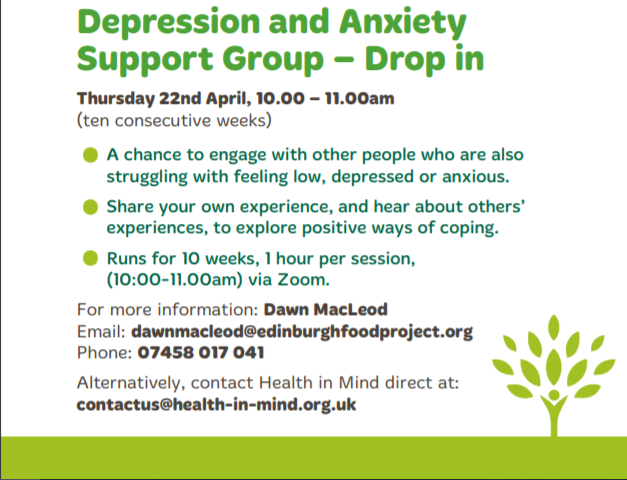
Health in Mind: Depression and Anxiety Support Group today

Image

EdinburghFoodProject@EdinFoodProject

Our Depression and Anxiety Group is getting ready for another week and we are looking forward to welcoming any new faces!

The group is on a “drop-in” basis so if you are interested in joining us please email dawnmacleod@edinburghfoodproject.org to sign up!

Taking a free COVID test ‘helps keep your community safe’

Residents living close to Wester Hailes Library are being urged to come forward and get a free, rapid COVID test at the temporary community testing centre if they don’t have symptoms of the virus. 

The Asymptomatic Testing Centre (ATC) is open until Sunday 9 May from 9am to 6pm daily and is the second ATC in the Capital, following the first one which operated from Craigmillar Library until 2 May. 

Local resident Sas Martinez popped into Wester Hailes Library for a quick COVID test, to check if he was carrying the virus despite feeling fine. 

Sas said: “I think it’s really important to get tested as you don’t really know if you are a carrier of COVID.  People are unwittingly spreading the virus as they don’t have any symptoms and they don’t know they could be spreading it. 

“If more people get the test they will know for sure they are ok and people who do test positive can self-isolate, which will help stop the spread and keep their families safe – and, in turn, their local community.

“We all want to get back to normal as soon as possible and taking this test will help us achieve that.”

When Sas went to the community testing centre, he also met Council Leader Adam McVey and Depute Leader Cammy Day, who had come along to visit the centre and meet the staff working so hard to help identify symptomless cases in the local community and limit the spread. 

Cllr McVey said: These community testing centres are vital in keeping the pandemic under control and getting back to something like normality again.

“If we can identify positive cases, even though there may be no symptoms, we can better keep the spread under control and keep people safe.

“It was great to meet Sas and all the staff doing such a great job to run the centre safely and efficiently.”

Cllr Day said: “If we don’t know where all the cases of COVID are, we’re in a much more difficult position when it comes to stopping the virus in its tracks if outbreaks do occur, so it’s really important as many people as possible come forward for a free and very quick test when there’s a community testing centre in their area.

“Hats off to all the centre staff here in Wester Hailes Library, they’re working incredibly hard on such a valuable project.”

Community testing information, including guidance on support available for anyone who has to self-isolate, is available on the council website. 

Asymptomatic testing centres are run in partnership with the Scottish Government. The next ATC in Edinburgh will open at Gilmerton Library from 10 to 16 May.

Residents who do not have any of the three COVID symptoms (a new continuous cough, temperature, loss or change in sense of taste or smell) are encouraged to get tested.

There is no need to book and testing is available from Wester Hailes Library until Sunday 9 May 2021, open 9am to 6pm daily. 

The centre is only for people without symptoms.

Anyone with COVID 19 symptoms should self-isolate and book a test in the usual way via nhsinform.scot or by calling 0800 028 2816.

Residents will be tested using lateral flow devices (LFDs), which can give people their results in around 45 minutes. Any positive cases will then be confirmed by PCR (Polymerase Chain Reaction) test.

Anyone who receives a positive LFD or PCR test result will be asked to self isolate. Dedicated support is available to anyone who needs to self isolate, including food packages and financial support.