
Social Security Scotland factsheet

Social Security Scotland factsheet

The flagship family payment – Scottish Child Payment – has now doubled to £20 per week per child. 104,000 children are already benefiting from this increase.
The payment, which is unique to Scotland, was designed to tackle child poverty head on. It is one of five family benefits which provides financial support to low income families with children aged under 6.
The benefit will be extended at the end of the year to all eligible children under the age of 16 – and at that point also increase further from £20 to £25.
Once extended, it is expected over 400,000 children could be eligible. The newly doubled Scottish Child Payment, together with the three Best Start Grant payments and Best Start Foods, will provide families with more than £10,000 by the time their first child turns 6 and £9,700 for subsequent children.
This compares to less than £1,800 for an eligible family’s first child in England and Wales, and less than £1,300 for subsequent children.

Visiting Glasgow based family charity Govan Help, First Minister Nicola Sturgeon said: “We are using our social security powers to take immediate steps to put cash in the pockets of families by doubling the Scottish Child Payment to £20 per week per child – support not replicated anywhere else in the UK.
“This is a key part of our national mission to tackle child poverty. We will further increase this payment to £25 by the end of 2022 – five times the amount campaigners originally asked. This will gives families additional financial support of £1,300 for each eligible child every year. We will back this with investment of around £671 million over the next two years – just part of our package of support for families.
“Our Tackling Child Poverty Delivery Plan will also build on our investment in employment support for parents, through new skills and training opportunities and key worker support to help reduce household costs and drive longer term change.
“We are determined to give children the best start and a bright future by putting more money into the pockets of those who need it most. Increasing the Scottish Child Payment will make a real difference to families and help to build a more equal and fairer Scotland for everyone.”

Viv Sawers, Chief Officer at Govan Help, said: “This is a fantastic measure from Scottish Government in tackling Child Poverty in Scotland. The roll out and the uplift in Scottish Child Payment will have an incredible impact on the families across Scotland who need it most and we are delighted to see money going directly to families who we know are struggling to meet their basic cost of living.
“Govan has higher than average rates of Child Poverty so this will have a hugely positive impact on the quality of life for families in this local community. We see families struggling daily, they have told us what a difference this has made already with the cost of living increases, we look forward to supporting more families to access this as it rolls out to children up to age 16 later this year.
“We know parenting is a really hard job, without financial pressures, this funding will go a long way to removing stresses that can impact on healthy family functioning and wellbeing.”


EIGHT of the benefits delivered by Social Security Scotland will now increase by 6%. The increase in payments for low income households and carers comes as the cost of living continues to rise.
Benefits and assistance including Job Start Payment, Young Carers Grant, Funeral Support Payment and Carer’s Allowance Supplement were due to be increased by 3.1% for 2022/23. Subject to parliamentary approval, the increases will now be almost doubled to a 6% uprate.
In addition, the three Best Start Grant payments, which we had not previously planned to uprate, will also now be uprated by 6%, and Child Winter Heating Assistance, which was previously set to rise by 5%, will now also rise by 6%.

From tomorrow (1st April), there will be a 100% increase in Scottish Child Payment, which will double from £10 per week to £20. Best Start Foods was already increased from £4.25 to £4.50 a week in August (5.88%).
Adult Disability Payment and Child Disability Payment will still increase by 3.1% on April 11 in line with the equivalent benefits (Disability Living Allowance and Personal Independence Payment) which are still administered by the Department for Work and Pensions under agency agreement.
This is to avoid creating a two-tier system where individuals paid by Social Security Scotland are paid more than clients whose cases have not yet transferred to the Scottish system.

Payment rates for 2022-2023 are:
| Benefit | Rates 2021-2022 | Rates 2022-2023 | New rates 2022-2023 (6% uprate) |
|---|---|---|---|
| Best Start Grant | |||
| Best Start Grant Pregnancy and Baby Payment (1st Child Payment) | £606.00 | £606.00 | £642.35 |
| Best Start Grant Pregnancy and Baby Payment (Subsequent Child Payment & Extra Payment for Twins/Triplets) | £303.00 | £303.00 | £321.20 |
| Best Start Grant Early Learning Payment | £252.50 | £252.50 | £267.65 |
| Best Start Grant School Age Payment | £252.50 | £252.50 | £267.65 |
| Child Winter Heating Assistance | |||
| Child Winter Heating Assistance (annually) | £202.00 | £212.10 | £214.10 |
| Funeral Support Payment | |||
| standard rate for other expenses element | £1,010.00 | £1041.30 | £1,070.60 |
| other expenses element where there is a funeral plan | £123.25 | £127.05 | £130.65 |
| removal of implanted medical devices | £20.55 | £21.20 | £21.55 |
| Job Start Payment | |||
| Job Start Payment (one-off) standard rate | £251.25 | £260.35 | £267.65 |
| higher rate | £404.00 | £416.50 | £428.25 |
| Young Carer Grant | |||
| Young Carer Grant (annually) | £308.15 | £317.70 | £326.65 |
| Carer’s Allowance Supplement | £8.90 | £9.15 | £9.45 |
| Child Disability Payment | Rates 2021-2022 | Rates 2022-2023* |
|---|---|---|
| Care Component Highest Rate | £89.60 | £92.40 |
| Care Component Middle Rate | £60.00 | £61.85 |
| Care Component Lowest Rate | £23.70 | £24.45 |
| Mobility Component Higher Rate | £62.55 | £64.50 |
| Mobility Component Lower Rate | £23.70 | £24.45 |
| Adult Disability Payment | Rates 2021-2022 | Rates 2022-2023* |
|---|---|---|
| Daily Living Component Standard Rate | £60.00 | £61.85 |
| Daily Living Component Enhanced Rate | £89.60 | £92.40 |
| Mobility Component Standard Rate | £23.70 | £24.45 |
| Mobility Component Enhanced Rate | £62.55 | £64.50 |
* 3.1% increase in line with the equivalent benefits (Disability Living Allowance and Personal Independence Payment) which are still administered by DWP under agency agreement.

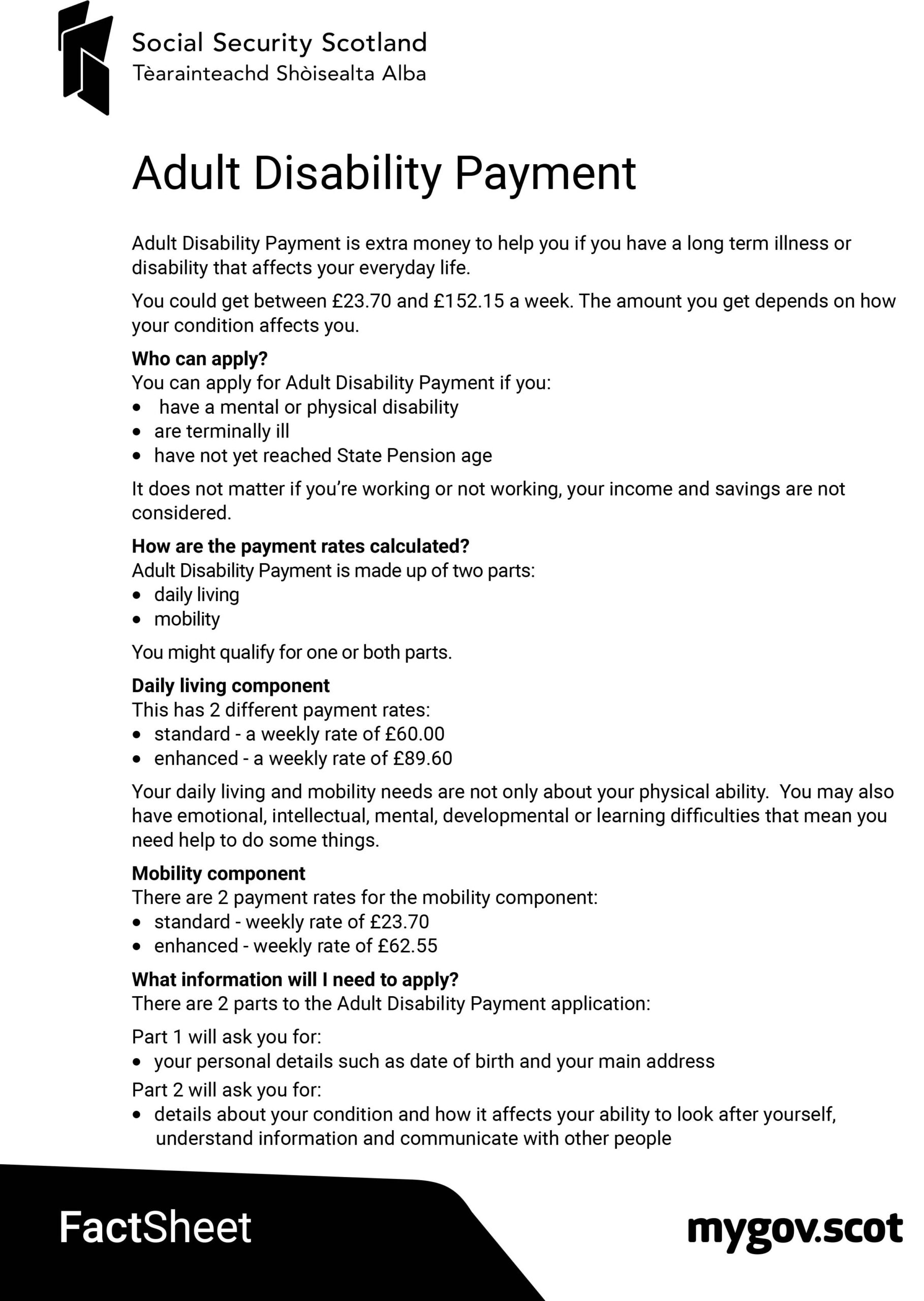
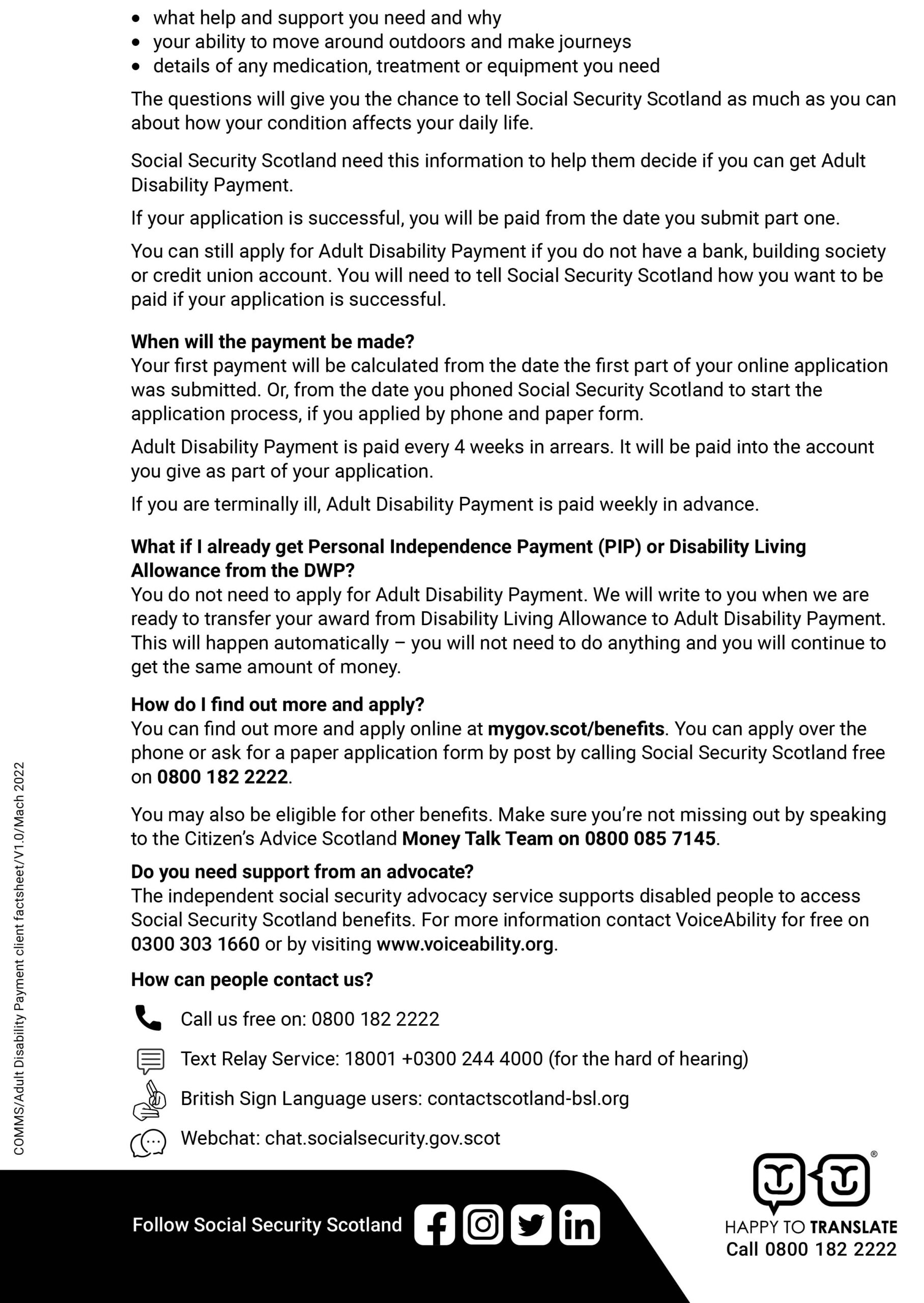
The new Adult Disability Payment will open for applications today (Monday 21 March) for people living in three pilot areas.
People aged between 16 and state pension age who are disabled, have a long-term health condition or a terminal illness living in Dundee City, Perth and Kinross and Western Isles council areas can apply.
Adult Disability Payment will replace the UK Government’s Personal Independence Payment (PIP) in Scotland.
People with ongoing awards of Personal Independence Payment and Disability Living Allowance do not need to make an application for Adult Disability Payment. Their awards will transfer to the Scottish social security system automatically from summer 2022.
Further council areas will be introduced in phases until Adult Disability Payment is rolled out nationally on 29 August 2022.

Minister for Social Security Ben Macpherson said: “Social security is a human right and none of us know when we might need it – it is a shared investment to help build a fairer society, together. We are developing a system that is rooted in trust to make sure people can access the support that they are entitled to.
“Launching this first Adult Disability Payment pilot is a significant milestone, as we start to deliver our biggest and most complex benefit. We are taking a positive and compassionate approach to delivering disability assistance, centred around our principles of dignity, fairness and respect.
“We know people have found applying for disability benefits stressful in the past. That is why we have listened to their experiences and have designed our service to work for people, not against them.
“We are ensuring that accessing Adult Disability Payment is as straightforward as possible and we will always start from a position of trust. Importantly, in the Scottish system no one will be subject to Department for Work and Pensions style assessments and we will never use the private sector to carry out health examinations.
“There won’t be any degrading functional examinations, such as asking a client to ‘touch their toes’.. These changes have been welcomed by those with lived experience, who we have worked with to design this benefit.
“People will only be invited to a consultation on occasions when we require more information so we can make a decision. This will be a conversation with a health and social care professional to understand how an individual’s disability or health condition impacts them.
“We are committed to giving people timely decisions, but our priority is making the right decisions first time and sometimes this may take a bit longer. This will reduce the need for people to go through a redetermination or appeal.
“Adult Disability Payment is there to support people to live well and provide security at the most difficult of times. I would encourage those who think they could be eligible to check and apply.”

Tracy McNally, Director of Dundee Citizens Advice Bureau said: “Helping people with social security payments, and disability payments in particular, is one of the biggest things we do and we’re excited that Dundee is one of the pilot areas for the roll out of adult disability payments.
“It’s really important that the new system is rooted in dignity and respect for applicants, and doesn’t cause unnecessary stress or anxiety.
“We’d encourage anyone who may eligible for the support to apply, and if anyone ever needs help or advice on social security issues, your local CAB is here for you.”
Disabled people with the most serious lifelong health conditions will have more financial security under Scotland’s social security system.
Adult Disability Payment will replace the UK Government’s Personal Independence Payment (PIP). It will open for new applications in pilot areas starting this month.
Disabled people on the highest components of the new benefit and whose needs are highly unlikely to change will be eligible for an “indefinite award”. In effect, this will mean they will not be subject to reviews and can rely on their new benefit into the long-term.
People with ongoing awards of Personal Independence Payment and Disability Living Allowance do not need to make an application for Adult Disability Payment. They will be contacted from this summer to let them know when their awards will automatically be moved safely and securely to Adult Disability Payment.

Social Security Minister Ben Macpherson said: “The introduction of indefinite awards, as part of Adult Disability Payment, underlines our commitment to deliver on the principles of Scotland’s social security system to treat people with dignity, fairness and respect.
“In making this decision, we have engaged with a wide range of people with lived experience of the current system and will continue to listen as we design and build a social security system that works for disabled people.
“We want to ensure that people on the highest levels of Adult Disability Payment awards receive long-term and adequate support, because those with lifelong conditions, or disabilities resulting in needs highly unlikely to change, should not be subject to unnecessary reviews when it is reasonably expected that their situation will not change.
“Under the UK Government’s Personal Independence Payment, similar awards have generally been reviewed between every 2 to 10 years. However, disabled people tell us that even review periods of 10 years can create stress and anxiety. That is why we have decided to introduce indefinite awards – we are determined to do things differently and build a more compassionate system in Scotland.”

Moira Tasker, Chief Officer, Inclusion Scotland said: “Inclusion Scotland warmly welcomes the announcement that there will be indefinite awards of Adult Disability Payment. We are glad the Minister has acted on the views expressed by disabled people and adopted this measure.
“It will come as a huge relief for disabled people with high, permanent levels of impairment who faced continual reassessments under the flawed DWP, Personal Independent Payment, system. Indefinite awards will also provide some certainty and security for those who receive them.”

Morna Simpkins, Director of MS Society Scotland, added: “We are pleased the Scottish Government has listened to the views of the MS community and MS Society Scotland and will re-introduce indefinite awards.
“MS is relentless, painful, and disabling. Indefinite awards will provide some people living with progressive long term conditions, like MS, with the security of knowing they will not have their awards downgraded or income cut.”
Adult Disability Payment is the twelfth benefit to be introduced by Social Security Scotland since September 2018, which includes seven new benefits, unique to Scotland.
PLANS FOR A NEW BENEFIT

Views are being sought on plans to improve support for Scotland’s community of unpaid carers through the introduction of a new benefit.
Under Scottish Government proposals, Scottish Carer’s Assistance will replace Carer’s Allowance, currently delivered by the Department of Work and Pensions (DWP), and be delivered by Social Security Scotland.
It will support over 80,000 people who provide 35 hours per week or more of care to those receiving certain disability benefits. An additional payment of more than £500 a year will be made to those who care for more than one person.
A consultation published today outlines proposals aimed at improving the service that carers receive, including increased financial support and links to wider support in areas such as social care, employability, education and bereavement.
It also highlights how support could be expanded once those already in receipt of Carer’s Allowance have been transferred from DWP to Social Security Scotland.
Social Security Minister Ben Macpherson said: “Caring for a loved one can be a positive and life changing experience but also presents many challenges. We will deliver Scottish Carer’s Assistance in a compassionate and considerate way, linking carers to wider services.
“We will also create a weekly payment of £10 for those caring for more than one person, and if the person they care for is challenging a change to their disability benefits we will make support available.
“This is in addition to continuing support for young carers and maintaining the extra support from our Carer’s Allowance Supplement, providing eligible carers with an extra £460 a year.
“When we have introduced our new benefit, and safely and securely transferred people from Carer’s Allowance to Scottish Carer’s Assistance, we intend to make further improvements. We will look for opportunities to make these changes sooner if we can do so without putting carers’ existing benefits at risk.
“These further changes would help remove barriers to education, allow carers to add together hours spent caring for more than one person to qualify for support, extend support after the loss of a cared for person or when a cared for person is in hospital, and enable carers to earn more from paid work.
“We want to hear people’s views on these plans, other potential changes beyond these, and thoughts on how improvements would help address inequality and poverty.”

Fiona Collie, Policy & Public Affairs Manager at Carers Scotland, said: “Carers Scotland is very pleased to welcome the publication of this consultation on proposals for Scottish Carer’s Assistance and a new Carer Additional Person Payment to support unpaid carers.
“This opportunity to improve the main financial support for carers in Scotland is an important one and carers have long discussed ways in which it can be changed to recognise their caring and better meet their needs.
“I would encourage as many carers as possible to respond and bring their views and experiences to the consultation, either individually or through events and activities that are planned.”
The Scottish Carer’s Assistance consultation is open for responses until 23 May 2022.

Over 658,000 Carer’s Allowance Supplement payments have been made to 126,055 carers since this additional payment, unique in the UK, was introduced in September 2018.
In total, £188 million has been paid to carers since launch and just under 82,000 eligible carers received a payment in December 2021.
Recognising the impacts of the pandemic on unpaid carers, these payments included an additional Coronavirus Carer’s Allowance Supplement payment, making the total December payment value £462.80.
Carer’s Allowance Supplement is an extra payment for people in Scotland who get Carer’s Allowance on a particular date.
There are two Carer’s Allowance Supplement eligibility dates each year – one in April and one in October. The eligibility dates for 2022 will be Monday 11 April 2022 and Monday 10 October 2022.
The Minister for Social Security, Ben Macpherson said: “In recognising the vital contribution of unpaid carers in our society, Carer’s Allowance Supplement was the first payment we introduced when we established our new social security system in 2018.
“Providing this supplementary payment rights the wrong that Carer’s Allowance on its own is the lowest of all working age benefits in the UK.
“The impacts of the pandemic put additional pressure on tens of thousands of carers across the country. That is why we also paid an additional Coronavirus Carer’s Allowance Supplement Payment in 2020 and 2021.
“The Scottish Government’s additional payments meant that eligible carers in Scotland received up to £694.20 more in support last year than carers in the rest of the UK.”

Eligible parents are being urged to apply for Scottish Child Payment on the first anniversary of its roll out.
The payment of £10 per week, unique to Scotland, began in February 2021 as a direct measure to tackle poverty. It provides regular, additional financial support to parents and carers to help with the costs of caring for a child.
Since launch, the families of around 106,000 children have benefited from £520 a year and the payment will double to £20 per week from April.
By the end of this year – subject to data being made available by the DWP – the payment will extend to include all eligible children under the age of 16.
In 2019-20 the Scottish Government invested nearly £2 billion in support for low income households, including over £672 million targeted specifically at children.

Shona Robison, Cabinet Secretary for Social Justice, Housing and Local Government said: “The Scottish Government is determined to deliver on our ambition to eradicate child poverty in Scotland. So this year we will be even bolder with the ambitious and transformational measures we will take.
“From April, our Scottish Child Payment will double to £20 a week – four times the amount anti-poverty campaigners originally asked for. Together with our Best Start Grant and Best Start Foods payments, this will provide a package of financial support worth £8,400 by the time an eligible family’s first child turns 6.
“The extension to 16 year olds will continue this progress with the number of eligible children increasing to 430,000. In 2023-24 we estimate the Scottish Child Payment could lift 40,000 children out of poverty.
“This is part of the national mission we have set ourselves and society to tackle child poverty and our focus must be relentless and constant.
“Because many people learn about Scottish Child Payment through word of mouth, if you think a friend or family member might qualify, please encourage them to find out more and to help to ensure that everyone eligible gets the support they are entitled too.
“This way, we can all play a part in ensuring the continued success of Scottish Child Payment, advancing our fight to eradicate child poverty and building an equal and fairer country.”
The Scottish Government committed to introducing the Scottish Child Payment in June 2019 as part of the Tackling Child Poverty Delivery Plan.

John Dickie, the Director of the Child Poverty Action Group, said: “The Scottish Child Payment is already providing vital financial support to families, helping parents give the best possible start in life to their children.
“Doubling its value from April comes at a critical time, helping families stay afloat as food and energy prices soar. The roll out to eligible children over five is now eagerly anticipated and really can’t come soon enough.”

The new Adult Disability Payment will open for applications in three pilot areas from 21 March 2022.
Legislation unanimously approved today by the Scottish Parliament means that working age disabled people, those with a long-term health condition and people who have a terminal illness should apply for disability assistance to the new Scottish system.
Applications will open first for those living in Dundee City, Perth and Kinross and the Western Isles council areas.
This payment will be the twelfth to be delivered by the Scottish Government and will replace Personal Independence Payment, which is currently delivered by the UK Government’s Department for Work and Pensions.
Adults of working age with a disability or health condition, who are not already in receipt of Personal Independence Payment or Disability Living Allowance, and living in the pilot areas, will be the first to be able to apply.
Further council areas will be introduced in phases until Adult Disability Payment rolls out nationwide on 29 August.

People already receiving DWP payments will not need to apply for Adult Disability Payment. Their awards will transfer to the Scottish social security system automatically, beginning in August.
This will be done safely and securely so that people will still get the same amount of money, to the same account. The date of their first payment will be confirmed in writing before they transfer.
Minister for Social Security Ben Macpherson said: “The unanimous passing of the regulations for Adult Disability Payment is a significant milestone for Scotland’s social security system. It means we can now take a very different approach to delivering disability benefits – in comparison to the current DWP system – and our focus is on providing a positive and compassionate experience for people applying for and receiving our new benefit.
“We know people have found applying for DWP disability benefits stressful in the past. That is why we have listened to their experiences and designed our new system to work for people, not against them. We are committed to doing things differently – we are ensuring that accessing Adult Disability Payment is as straightforward as possible and we will always start from a position of trust.

“Importantly, we have abolished assessments in the form currently undertaken by the DWP. Instead, and only where required, we will hold consultations between the person and a Social Security Scotland health or social care practitioner. Our consultations will not involve functional examinations.
“To ensure we don’t create a two tiered system as we complete safe and secure transfer, we are largely keeping the eligibility criteria for Adult Disability Payment the same, ahead of a two stage independent review of Adult Disability Benefit.
“This review will begin later in the year, to consider what further changes and improvements could, and should, be made in the future.”
SOCIAL Security Scotland is urging families to apply for Best Start Grant School Age Payment before the deadline and to apply for help with early learning costs.
Eligible families with children born between 1 March 2016 – 28 February 2017, are being encouraged to apply for the School Age Payment before applications close on 28 February 2022.
Parents or carers enrolling children in nursery this year have also been urged to check whether they are eligible for a one-off payment to help with early learning costs.
For Early Years Payment, eligible families who are in receipt of certain benefits or tax credits with a child who is aged between 2-3 and a half years old. Parents or carers who are eligible for the Early Learning Payment receive a one-off grant of £252.50
The money can be used to help pay for clothes, equipment, bags, books or anything else which is helpful for people caring for children in that age range.
Eligible families for School Age Payment may be parents or carers who are in receipt of certain benefits or tax credits with a child who is old enough to start school.
School Age Payment is a payment of £252.50 per child and is designed to support children at a key stage in their life.
It is not directly linked to taking up a school place. As such, even if the child’s school start has been deferred until next year, or if the child is not going to start school at all, parents or carers should still apply for the payment by 28 February 2022. If they do not apply by this time, they will not be able to receive the payment.

Social Security Scotland wants to ensure that everyone who is entitled to money for Early Learning or School Age Payment receive it and we would welcome support from our stakeholders to make sure people don’t miss out on these payments.
Please encourage any clients in your networks to apply for School Age Payment before the 28 February deadline and for Early Years Payment when enrolling their child into nursery.