Get your game on for RNIB! Charity encourages gamers to fundraise

Online video gamers are being encouraged to fundraise for sight loss charity RNIB in May while they play, as part of a drive to highlight the need for more inclusion in gaming.

This will tie in with Global Accessibility Awareness Day on May 20th, a day which focuses on digital access and inclusion for people with disability and impairment.

The charity is inviting supporters who enjoy online gaming to host  ‘Gaming for RNIB’ fundraising livestreams on or around this date.

Gamers with sight who wish to experience how games might look to those with different sight loss conditions can be provided with helpful materials, including overlays and simulation glasses.

RNIB’s community giving manager Becca McRow-Brewer said: “Games rely largely on visuals. But blind and partially sighted people are also active gamers, they just need the help of accessibility features. Sight loss doesn’t have to mean losing your passions.

“We are encouraging gamers from across the UK to support RNIB by hosting a fundraising stream around Global Accessibility Awareness Day. Every pound raised will help create a world without barriers for people with sight loss.”

RNIB currently supports gaming groups for blind and partially sighted players across the UK that were set up at the beginning of the year, with a group in Scotland among the first.

Members meet weekly on an online telephone call and share their experiences of the games they’ve found most accessible. They’re also challenging software developers to consider blind and partially sighted people when designing new games.

Conor Joseph (24) who lives in Livingston is visually impaired with a rare genetic condition called Leber’s Hereditary Optic Neuropathy.

“I lost my sight around the age of eight,” he said. “For the most part I am able to get around and live independently. I love all forms of media from gaming to movies and music and even graduated with a degree in film and media.

“I’ve loved gaming my whole life and have an interest in a range of genres with first-person shooters and open world games being among my favourites.

“While I have been fortunate in having a lot of useful sight left, becoming visually impaired forced me to make adjustments in most aspects of my life which included gaming. I frequently avoid games heavy in text and dialogue as sitting close in to read everything can become extremely tedious and tiring.

“Joining RNIB Scotland’s gaming group has allowed me to chat to other visually impaired gamers, many of whom have similar experiences to me. I would definitely urge other disabled gamers to become part of the community and talk to others with similar experiences.

“Accessibility in gaming is extremely important and the industry has already seen a great shift towards being accessible within the last few years. Creating focus groups and directly working with disabled gamers in order to discover what user experience settings are most effective. In a general sense, I would say giving people as many options as possible is the best thing a developer could do.

“Gaming as a whole is very important to me and a big part of my life and I can’t imagine what it would be like if I lost more of my sight. Playing games is a great stress reliever, both as a solo gamer and a fun social activity when playing with friends. All games are created to let the player have fun, and all disabled people should have the chance to have fun just like anyone else.”

For more information or to register to host a fundraising gaming stream for RNIB visit rnib.org.uk/gaming-for-rnib

Lockdown easing mustn’t create new barriers for people with sight loss, says charity

Lockdown restrictions that ease today [Monday 26 April] must not inadvertently create new barriers for blind and partially sighted people and those with other disabilities, says the national sight loss charity RNIB Scotland.

RNIB Scotland director James Adams said: “With lockdown restrictions easing further today, we’re all looking forward to getting outside to see loved ones and enjoy the warmer weather.

“But we are hearing from many blind and partially sighted people who have lost confidence in going outside after a year of covid restrictions and are anxious about public spaces becoming busier and more cluttered with café and bar tables and chairs.

“Social distancing often relies on being able to see things such as signs, queuing systems or barriers. When you can’t see these changes, they can create new obstacles to navigate and further erode confidence.

“So we’re asking the public to be aware of the challenges people with sight loss might face, and help them to safely social distance as the restrictions change. We’re also reminding local authorities and businesses that the measures in place to protect us must be inclusive to everyone, not just to those who can see them.

“This is the ‘new normal’ we should aim to return to in Scotland.”

* RNIB’s website (www.rnib.org.uk) and helpline (tel 0303 123 9999) has more information on this.

Edinburgh woman determined to takes steps to help those living with sight loss

Scotland’s Virtual Kiltwalk is taking place from April 23rd to 25th and Leith couple Annette and Warren West plan to put their best feet forward in aid of sight loss charity RNIB Scotland.

“Our proposed route is from my house in Leith to Portobello and back again,” she says, “approximately six miles, which is in similar length to the traditional Kiltwalk’s ‘Wee Wander’ option.”

Annette (61) has experienced sight loss herself for over 30 years but has always been helped and supported by RNIB Scotland. She thinks lockdown has made the Edinburgh-based charity’s services even more vital.

But rather than join her on her walk, where social distancing rules still apply, she suggests people might want to sponsor her, or organise their own activities and donate any funds raised to her Just Giving page.

“The great thing about the Kiltwalk has always been that any money raised is topped up by 50 percent by the Tom Hunter Foundation,” Annette says. “So any donation can lever in even more money, increasing the impact.

“I’m now into my fifth year of doing the Kiltwalk and fundraising on behalf of RNIB Scotland is more important than ever, as it enables blind and partially sighted people to stay connected with each other at a time when many are feeling very isolated.

“I’m also passionate about health and wellbeing and I try to maintain regular exercise, which isn’t always easy due to the restrictions currently in place. Having the Virtual Kiltwalk gives me something to focus on and keeps me motivated. It helps me, too, to develop good eating habits and take regular exercise.

“So, for me doing the Kiltwalk is not just about walking but a way of maintaining a healthy balanced life-style.”

You can donate to Annette’s Just Giving page at:

https://virtual.thekiltwalk.co.uk/fundraising/ScotlandsVirtualKiltwalk2021-AnnetteWest.

Letters: Spaces for People could create obstacles for blind and partially sighted people

Dear Editor

Tuesday, March 23rd, marks the anniversary of the day the UK was officially plunged into lockdown. We have lived through what is probably the most extraordinary year in most people’s lifetimes.

Blind and partially sighted people have had to adjust like everyone else  to the daily challenges this  has created. Thankfully, there’s now light at the end of the tunnel. But some ongoing measures could continue to be barriers to their independence and confidence.

People with sight loss can sometimes find it difficult to judge space, so we’re asking everyone to maintain their own distance, be patient and be helpful

video – https://youtu.be/D9cgim4Qv88].  

Just getting out and about can be more hazardous for those without sight. The Government’s ‘Spaces for People’ initiative has already transformed many of our streets and thoroughfares. We must take care that this doesn’t inadvertently create new obstacles for those with disabilities.

The covid crisis has given all of us a sense of uncertainty and vulnerability, of what it’s like to depend more on others.

So let’s make one positive legacy of this crisis a resolve to make sure we re-emerge as a society in which no one is left at the margins.

James Adams

Director, Royal National Institute of Blind People (RNIB) Scotland

12-14 Hillside Crescent, Edinburgh

People with sight loss urged to join lobby of election candidates

Over 8,500 blind and partially sighted people and their supporters across Scotland have been urged to join a concerted drive to contact their local candidates for the Scottish Parliament election in May.

The move comes after a year of lockdowns which sight loss charity RNIB Scotland says has exacerbated the issues that have made life more difficult for those with a visual impairment

It is linking people on its database to an online system that will let them quickly find and email the election candidates standing in their area.

“Covid highlighted some serious gaps in our services last year, gaps that were troubling enough in normal times but very alarming during a period of crisis,” said director James Adams.

“Vital information that sometimes wasn’t available initially in formats like audio and braille, access to online shopping, confusion over social distancing and guiding – not priorities for most people, perhaps, but absolutely essential to those who are blind and partially sighted.

“We want to mobilise our members and supporters to push their concerns onto the political agenda.”

In its own manifesto for the election, RNIB Scotland is calling for sight loss issues to be given more priority – not least a commitment that voting itself will be made more accessible for blind and partially people.

Research by RNIB last year found that only 13 per cent of one blind voters across the UK, and less than half of partially sighted voters (44 per cent), said they were able to vote independently and in private in the last General Election. A legal ruling in 2019 criticised existing arrangements for voters with sight loss as ‘a parody of the electoral process’.

The RNIB Scotland manifesto also calls for emotional support for people first diagnosed with sight loss, more specialist teachers in schools, disability benefits that better recognise the needs of blind and partially sighted people, and support in finding employment.

The charity wants an assurance, too, that the new post-covid emphasis on ‘active travel’ – which could see the legalisation of rented e-scooters – doesn’t infringe on the rights of people with disabilities to go safely outdoors.

“After the shock that was covid in 2020 we need to make our society safer and more resilient,” said Mr Adams. “But let’s grab this opportunity to make it fairer, too. Covid gave us all a sense of what it’s like to feel more vulnerable and unsure, more dependent on each other.

“Scotland should plan for more than just a return to yesterday in 2021 but aim towards a better tomorrow. Let’s make sure that the society and structures that we do at last come back to are open and inclusive for everyone.”

* The RNIB Helpline can be called on 0303 123 9999. The RNIB Scotland website is at www.rnib.org.uk/scotland.

Letters: Emergency Mental Health Sessions for blind people

Dear Editor,

2020 was a difficult year for everyone. Though hope is on the horizon, starting 2021 in lockdown is not how most of us wanted for January. It’s understandable that many people are feeling down and in need of a little extra emotional support.

The situation is especially challenging for those living with sight loss. Many have faced anxiety, sadness and even fear about the unique challenges they have experienced – problems such as social distancing, difficulty shopping without guidance and isolation from losing tactile contact with friends and family during lockdown.

That’s why RNIB has launched Emergency Mental Health Sessions for blind and partially sighted people.

The sessions are completely free and offer people with sight loss the opportunity to speak to a counsellor for an hour over the phone, about however they are feeling and any problems that are on their mind. It doesn’t have to be about their sight at all.

We know that the next few months might still be tough for many, so we want to remind you that RNIB is here to help. If you or someone you know could benefit from speaking to someone, please call our Helpline on 0303 123 9999. We can set up a chat within 36 hours and the service can be used as many times as needed.

No one with sight loss has to suffer on their own. Blind and partially sighted people deserve the same expectation of mental wellbeing as everyone else. That’s why RNIB in Scotland will always be here.

Thank you

James Adams

Director, Royal National Institute of Blind People Scotland

12-14 Hillside Crescent, Edinburgh

Scotland should work towards a better tomorrow in 2021, says sight loss charity

Scotland should aim for more than just a return to yesterday in 2021, says national sight loss charity RNIB Scotland, but work towards a better tomorrow.

“Let’s make sure that the society and structures that we do finally return to are more open and inclusive for everyone,” urged director James Adams.

“Covid highlighted some serious gaps in our provision last year – gaps that were troubling enough in normal times but very alarming during a period of crisis. Vital information that sometimes wasn’t initially available in formats like audio and braille, confusion over social distancing and guiding – not priorities for most people, perhaps, but absolutely essential to those who are blind and partially sighted.”

RNIB Scotland will push for these issues to be given priority in the run up to the Scottish Parliament elections in May – not least a commitment that voting itself will be more accessible for blind and partially people.

It also wants a pledge that there will be no cuts to essential services for vulnerable groups, and that when full NHS eye-health services are resumed there is an emphasis on preventing avoidable sight loss

The charity is concerned, too, to ensure that the new post-covid emphasis on ‘active travel’ – which could see the legalisation of rented e-scooters – doesn’t infringe on the rights of people with disabilities to go safely outdoors. It will also call for a looming shortage of specialist school-teachers for children with sight loss to be addressed as a matter of urgency.

“After the shock that was covid in 2020 we need to make our society safer and more resilient,” said Mr Adams. “But let’s grab this opportunity to make it fairer, too. Covid gave us all a sense of what it’s like to feel more vulnerable and unsure, more dependent on others. We must return to a Scotland where no one is left exposed at the margins.”

* The RNIB Helpline can be called on 0303 123 9999. The RNIB Scotland website is at www.rnib.org.uk/scotland.

‘Simple but far-reaching’: RNIB launches Holyrood manifesto

National sight loss charity RNIB Scotland is calling on all political parties to build on the greater social cohesiveness that the coronavirus crisis has engendered.

Launching its manifesto for next year’s Scottish Parliament elections, the charity’s director James Adams said: “The next Scottish Parliament will convene in a changed world. A world forced to re-evaluate things previously taken for granted, in which everyone has been made more aware of how dependent we are on each other.

“‘A Vision for the 2020s’ sets out simple but far-reaching steps that can create a more inclusive Scotland for blind and partially sighted people. Let’s seize this opportunity.”

The manifesto is calling on the next Scottish Government to launch a new campaign to emphasise the importance of regular eye examinations in preventing sight loss. Over 178,000 people in Scotland currently live with significant sight loss but this could potentially double if steps aren’t taken to contain it.

The manifesto also wants Ministers to report annually on the attainment figures for blind and partially sighted school pupils and train more specialist teachers as a matter of urgency. It highlights that only one in four blind and partially sighted adults are currently in paid employment.

‘Shared spaces’ schemes – where pedestrians and vehicles occupy the same level area – should be scrapped, the manifesto says, and a nationwide ban on pavement parking and advertising boards implemented.

People with sight loss claiming the new disability benefits devolved to Scotland should not have to undergo periodic reassessed if there is no realistic prospect of their condition improving. Any benefits awarded should cover the, often significant, additional costs of living with a visual impairment.

The manifesto is also calling for all public information to be available in accessible formats such as braille, large-print and audio, and for alternative voting methods to ensure people can cast their ballot independently and in secret.

Mr Adams said: “We want a health service that prevents avoidable sight loss and helps people come to terms with it when it isn’t.

“Education that helps every child reach their full potential, and employers who better understand what people with sight loss are capable of.

“Information that’s always available in alternative formats and public transport that’s always accessible.

“And we want our streets and thoroughfares to allow pedestrians to walk safely and without obstacles.

“Today’s coronavirus crisis has exacerbated many of the problems blind and partially sighted people face. But it’s brought to the fore, too, some of the best instincts of our society. That generosity of spirit can be the spur for a new deal for people with sight loss and other disabilities.

“Let’s make that one lasting legacy of the parliamentary term ahead.”

www.rnib.org.uk/scotland

Awareness week warns of ‘ticking time-bomb’ of preventable sight loss

Concerns are being raised that the coronavirus crisis may lead to a ‘ticking time-bomb’ of preventable sight loss if people neglect eye-treatment or regular check-ups.

A drive to emphasise the importance of maintaining eye-health and reassure the public it is safe to visit their local optometrist begins at the start of National Eye-Health Week today.

Eye examinations, which are NHS funded in Scotland, can not only detect early signs of sight problems, in time to arrest or reverse damage, but sometimes pick up the symptoms of other serious health conditions such as high blood pressure and diabetes to name just a few.

One woman visited an optometrist at an Emergency Eye Treatment Centre after experiencing blurred vision then sight loss in one eye, and was referred to hospital where she received potentially life-saving treatment for a brain aneurysm.

Another patient was referred to hospital after his optician investigated a shadow on his retina – he was found to have suffered a mini eye stroke, and by chance during his tests kidney cancer was also detected before it metastasised allowing him to be referred for vital treatment.

During National Eye-Health Week, Optometry Scotland and national sight loss charity RNIB Scotland are joining forces to boost the eye-health message.

David Quigley, chair of Optometry Scotland, said: “Community Optometrists and Opticians practices remain the first port of call for any eye problems and we want to reassure the public that a range of enhanced hygiene measures, including NHS-approved PPE, are in place across practices, enabling patients to seek effective care in a safe environment.

“If you have any concerns whatsoever about your eye health, or you’re due a routine eye examination, don’t delay in contacting your local optician.  We are open and ready to help.  It’s important not to turn up without an appointment so please make sure you call in advance.”

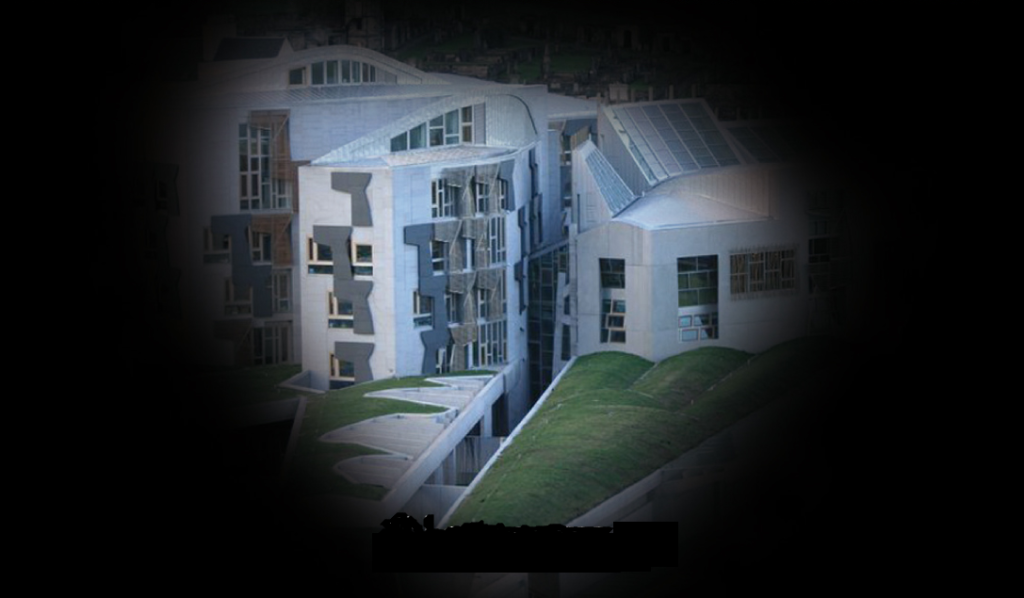
RNIB Scotland has produced a series of photographs of iconic Scottish landmarks distorted by the effects of common sight loss conditions.

“We want to illustrate the potential consequences of not maintaining good eye-health,” said its director James Adams. “Some people have expressed concern over attending optometrist or eye clinic appointments, or are worried about using public transport to get there. We’ve even heard some people say they don’t want to ‘bother’ optometrists during this crisis period.

“Every survey shows that sight is the sense people fear losing most. And yet we can be surprisingly complacent about our eyes. During National Eye Health Week, we want to remind everyone to take care one of the most precious things we have – our sight.”

During the awareness week optometrists will take part in question and answer sessions on RNIB’s Connect radio station, while Stuart McMillan MSP, chair of the Scottish Parliament’s cross party group on visual impairment, will table a parliamentary motion highlighting the message.

* PHOTOGRAPHS show Edinburgh Castle as seen by someone with age-related macular degeneration, and the Scottish Parliament as seen by someone with glaucoma.

Annette tackles Kiltwalk challenge to support RNIB

Leith resident Annette West has helped to raise £2,250 for sight loss charity RNIB Scotland after taking part in the Virtual Kiltwalk last Sunday.

Annette (above, left)was one of eight people who walked six miles along the Water of Leith, in two groups of four to maintain social distancing.

“I have experienced sight loss for over 30 years but have always been helped and supported by RNIB Scotland,” says Annette (60). “I just wanted to do the Virtual Kiltwalk to help give something back.

“I found the walk very easy and relaxing. I also found that pathway easy to get around as there was not too many steps. Socially distancing was only a problem when the path was narrow and when people in the opposite direction were trying to pass by. I think the route is very popular for walkers on Sundays.

“It was really good to meet up and spend quality time with friends before we all went back to our own lockdown homes. It gave me a sense of freedom by being out in the open. I also felt re-connected with nature and that it was great to meet other human beings.

“After the walk I felt that my spirits had been lifted and that going back home, I was mentally and physically in a good place.”

You can still donate to Annette’s fundraising page for RNIB Scotland until Monday 21 September:  https://edinburghkiltwalk2020.everydayhero.com/uk/netwalk2020