Social Justice Secretary writes to DWP on work capability announcements
Changes to work capability assessments announced in the Autumn Statement are ‘deeply concerning’ and could mean people receive less support based on a change of criteria rather than a change in their health, Social Justice Secretary Shirley-Anne Somerville has said.
Writing to DWP Secretary Mel Stride, Ms Somerville highlighted how the Scottish Government has taken a different approach with its social security system being based on treating people with fairness, dignity and respect.
Ms Somerville said: “I remain deeply concerned about the changes to the activities and descriptors for ‘getting about’ for Limited Capability for Work, and the mobilising and substantial risk criteria for limited capability for work-related activity.
“The changes you are proposing, including the extension of the sanctions regime, will have very significant additional impact on some of the most vulnerable people in our communities who need our support most.
“In Scotland, we have taken a different approach to devolved employability support; our services remain voluntary, and we want the support we provide to be seen as an opportunity, not a threat, with fairness, dignity and respect at its heart.
“In delivering our first devolved employability service, Fair Start Scotland, Scottish Government officials had a close working relationship with Job Centre Plus to ensure we were collectively working to provide support for the people of Scotland.”
The proposals in the UK Government’s Back to Work Plan contain a confusing mixture of devolved and reserved responsibilities, which leave us slightly mystified as to exactly how this is all going to work in practice (writes Fraser of Allander Institute’s MAIRI SPOWAGE):
In his speech, the Chancellor said: “… last week I announced our Back to Work Plan. We will reform the Fit Note process so that treatment rather than time off work becomes the default.
“We will reform the Work Capability Assessment to reflect greater flexibility and availability of home working after the pandemic. And we will spend £1.3 billion over the next five years to help nearly 700,000 people with health conditions find jobs.
“Over 180,000 more people will be helped through the Universal Support Programme and nearly 500,000 more people will be offered treatment for mental health conditions and employment support.
“Over the forecast period, the OBR judge these measures will more than halve the net flow of people who are signed off work with no work search requirements. At the same time, we will provide a further £1.3 billion of funding to offer extra help to the 300,000 people who have been unemployed for over a year without having sickness or a disability.
“But we will ask for something in return. If after 18 months of intensive support jobseekers have not found a job, we will roll out a programme requiring them to take part in a mandatory work placement to increase their skills and improve their employability. And if they choose not to engage with the work search process for six months, we will close their case and stop their benefits.”
These changes have the potential to impact recipients of Universal Credit. The complication is that UC is reserved, while many elements of employment support – the “extra help” that the Chancellor talks about – is, on the whole, devolved.
Because of this, many of the support mechanisms to help people avoid sanctions in England (& Wales in most cases) generated Barnett consequentials, including:
Restart: expand eligibility and extend the scheme for two years
Mandatory Work Placements: phased rollout
Universal Support: increase to 100,000 starts per year
Talking Therapies: expand access and increase provision
Individual Placement and Support (IPS): expand access
Sanctions: closing claims for disengaged claimants & end of scheme review
Fit Note Reform trial
So, in summary, it looks like the sanctions could be applied in a reserved benefit, following support that may or may not be provided by the Scottish devolved employability system as the Scottish Government could choose to spend the money on something else.
We wait for more details from both the UK & Scottish Governments about how this is going to work in practice.
• The real pay crisis is intensified and now expected to last 20 years. • The politically charged National Insurance cut makes the smallest dent in the worse squeeze on household incomes since the 1950s. • While the Chancellor has enjoyed higher revenues, he has chosen to play austerity politics rather than back public services on the brink – £20 billion has been taken from public services to fund the meagre tax cut. • An ‘Autumn Budget for growth’ has meant the reduced growth in almost every year of the forecast. • ‘Full expensing’ of capital expenditure is a seriously inefficient way to boost the economy. • In spite of all the claims to the contrary, the Tories are still presiding over worst deterioration in public finances for more than 100 years.
Real wage and household disposable income crisis unended
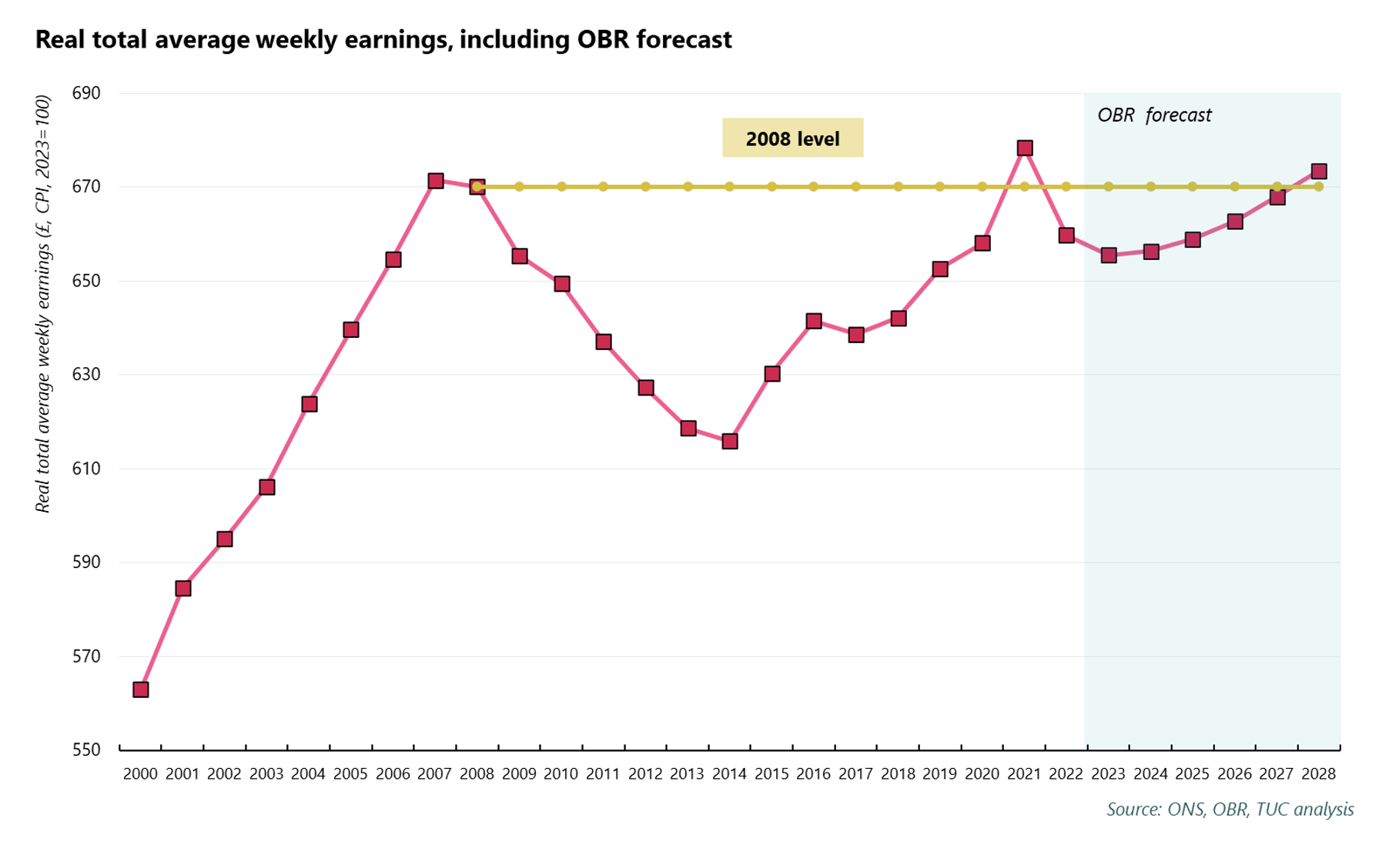
The forecasts published alongside the statement by the Office for Budget Responsibility (OBR) contained alarming news on real wages. According to the OBR forecasts, real wages are now not set to return to 2008 levels until 2028. The current pay squeeze will hit two decades.
This is a significant downgrade on the March forecast, when wages were returning to 2008 levels by 2026 – two years sooner than it now expects.
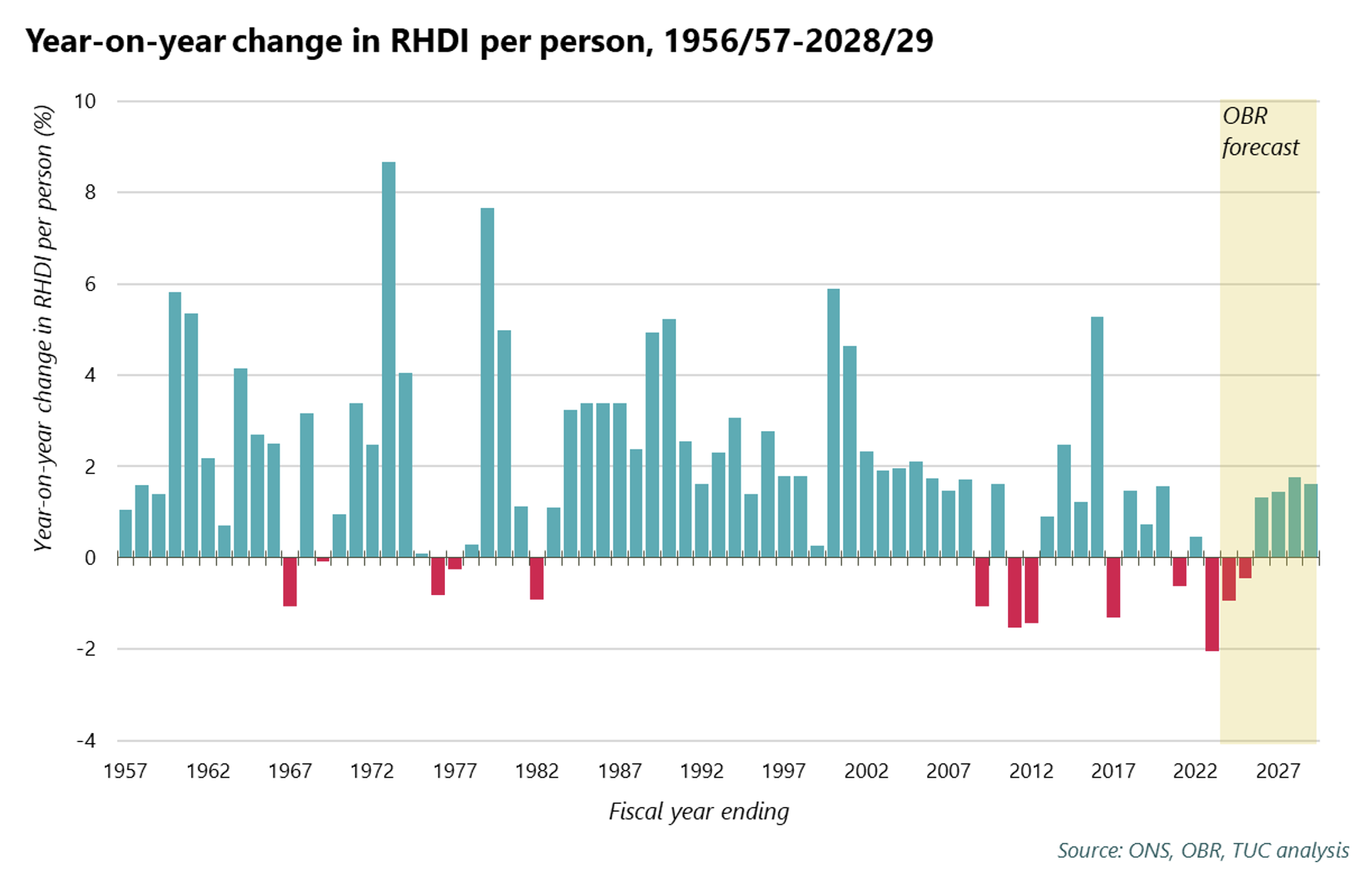
The forecast for broader living standards (as measured by real household disposable income per person) remains dire. After already declining in both the 2020/21 and 2022/23 financial years, further falls are expected over the next two.
While in fact a less bad forecast than March, the OBR stress that living standards “are forecast to be 3½ per cent lower in 2024-25 than their pre-pandemic level … this … represents the largest reduction in real living standards since ONS [Office for National Statistics] records began in the 1950s”.
The OBR also put into perspective the 2 per cent cut in National Insurance, reckoning it will boost living standards by around 0.5 per cent at the end of the forecast. This is a minor dent in an immense collapse, and of course as everybody has pointed out only reverses in a small way tax increases at past statements – even on their own terms the government are failing.
Minimum wage
Specifically for those on the minimum wage, the Chancellor has accepted the recommendations of the Low Pay Commission (LPC). This takes the wage floor to £11.44 an hour and extends coverage to everyone aged 21+. This is badly needed and follows pressure from unions and low-pay campaigners. But with prices sky high, and the OBR increasing its inflation forecasts, the minimum wage must be raised to £15 as soon as possible, and extended to all adult workers.
The Low Pay Commission’s recommendations take the minimum wage to 66% of median wages. This is an internationally recognised measure of relative low pay. However, the Chancellor’s claims that he has eliminated low pay should be taken with a pinch of salt. This is a measure of pay distribution which looks at how close low-paid workers are to the median worker. The floor has risen since 2010 but the middle has had no real pay rise over 13 years. The bottom has been catching up, in part, because wages are stagnant for everyone else. The government should set the LPC’s next minimum wage target at 75% of median wages, and this should be delivered alongside a plan for real wage growth for all workers.
Unemployment rise
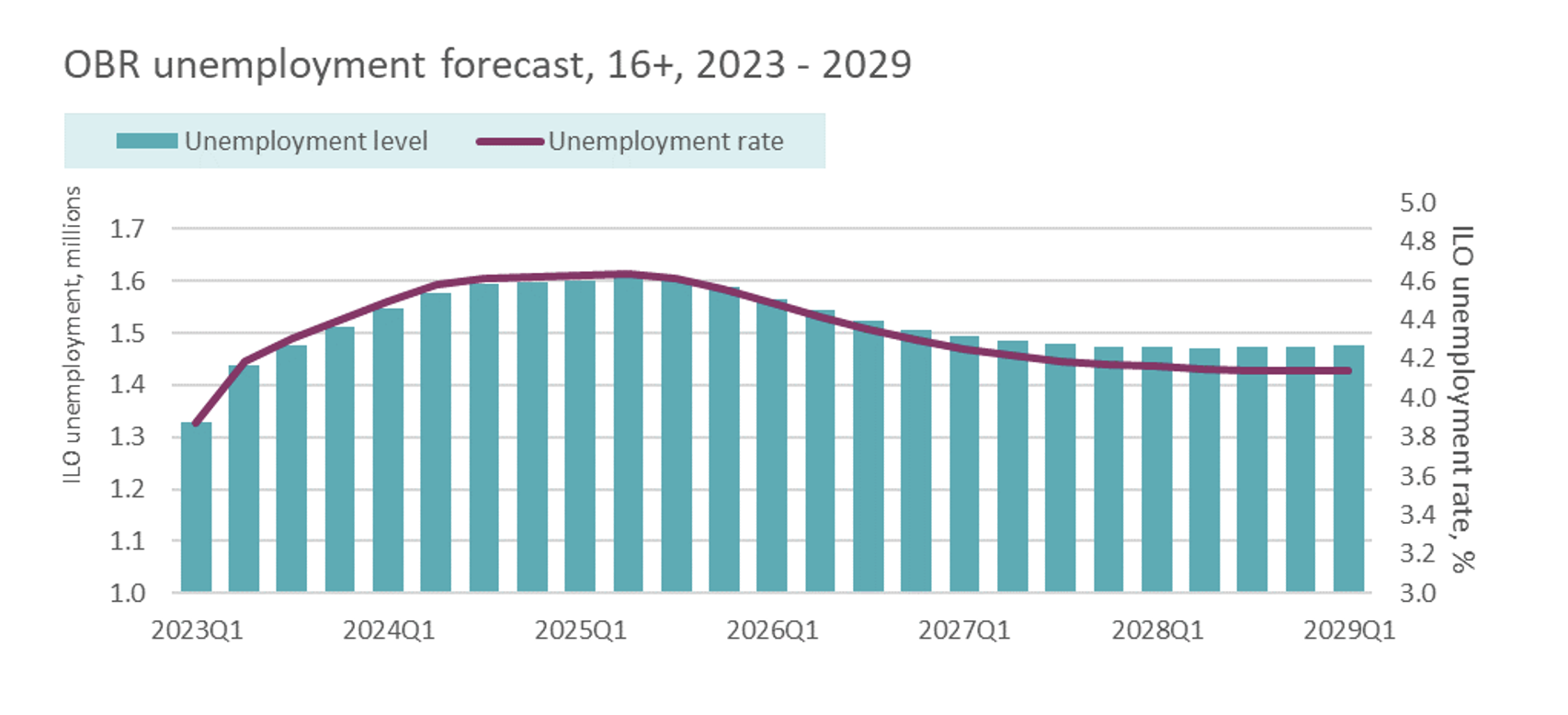
The OBR has also predicted that unemployment will steadily rise from now until midway through 2025, estimating there will be 275,000 more people in unemployment than at the start of this year. At no point in the OBR forecasts do they predict unemployment will fall below the level at the start of the year.
It is unfair to put it mildly to penalise individuals for an economic climate which is out of their control. The Chancellor decided to support compulsory work placements, but analysis show this punitive policy does not result in an improved employment outcome.
Skills
The Government plans focus largely on reforms coming in for 16-18 year olds, overlooking the skills gap faced by those already in the labour market. On apprenticeships £50m for a 2-year pilot widely misses the mark. In 2021/22, there were approximately 349,200 apprenticeship starts in England – a 31% decline from the pre-Apprenticeship Levy figures of 509,400 starts in 2015/16 (Source: CIPD). The funds are largely directed at male-dominated sectors, according to the Women’s Budget Group. Other measures are recycled and/or small – though the increase to the pitifully low apprenticeship minimum wage is be welcomed.
Little has been done to reverse cuts to adult and further education budgets since 2010, with spending still significantly below where it was when the government took office. Celebrating an uptick in Level 4 apprenticeships just repeats the ‘virtuous cycle’ where those with the highest levels of qualification receive the most investment in their training. Graduates get most of the training as working adults, and almost half of adults from the lowest socio-economic group receive no training at all after leaving school.
Social security
It is a low bar for this Government when they boast that benefits are being uprated in line with September’s rate of inflation, which is standard practice. Though they have severed the link between inflation and the uprating of benefits numerous times since 2010 – which has slashed vital financial support for families.
And while the Local Housing Allowance has been restored to the 30th percentile after it was last frozen in 2020, it will be frozen again and support reduced for ever-increasing rental prices.
There were also significant cuts to benefit entitlements for some people with long term health conditions. They are expected to lose £400 a month compared to current system, and face the threat of sanctions to enter employment.
The rate at which prices are increasing may have slowed, but families are still struggling with the essentials. Over the last two years the cost of energy has increased by 49 percent while food prices have increased by 28 percent.
Energy prices
And energy bills are a glaring omission from this Autumn Statement.
Household energy bills remain 50% higher than they were in the winter of 2021-2022 (approximately £600 higher for an average household). This means that an estimated 6.3 million households are in fuel poverty (spending more than 10% of their income on energy), and more than 1 million households are in extreme fuel poverty (spending 20% or more of their income on energy). (Estimate by Friends of the Earth and National Energy Action as government data are not yet available.)
Energy prices are expected to remain high or increase. Ofgem today raised the domestic energy price cap by 5%, based on wholesale price volatility.
Many employers will also struggle with rising and volatile energy bills. The UK consistently has some of the highest electricity prices for business in Europe, affecting the ability of UK manufacturers to compete internationally. Unions representing manufacturing workers have consistently campaigned alongside employer bodies for measures to rein in excessive and volatile wholesale energy prices – but these issues seem to be far from the list of priorities of the current Government.
Public services and public finances crises continue
As the OBR gently warn, “it is worth dwelling for a moment on something the Chancellor didn’t announce in his Autumn Statement – which is any major change to departmental spending plans despite significantly higher inflation”.
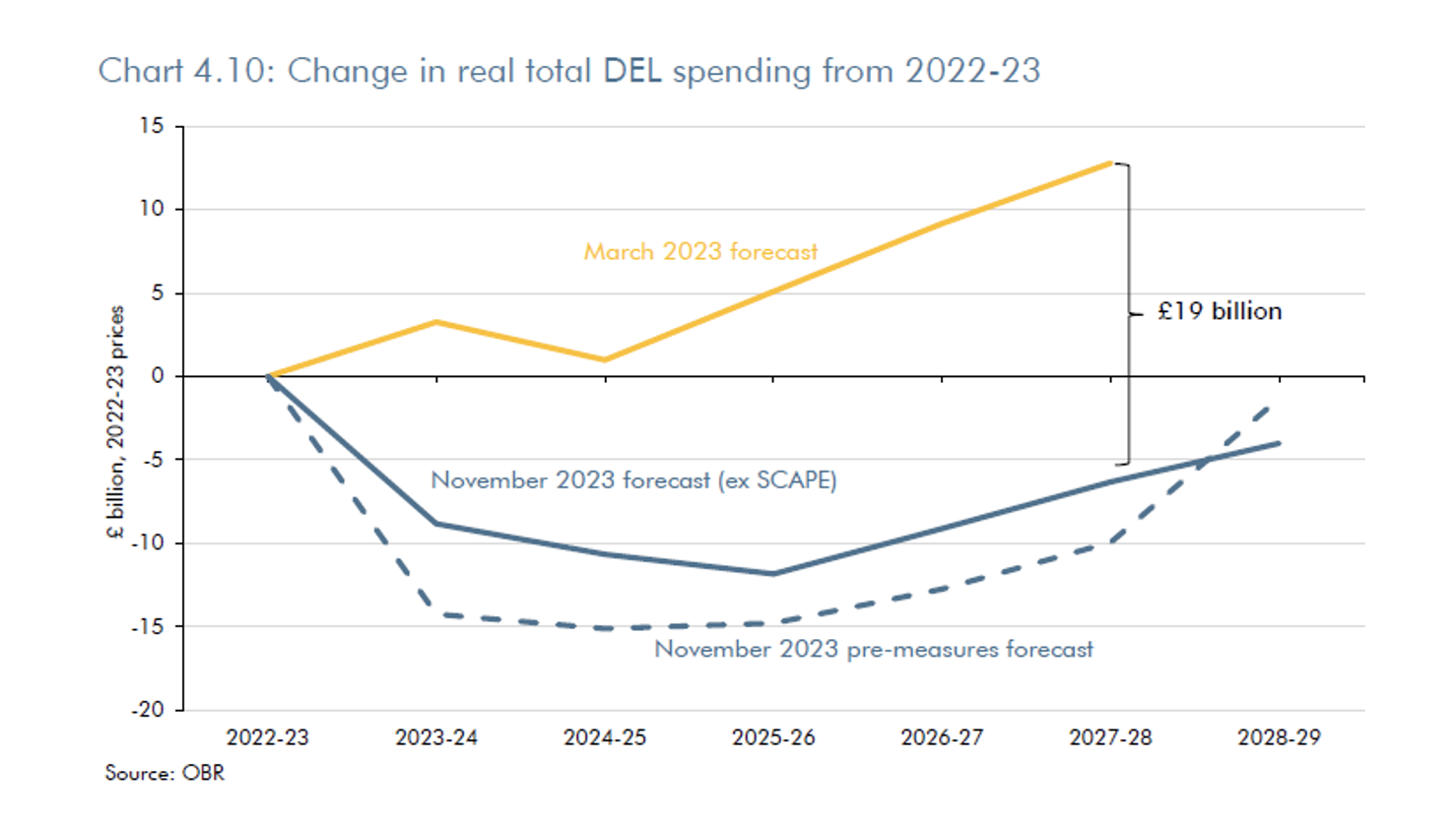
The government has added “just” £5 billion a year in cash terms to departmental budgets, and this means that “the real spending power of these budgets is eroded by around £19 billion” relative to the previous forecast (as on their chart below).
In 2023-24 the increased budget is allocated for public sector pay increases (£3.9 billion for the NHS in 2023-24, and £0.4 and £1.4 billion for other departments in 2023-24 and 2024-25, respectively). Overall, the OBR have departmental spending growing by 0.9 per cent a year in real terms, down from 1.1 per cent at the March Budget.
Given the government’s political priorities on spending, the OBR stress that unprotected departmental spending is projected to fall by between 2.3 and 4.1 per cent a year in real terms from 2025-26. They wryly observe this (austerity) would “present challenges” and cite the Institute for Government’s recent report finding that “performance in eight out of nine major public services has declined since 2010”. Plainly there is no intention to resolve the crisis in public services and public service recruitment. And ultimately
The public finances overall
For the public finances as a whole, the government has enjoyed a momentary windfall – with less bad than expected growth outturn and higher inflation meaning tax gains (especially with tax thresholds not being uprated) outweighing higher interest and other costs. This has been spent on the NI cut and expensing.
But the Chancellor has made hollow boasts about the improved condition of the public finances. The overall management of the economy for 13 years has meant a disastrous failure for them. Immediately less bad GDP outcomes (next section) have meant marginally improved ratios for this statement. But overall the Conservatives have presided over a huge increase in debt from 65 per cent of GDP in 2009-10 to 98 per cent of GDP in the current financial year. This is an unprecedented deterioration relative to all economic cycles for more than a century.
Growth crisis unended
At the end of his speech the chancellor proclaimed an “Autumn Statement for Growth”. But nothing announced yesterday changed the bottom line. While the forecasts reflected ONS revisions to GDP data and a less bad than expected 2022, growth over the next two years is revised steeply down. And on a medium term view the OBR warn:
“we have revised DOWN our estimate of the medium-term potential GROWTH rate of the economy to 1.6 per cent, from 1.8 per cent in March” (our emphasis)
Of the onslaught in policy measures, the most prominent was making permanent the full expensing of business capital investment. The Chancellor chose to disregard OBR analysis showing both precursor measures (the super-deduction and temporary full expensing in the March 2021 and March 2023 Budgets) had a lower impact on investment levels than predicted (see OBR, Economic and Fiscal Outlook, November 2023, pp 33 – 34).
Introducing full expensing is forecast by the OBR to lead to an increase in business investment of £14 billion between now and 2028-29 and to cost £29.5 bn over the same period. This would appear then to be an extremely inefficient means of increasing business investment, reflecting huge ‘deadweight’ effects, whereby businesses gain generous tax relief on investment that would (likely) have taken place anyway.
The OBR estimates that the measure will raise the capital stock by 0.2 per cent by 2028-29 – a positive, but small, and very costly impact.
Pension saving
The chancellor also had high hopes for the role workers’ £2.5tn of pension savings could play in boosting our flagging economy. But while there were some welcome steps such as setting up a new growth fund through the British Business Bank the plans rely mostly on merging pension schemes in ways that are unlikely to be in the interests of their members, and leaning on funds to put more money into global private equity. These measures were also over shadowed by a poorly thought through proposal to upend the workplace pension system. See our fuller commentary here.
Industrial strategy?
As the Chancellor noted, the lack of long-term certainty over policy decisions (including industrial strategy, taxes, and climate commitments) is a drawback to business decisions to invest. But there was no reassurance in the Autumn Statement that the Government would provide that certainty. While reannouncements of investment commitments to support the automotive, advanced manufacturing, and energy sectors – amounting to £4.5 billion are welcome, this represents only a small proportion of the investment requirements of the Biden-style industrial strategy that the UK needs.
Ending the failure
The failure – as Labour have repeatedly identified – is still a failure of growth. The government need to invest in a stronger economy where growth and fairness go hand in hand, where decent pay means workers spend and businesses produce to meet that spending. A virtuous cycle comes when businesses invest in the face of expansion and optimism, and stronger public services re-enforce the upward dynamic. Fairer and sustainable growth will then support the public finances.
Yet the government continues to take us in the wrong direction. Yesterday’s Autumn Statement showed more strongly than ever why it is time for a change.
Autumn Statement ‘ushers in new era of welfare reform’
A ‘bold new vision for welfare’ backed by nearly £30 billion has been set out by Work and Pensions Secretary Mel Stride
Millions of people will benefit from next generation of welfare reforms and extra support for those most in need, announced at Autumn Statement
Benefits increased by 6.7% and pensions by 8.5%, maintaining commitment to seeing the country through cost of living pressures
DWP Secretary Mel Stride heralds new era offering a “brighter future for millions”
The plans offer unprecedented employment and health support to help over a million people, while protecting those in most need from cost of living pressures – including raising pensions and benefits and increasing help with housing costs.
Long term decisions to provide unprecedented help for people to move off welfare and into work were at the heart of the Government’s plan for growth set out at the Autumn Statement.
While unemployment has been almost halved since 2010, the £2.5bn Back to Work plan will help thousands of people with disabilities, long-term health conditions and the long-term unemployed, to move into jobs. This comes alongside new guarantees for those on the highest tier of health benefits around keeping benefit support to cushion those who try work.
The transformative employment programme comes as the Government continues to protect the most vulnerable, delivering a Triple Lock-protected boost for pensioners and raising benefits in line with inflation next year, worth £20bn taken together.
The changes mean the full rate of the new State Pension will go up by £17.35 per week, while families on Universal Credit will be on average £470 better off next year.
Around 1.6 million households will also benefit from an increase to the Local Housing Allowance – and will be around £800 a year better off on average. Worth more than £7bn over five years, this commitment will support low-income families in the private rented sector with rent costs and help prevent homelessness.
Secretary of State for Work and Pensions, Mel Stride MP said: “Work changes lives. With the next generation of welfare reforms, we will help thousands of people to realise their aspirations and move off benefits into work, while continuing to support the most in need.
“We are taking long term decisions that will build a brighter future for millions, offering unprecedented support to open up opportunity and grow the economy, building on our record that has seen almost four million more people in work since 2010.
“Our reforms will remove the barriers to work that we know some people still face, while we’re boosting benefits and pensions to help with cost of living pressures.”
Welfare reforms announced at the Autumn Statement include:
Uprating working age benefits in line with September’s CPI index figure of 6.7%.
Uprating state pensions in line with September’s earnings figure of 8.5%.
Increasing the Local Housing Allowance to cover the 30TH percentile – worth an average of £830 per year.
Expanded jobcentre support including intensive help for those on Universal Credit
Introducing the Chance to Work Guarantee, which will tear down barriers to work for millions of claimants to try work with no fear of reassessment or losing their health benefit top-ups.
Increasing mental health support for jobseekers by expanding NHS Talking Therapies treatment and the Individual Placement and Support programme, supporting almost 500,000 over five years.
Matching 100,000 people per year with existing vacancies and supporting them in that role through Universal Support.
Rolling out WorkWell to support people at risk of falling into long-term unemployment due to sickness or disability.
Reforming the Work Capability Assessment for new health benefit claimants to better reflect the opportunities available in the modern world of work.
Stricter sanctions for people who should be looking for work but aren’t engaging with jobcentre support.
Building on the Mansion House reforms with further steps to improve private pension returns and grow the economy.
Introducing new Government powers to request data from organisations such as banks when accounts are showing signals of fraud and error.
The Government’s ‘radical new plan’ will stem the flow people falling out of work and onto inactivity benefits due to physical or mental health problems, as it takes the long-term decisions to help people realise their dreams to find a job and build a better life.
With this unprecedented level of employment support comes tougher enforcement of sanctions for fit and able people who should be looking for work but aren’t.
Work coaches will use tools to track people’s attendance at jobs fairs and interviews, and close benefit claims of those able to work who have been sanctioned and no longer receiving money after six months.
Taken together, the package will make sure those who are vulnerable or on the lowest incomes are protected, with intensive support to get them back into work, while ensuring fairness to the taxpayer.
The number of 50PLUS Champions helping older workers into work has been doubled in Jobcentres up and down the country, the Minister for Employment has announced.
Network of dedicated 50PLUS Champions across Great Britain is increased ahead of National Older Workers Week
This builds on millions invested to support the over 50s into work as Minister for Employment and B&Q back older workers
The number of 50PLUS Champions helping older workers into work has been doubled in Jobcentres up and down the country, the Minister for Employment has announced.
Ahead of https://www.nationalolderworkersweek.co.uk, 77 50PLUS Champions – up from 37 – are now in place across England, Wales and Scotland, working directly with Jobcentres and employers to remove barriers that are keeping older people out of work.
50PLUS Champions work with jobseekers to change preconceptions about hiring older workers and ensure Jobcentre staff are supporting jobseekers to find roles or opportunities tailored to their skills to deliver for employers.
There are 83,000 more over 50s in work compared to this time last year. The DWP is supporting older jobseekers, with Midlife MOTs both online and in Jobcentres, helping people assess their skills and, make long-term plans for their work, wealth and wellbeing.
The news comes following a recent visit made by the new Minister for Employment, Jo Churchill, to B&Q’s New Malden branch. The company prides itself on having a multi-generational workforce with 35 percent of staff being over 50.
Minister for Employment, Jo Churchill MP said: “I know that work brings benefits to all ages, whether that’s improved wellbeing, making important friendships, or earning more.
“As a Government, we are working hard to get more people into work and tackle inactivity.
“Doubling the number of our 50PLUS Champions means even more jobseekers can access tailored support.
“On this National Older Workers Week, I urge all businesses to step up and put age diversity at the heart of what they do.”
Andy Moat, B&Q’s HR Director added: “We were delighted to recently welcome the new Minister for Employment to B&Q New Malden for her to hear at first hand from some of our older workers the benefits of working.
“B&Q is a very multigenerational workforce, and we believe in creating an environment where people can grow, thrive, and truly be themselves.
“We do this in many ways, including through our Apprenticeship programme, and we have Apprentices aged from 17 to 70 years studying to gain new knowledge and skills to help develop their careers, whilst continuing to earn the same rate of pay as others doing their role.”
While in New Malden, the Minister saw first-hand how the business is supporting the over 50s into work, meeting with older Apprentices who highlighted the impact retraining can have on this age group.
The Government is investing £6 billion to tackle economic inactivity to get more people into work, including older people. This includes £2.5 billion announced this week as part of our Back to Work Plan, an ambitious package of employment support which will keep more people in work by helping them to manage their health conditions.
To mark National Older Workers Week, the DWP is organising numerous events across Great Britain, including jobs fairs in Oldham, Edinburgh, Bath and Newport all specifically targeted at jobseekers who are over 50.
“But our message is clear: if you are fit, if you refuse to work, if you are taking taxpayers for a ride – we will take your benefits away.”
Changes are part of the new Back to Work Plan which will help up to 1,100,000 people with long-term health conditions, disabilities or long-term unemployed to look for and stay in work.
Additional support comes alongside tougher sanctions for people who don’t look for work, as part of the next generation of welfare reforms.
Includes exploring reforms of the fit note system, expansion of available treatment and employment support, and formal launch of the WorkWell service to help people start, stay and succeed in work.
The Chancellor Jeremy Hunt and the Secretary of State for Work and Pensions Mel Stride will unveil their Back to Work Plan– a package of employment focused support that will help people stay healthy, get off benefits and move into work – as part of the Autumn Statement.
Building on the ambitious £7 billion employment package from Spring Budget the Chancellor is using his Autumn Statement to outline a new Back to Work Plan, which will expand the employment support and treatment available and reform the ways that people with disabilities or health conditions interact with the state.
Getting more people into work and ensuring work pays remains a key priority for the government. It is important for growing the UK economy, managing inflation, controlling spending, and improving living standards. Getting more people into good jobs is also good for those individuals and the best route out of poverty.
The government is boosting four key programmes – NHS Talking Therapies, Individual Placement and Support, Restart and Universal Support – to benefit up to 1.1 million people over the next five years and help those with mental or physical health conditions stay in or find work.
The new WorkWell service as announced at Spring Budget and delivered by the Departments for Work and Pensions and Health and Social Care is also being formally launched today and will support almost 60,000 long-term sick or disabled people to start, stay and succeed in work once rolled out in approximately 15 areas across England.
The prospectus that will be launched in the coming weeks will provide information for all Integrated Care Systems across England to develop their localised work and health strategy.
Ministers are also planning to trial reforms to the fit note process to make it easier and quicker for people to get specialised work and health support, with improved triaging and signposting. Since the pandemic the number of people inactive in the UK due to long-term sickness or disability has risen by almost half a million to a record high of 2.6 million, with mental health, musculoskeletal conditions and heart disease being some of the main causes.
Stricter benefit sanctions will also be enforced by the Department for Work and Pensions for people who are able to work but refuse to engage with their Jobcentre or take on work offered to them. Benefit claimants who continue to refuse to engage with the Jobcentre will face having their claim closed. The latest published data shows that there were 300,000 people who had been unemployed for over a year in the three months to July.
The announcement today forms part of wider plans to grow the economy expected in the Autumn Statement on Wednesday 22 November. The Chancellor is set to reveal a raft of changes to get the UK economy growing including getting people back into work.
Chancellor of the Exchequer, Jeremy Hunt, said:“We’re serious about growing our economy and that means we must address the rise in people who aren’t looking for work – especially because we know so many of them want to and with almost a million vacancies in the jobs market the opportunities are there.
“These changes mean there’s help and support for everyone – but for those who refuse it, there are consequences too. Anyone choosing to coast on the hard work of taxpayers will lose their benefits.”
Secretary of State for Work and Pensions, Mel Stride, said:“We are rolling out the next generation of welfare reforms to help more people start, stay and succeed in work. We know the positive impact work can have, not just on our finances, but our health and wellbeing too.
“So we are expanding the voluntary support for people with health conditions and disabilities, including our flagship Universal Support programme.
“But our message is clear: if you are fit, if you refuse to work, if you are taking taxpayers for a ride – we will take your benefits away.”
The plans announced today set out how the government will tackle long-term unemployment by supporting Universal Credit claimants to find work while strengthening work search requirements for job seekers through all stages of their Universal Credit claim.
As a result of these reforms, no claimant should reach 18 months of unemployment in receipt of their full benefits if they have not taken every reasonable step to comply with Jobcentre support.
The plans to tackle long-term unemployment include:
Testing Additional Jobcentre Support in England and Scotland – testing how intensive support can help claimants into work who remain unemployed or on low earnings after 7 weeks into their Universal Credit claim.
Extending and expanding the Restart scheme in England and Wales for 2 years – expanding tailored, intensive support to people who have been on Universal Credit for more than 6 months rather than 9, helping them to tackle barriers to entering employment through coaching, CV and interview skills, and training. The scheme will be extended for two years until June 2026.
Introducing a claimant review point – Universal Credit claimants who are still unemployed after the 12-month Restart programme will take part in a claimant review point: a new process whereby a work coach will decide what further work search conditions or employment pathways would best support a claimant into work. If a claimant refuses to accept these new conditions without good reason, their Universal Credit claim will be closed.
Rolling out mandatory work placement trials – through the claimant review point, claimants who have not yet moved into work by the end of Restart will be required to accept a job or to undertake time-limited work experience or other intensive activity to improve their employability prospects. Failure to do so at this stage will lead to immediate sanction, with the full removal of the Universal Credit standard allowance.
Stricter sanctions for people who should be looking for work but aren’t – including:
targeting disengaged claimants by closing the claims of individuals on an open-ended sanction for over six months and solely eligible for the Universal Credit standard allowance, ending their access to additional benefits such as free prescriptions and legal aid;
rooting out fraud and error using the government’s Targeted Case Review to review the Universal Credit claims of disengaged claimants on an open-ended sanction for over eight weeks, ensuring they receive the right entitlement;
digital tools to track claimants’ attendance at job fairs and interviews.
Plans set out also include expanding key health and employment programmes, to benefit over half a million people over the next five years and help those with mental health conditions stay in or find work:
NHS Talking Therapies – increasing the number of people benefitting from courses of mental health treatment by an additional 384,000 people over the next five years and increasing the number of sessions available.
NHS Talking Therapies provides evidence based psychological therapies including Cognitive Behavioural Therapy (CBT), for treatment of mild and moderate mental health conditions such as depression and anxiety disorders.
Individual Placement and Support (IPS) – aiming to help an additional 100,000 people with severe mental illness to find and keep jobs over the next five years. IPS is an employment support programme integrated in community mental health services. IPS employment specialists:
Work with people accessing the service to find them employment that matches their aims, interests and skills, and offer continued support once they are in post.
Integrate with the mental health team to support the individual with any issues that affect their work and recovery.
Build relationships with employers to negotiate job opportunities.
Universal Support in England and Wales – matching 100,000 people per year with existing vacancies and supporting them in their new role, an increase on the 50,000 people outlined at Spring Budget, also helping people with disabilities and from vulnerable groups.
Participants will access up to 12 months of personalised ‘place and train’ support. The individual will be supported by a dedicated keyworker who will help the participant find and keep a job, with up to £4,000 of funding available to provide each participant with training, help to manage health conditions or help for employers to make necessary accommodations to the person’s needs.
WorkWell – The service announced at Spring Budget 2023 is being formally launched to Integrated Care Systems across England and will help support people at risk of falling into long-term unemployment due to sickness or disability, through integrated work and health support. Integrated Care Systems across England will be supported to develop a localised work and health strategy, and then services will be provided in approximately 15 pilot areas.
Secretary of State for Health and Social Care, Victoria Atkins, said:“We know that tailored work and health support initiatives can help break down the kinds of barriers that can make finding and staying in a job more difficult for those with mental health conditions.
“Backing them with further investment means they’re more widely available, enables personalised help and will get thousands back to work by overcoming any issues that may be preventing them from fulfilling their career potential.”
Kate Shoesmith, Recruitment and Employment Confederation (REC) Deputy Chief Executive, said:“Today’s announcements will help the Restart scheme keep making a real difference to people’s work and life chances.
“It contributes to efforts to overcome our labour and skills shortages and to further growing our economy. Bringing public and private employment services together is vital to get people into work and not look back.
“Our own award-winning Restart scheme, which sees recruiters work with employability services provider Maximus, has helped place 1700 long-term unemployed people into work since 2021.”
Bereaved parents who lost their partner between 9 April 2001 and 8 February 2023 may be eligible for a backdated government payment even if they no longer have dependent children.
The Government extended eligibility for Bereavement Support Payment (BSP) and Widowed Parent’s Allowance (WPA) to cohabiting parents with dependent children in February. These benefits were previously only available to bereaved parents who were married or in a civil partnership.
The payments are designed to help with the financial impact of losing a partner and can be backdated to 30 August 2018. Anyone who had dependent children when they lost their cohabiting partner should check GOV.UK for more information.
DWP Minister Viscount Younger of Leckie said: “This change will help provide many more bereaved families with children access to the financial support they need through a profoundly difficult time.
“I would urge anyone who thinks they may be eligible to claim as soon as possible so that they can ensure that they benefit from these backdated payments.”
The Department for Work and Pensions (DWP) opened a 12-month window for cohabiting parents to backdate their claims. Parents whose partner died before 9 February 2023 have until the end of 8 February 2024 to do so. After this, it will not be possible to claim WPA and they will not get their full entitlement to backdated BSP.
Parents will be eligible for different benefits depending on the date their partner died. If they died before 6 April 2017, they would need to claim WPA. If they died on or after 6 April 2017, they would need to claim BSP, which has replaced WPA.
Payments can only be backdated to 30 August 2018, even if a partner died before this date.
Alison Penny MBE, Director of the Childhood Bereavement Network said: “Time is ticking on for the thousands of families that could be eligible for a back-dated payment but haven’t yet claimed. It’s crucial that we find them so they can make a decision about putting in a claim before the window closes and they miss out.
“We’re urging friends, families and support organisations to spread the word. Even if someone was bereaved a long time ago, it’s worth exploring whether they are eligible for a back payment.”
BSP claims can be made online, over the phone or through a paper application form. WPA claims are only processed by paper forms. These can be downloaded from the GOV.UK website or requested via the Bereavement Service helpline: 0800 151 2012.
Millions of people across the country are set to receive significant cost of living support ahead of winter, with the second instalment of the cost-of-living payment – worth £900 in total – landing directly in bank accounts from today
Significant cost of living support to come into effect from today as millions of households set to receive second £300 payment
Comes as £2 bus fare cap in England extended with millions of people also set to benefit from lower travel costs
Prime Minister continues to support families with the cost of living ahead of winter as we are on track to halve inflation
Millions of people across the country are set to receive significant cost of living support ahead of winter, with the government freezing bus fares in England and the second cost-of-living payment – worth £900 in total – landing directly in bank accounts from today.
The bus fare cap had been due to rise to £2.50 but the government is keeping the fares down at £2 until the end of next year to help millions of people make significant savings on their travel costs. The fare cap has helped cut bus fares in England outside London by 7.4% between June 2022 and June 2023, with even bigger savings in rural areas where fares have dropped by almost 11%.
This government says the extension is only possible due to the redirected HS2 funding as part of the Network North plan and takes the total government investment to keep bus fares down to nearly £600 million – with over 140 operators signing up to continue offering the cap across more than 5,000 routes.
Over 8 million households across the UK will also receive the second of up to three payments from today, totalling up to £900 through 2023/24 with a further cost of living payment due to be made to eligible households by next Spring.
These payments are entirely tax-free, will not count towards the benefit cap, and will not have any impact on existing benefit awards. Those who are eligible will be paid automatically and do not need to apply for the payment or do anything to receive it.
Prime Minister Rishi Sunak said: “I know that winter can be a particularly challenging period for many families across the country. That’s why we have put in place a package of immediate support for vulnerable households over the coming months.
“We are lowering travel costs through the bus fare cap, which we are able to do because of our long-term decision to cancel phase 2 of HS2. We are also providing an extra top up to help pay energy bills and direct payments to cover the cost of day-to-day essentials.
“But the best way to put more money in the pockets of hardworking people is to focus on the long-term decisions that will help not only them, but future generations too. We’re on track to halve inflation which will help people’s wages go further, and we’re growing the economy to create better paid jobs and opportunities across the country.”
The government is also committed to helping vulnerable households across the UK with their energy bills over winter. Winter Fuel Payments – boosted again this year by an additional £300 per household Pensioner Cost of Living payment – will provide pensioners with up to £600 to help with heating costs over the colder months.
On top of this, nearly three million low-income households are also eligible for a £150 rebate on their winter electricity bills through the Warm Home Discount. From tomorrow (1st November) Cold Weather Payments will also come into effect to provide eligible households £25 extra a week when the temperature is zero or below for more than seven days across the UK.
Transport Secretary Mark Harper said: “Buses are the most popular form of public transport and help people across the country get to work, attend medical appointments, and see loved ones – that’s why we are extending the ‘Get Around for £2’ scheme all the way to 31 December 2024.
“Extending the £2 bus fare cap has only been possible with the redirected HS2 funding secured by this Government making the right long-term decisions for a brighter future, delivering immediate benefits and helping people save money.”
Mel Stride, Secretary of State for Work and Pensions, said: “Tackling inflation is the best way to boost people’s incomes, but as we work to halve it, we are protecting the most vulnerable households from high prices with this latest Cost of Living payment.
“Thousands of Work Coaches based in Jobcentres across the country are on hand to help people find work or enhance their skills, and I encourage anyone wanting to strengthen their finances and unleash the benefits of work to contact their local Jobcentre to see what help is available.”
Taken together, these measures build on the significant cost of living support already provided to eligible households throughout last year – now worth an average of £3,300 per household over this year and last.
The government says it has also gone further by:
Increasing benefits in line with inflation, meaning more than 10 million working age families will see an average increase of around £600.
Maintaining the Triple Lock earlier this year to give around 12 million pensioners the largest ever cash increase to the State Pension.
Extending the Household Support Fund for another year in England to help families with essential costs with £1 billion of extra funding.
Increasing the National Living Wage by its largest ever cash amount for 2 million workers – worth over £1,600 to the annual earnings of a full-time worker – and committing to increase it to over £11 an hour from April 2024.
Cutting fuel duty by 5 pence and freezing the increase, worth £100 to the average driver this year.
Covering up to 85% of childcare costs for working households on Universal Credit, up from 70% under the legacy system – currently worth over £19,500-a-year for families with two or more children.
The government says it has ‘a strong record on supporting the most vulnerable and lifting households out of poverty’, with the latest data showing there were nearly 1 million fewer workless households since 2010 and 1.7 million fewer people in absolute poverty after housing costs over the last decade.
They maintain the best route out of poverty is through work, ‘which is why we’ve introduced a package of measures worth £3.5 billion to break down the barriers for people to find jobs and fulfil their potential. This includes our flagship Universal Support scheme which will get thousands more people into jobs with a personal adviser providing wraparound support for up to a year while they find their feet.
‘We encourage people in need of additional support over winter to check their eligibility through our Help for Households website for the various cost of living schemes that are place.’
Millions of households across the UK will receive £300 directly from the Department for Work and Pensions (DWP) between 31 October and 19 November
Millions of households to receive £300 from DWP between 31 October and 19 November 2023
This is the second of 3 payments totalling up to £900 supporting eligible people on means-tested benefits with the cost of living
Payments make up part of government’s record financial support for the most vulnerable worth an average of £3,300 per household
Tax credits-only customers who do not qualify for a payment from DWP will receive £300 from HMRC between 10 and 19 November 2023
Millions of households across the UK will receive £300 directly from the Department for Work and Pensions (DWP) between 31 October and 19 November.
This is the second of 3 payments totalling up to £900 for those eligible and on means-tested benefits, such as Universal Credit, Pension Credit, or tax credits, in 2023 to 2024, and eligible pensioner households will also receive a further £300 payment later this year as an addition to the Winter Fuel Payment.
The £300 Cost of Living Payment will be sent out automatically and directly to recipients, meaning those eligible do not need to apply, contact the Government, or take any action to receive it. This includes tax credits-only customers who will receive the payment from HM Revenue and Customs (HMRC) between 10 and 19 November 2023.
The payment reference for bank accounts will be the recipient’s National Insurance Number followed by DWP COL or HMRC COLS.
Mel Stride, Secretary of State for Work and Pensions, said: “The best way we can boost bank balances is by bearing down on inflation, but as we get there, we are ensuring the most vulnerable households are cushioned from high prices with a further Cost of Living payment.
“Alongside this, thousands of Work Coaches across the country are helping find work, increase their hours and boost their skills. I encourage anyone who wants to progress their career and strengthen their finances to visit their local Jobcentre to find out what help is available.”
Jeremy Hunt, Chancellor of the Exchequer, added: “Halving inflation and getting price rises under control is the best way to support households struggling with their bills.
“But it is also right that we are helping the most vulnerable in our society, and this latest Cost of Living payment is part of a package of support worth £3,300 per household on average over this year and last to help those struggling the most.”
The full list of benefit recipients that qualify for the second Cost of Living Payment are those who are eligible and receive at least one of the following:
Universal Credit
Income-based Jobseekers Allowance
Income-related Employment and Support Allowance
Income Support
Working Tax Credit
Child Tax Credit
Pension Credit
To be eligible for the Cost of Living Payment from DWP, you need to have been entitled to a payment for a qualifying benefit between 18 August 2023 and 17 September 2023, or payment for an assessment period, ending between these dates. From HMRC, you need to have received a payment of tax credits for any day in the period between 18 August 2023 and 17 September 2023.
The DWP continues to encourage low-income pensioners not already getting Pension Credit to check their eligibility, as – thanks to Pension Credit backdating rules – they could still qualify for both the second Cost of Living Payment as well as the third payment due in Spring 2024.
Over eight million pensioner households will also receive a further £300 payment later this year in addition to the Winter Fuel Payment.
Carer Support Payment will open for applications in pilot areas from November 2023, subject to parliamentary approval of regulations setting out rules and eligibility.
Adults living in Perth and Kinross, Dundee City and Na h-Eileanan an Iar, will be the first to be able to apply ahead of phased national rollout from Spring 2024. The benefit will be available nationally by Autumn 2024.
Carer Support Payment will replace Carer’s Allowance, currently administered by the Department for Work and Pensions, and will be provided by Social Security Scotland. It will be the 14th Scottish benefit and is a Programme for Government commitment.
More than 80,000 carers, will be able to receive the benefit in Scotland, including 1,500 carers who are currently unable to access Carer’s Allowance due to studying full-time.
Social Justice Secretary Shirley Anne Somerville said: “This 14th Scottish benefit feeds into our critical mission to reduce poverty and provide support those who are in the greatest need.
“Unpaid carers play a vital role in looking after their loved ones, but we know this can affect their own health and wellbeing. Carer Support Payment will provide unpaid carers with income in recognition of their caring role, giving them more security and helping them access opportunities outside of caring.
“Access to education is a key part of this, which is why we want to extend eligibility for our benefit to many carers studying full-time. I am pleased student carers will be able to apply as soon as Carer Support Payment is available in their local authority area, given the calls from carers and support organisations for changes to the current rules.
“This change and the delivery of Carer Support Payment will be a key milestone in our ongoing work to improve support for unpaid carers, and we are committed to further changes to make the benefit work even better in future.”
Disabled people and those with health conditions, who are currently being held back from improving their lives through work, will be better supported to realise their potential under UK Government plans unveiled yesterday.
As part of Government’s mission to support more people into work, the Department for Work and Pensions (DWP) has today launched a consultation on changes to the Work Capability Assessment, following the landmark Health and Disability White Paper published earlier this year
Changes represent the next step in welfare reform, reflecting the rise of flexible and home working and better employer support for disabled people and people with health conditions
Changes also reflect that one in five of those with no work preparation requirements would like to work at some point in the future, with the right support
A consultation, launched yesterday (Tuesday 5 September), will consider changes to the Work Capability Assessment, with proposals to ensure it is delivering the right outcomes for supporting those most in need.
The consultation will look at updating the Work Capability Assessment’s categories so they better reflect the modern world of work and the opportunities more readily available to disabled people.
Earlier this year, Government confirmed investment worth £2 billion to support disabled people and those with long-term health conditions into work, while delivering on the Prime Minister’s priority to grow the economy. Today’s consultation will go further to facilitate appropriate work opportunities for people, by reviewing a range of categories in the assessment – representing its first significant update since 2011.
These categories are designed to determine what activity people can do and how that affects their ability to work. This then informs assessors’ decisions on what additional financial support people can receive through their benefits, and if claimants need to do anything to prepare themselves for work.
The consultation’s proposals include updating the categories associated with mobility and social interaction, reflecting improved employer support in recent years for flexible and home working – and minimising the risk of these issues causing problems for workers.
Those who were found capable of work preparation activity in light of the proposed changes would receive tailored support, safely helping them to move closer to work and ensuring a significant proportion of people are not automatically excluded from the support available.
Prime Minister Rishi Sunak MP said: “Work transforms lives – providing not just greater financial security, but also providing purpose that has the power to benefit individuals, their families, and their communities.
“That’s why we’re doing everything we can to help more people thrive in work – by reflecting the complexity of people’s health needs, helping them take advantage of modern working environments, and connecting them to the best support available.
“The steps we’re taking today will ensure no one is held back from reaching their full potential through work, which is key to ensuring our economy is growing and fit for the future.”
Secretary of State for Work and Pensions Mel Stride MP said: “Health assessments haven’t been reviewed in more than a decade and don’t reflect the realities of the world of work today. That’s why we’re consulting on reforms which will mean that many of those currently excluded from the labour market can realise their ambition of working.
“Anyone helped towards work through these proposals would receive appropriate support tailored to their individual circumstances, allowing them to safely access the life-changing impacts that work can provide.”
Jane Gratton, Deputy Director of Public Policy at the British Chambers of Commerce, said: “Across the country, businesses are crying out for workers to fill job vacancies. Being employed has many positive benefits for people, so it makes sense to help everyone who wants to work to find a good job that meets their needs and personal circumstances.
“Employers understand this and want to be as flexible as possible to assist. To be effective, it’s crucial that, both sides, have the right support in place for as long as needed to help people find work, stay in work and have fulfilling careers.”
The UK Government is spending £25.9 billion on incapacity benefits this year, a 62% real-terms rise on 2013/14 (£15.9 billion), with current projections predicting a further 13% real-terms rise to £29.3 billion – with an extra 500,000 people coming onto these benefits – by 2027/28 if nothing changes.
This is fuelled in large part by the proportion of new claimants for incapacity benefits assessed as the highest possible award (no work-related requirements) rising from 21% in 2011 to 65% in 2022.
The Work Capability Assessment is being reviewed to ensure it reflects the latest opportunities for employment support, so that growing numbers of people are not missing out on the help available, particularly given the known health benefits from working. This is especially important when research shows that one in five of them would like to work at some point in the future.
Representing the latest step to support people with health conditions into work, this follows last year’s milestone of getting over one million more disabled people into employment compared to five years ago.
Minister for Disabled People, Health and Work Tom Pursglove MP added: “I am incredibly passionate about supporting disabled people to have the most fulfilling life possible, including through work, and these proposals would enable us to provide help to people who could benefit greatly from it.
“We will continue to look at ways to safely support more disabled people into work, unlocking all the positive wellbeing benefits that brings, whilst meeting the Prime Minister’s pledge to grow the economy.”
These proposed changes, due to come into force in 2025, come as part of the Government’s wider multi-billion pound plan to tackle inactivity and boost economic growth.
One of the measures the Government is also consulting on is the substantial risk category, where claimants who would otherwise be capable of work-related activity are excluded from work preparation requirements, on the basis that this could put them at risk to themselves or others.
The consultation will consider whether the application of this category is being applied too broadly, in turn excluding a significant number of vulnerable people from support that would prepare them to move closer to work, financial independence and a more fulfilling life.
This cohort could also benefit from the Government’s £2 billion investment to help those with long-term illnesses and disabilities get into work, and also from funding for work coaches to help people who need further support.
This includes the new Universal Support programme, which will help disabled people and people with health conditions by matching them with vacancies and providing support and training to help them start and stay in that role.
The DWP is also currently running a consultation on occupational health, which is looking at ways to encourage employers to expand their occupational health offer.
And the Spring 2023 Budget provided around £250 million of funding to modernise and digitise mental health services in England, providing wellness and clinical apps, piloting cutting-edge digital therapies and digitising the NHS Talking Therapies programme.