Is your child entitled to free school meal payments?

Families struggling to provide food for their children are being urged to find out if they are entitled to receive free school meal payments if they do not already receive them.

Funding from the City of Edinburgh Council and the Scottish Government means that free school meal payments for thousands of eligible families will continue over the Christmas holidays and both the February and Easter breaks next year.

In addition backdated payments were made yesterday (Monday 26 October) to support eligible families for the October break period, where the city council already hold their payment details. 

The Council is also issuing letters to parents/carers who have been identified as being entitled to free school meals but we do not have payments details for them – these families do not need to contact the Council.

The payments are paid to P1 to S6 children who receive a School Clothing Grant. 

Now the Council is urging families who may be missing out on the vital payments to check online to see if they are eligible. Those who already receive free school meals do not need to contact the Council.

The funding announcement comes after the Edinburgh Poverty Commission published their final report last month which highlighted that almost 15% of Edinburgh’s population lives in poverty, including one in five children.

The payment for free school meals reinforces the Council’s commitment to providing much needed support to families through such projects as the Discover! programme which aims to reduce food and financial insecurity during the school holidays and supported over 200 families last week.

Families took part in a number of online cooking, music and art sessions in addition to receiving a Discover! box containing fresh foods, art supplies, active schools kits and information on advice services as well as support with devices at home if they had no digital access.

Council Leader Adam McVey said: “This provides important support for families across the city and almost 6,500 young people have already benefited from free school meal payments covering the October break. 

“This Council and Scottish Government funding means that we’re helping families most in need over the winter months. These are extremely challenging times for everyone but no family should have to worry about how they’re going to put food on plates during the holidays or at any other time.”

Depute leader Cammy Day said: “As the city’s Poverty Champion I’m fully aware of the enormous struggles many people are experiencing so this vital funding means no families need to go hungry in Scotland’s Capital over the winter months.

“The Edinburgh Poverty Commission report highlighted that one in five children are living in poverty so we want to make sure that everyone who’s entitled to receive this financial lifeline can do so.

This is especially important as many families’ circumstances may have changed over the recent months with furlough and redundancies.

“Please check our online application form which outlines who is eligible for funding and apply before the end of November so we can process the payments as swiftly as possible.”

The application form for families eligible for free school meal payments is available on the Council website.

UK must not return to ‘broken’ mental health system after coronavirus is over, says Barnardo’s

The Government must use the coronavirus pandemic as a catalyst to fix the ‘broken’ children and young people’s mental health system so it works for each individual child.

This is the message from Barnardo’s, which says the lessons learned during the ongoing Covid-19 crisis must not be forgotten when it is, eventually, a distant memory.

It comes as young people who are supported by the UK’s leading children’s charity say they have had mixed experiences about the ways services have adapted during the pandemic.

This has included by embracing alternative therapies and the use of digital technology such as video calls to provide ongoing support to children.

Using technology has worked well for some children because they have more control over when and where they get support.

But others have found it difficult due to digital poverty, where they do not have a smartphone or internet access, which has put them at a considerable disadvantage.

Some have found it difficult to fully interact with professionals online, when they have been used to in-person, one-to-one support.

Barnardo’s says the Government has some good mental health policies, like the 0 to 25 promise in the NHS 10 year plan which will end the ‘cliff edge’ at 18, but it argues progress hasn’t been anywhere near fast enough and says young people simply cannot afford to wait.

It says the Government needs to learn lessons from the pandemic and must ensure that all the different ways a child can access support at the moment – whether that’s one-to-one support in person, through apps and video calls, alternative therapies, or a combination of all of these – are still available once the Covid-19 crisis is over.

Support needs to be tailored to the needs of the individual, rather than being a one-size fits all approach.

And it needs to ensure there is long term, sustainable funding for children’s mental health to rebuild the system from the ground up with children and young people at the heart.

One of the young people supported by Barnardo’s, and who has worked with the charity to ensure the views of her peers are heard, is Tia, from Plymouth. 

Tia said: “It’s vital that the Government listens to young people about our experiences of mental health services during the pandemic and involves us when looking at how they should operate in the post-Covid world.

“There cannot be a one size fits all solution. What is right for one child will not be right for another. While some have embraced alternative therapies and getting support online, others have struggled to access services.

“It’s important for us to have a say in helping shape services so they work for each individual.”

Barnardo’s Chief Executive Javed Khan said: “Even before the pandemic the system was failing too many children and young people with mental health needs. Instead of going back to a broken system, we need a radically new approach. 

“We need to identify and support children earlier, before they reach crisis point. We need to end the ‘cliff edge’ at 18, where help often drops off. And we need to make sure every child and young person can access the type of help that works for them – whether that’s digital, support in the community, alternative therapies, or traditional cognitive behaviour therapy. 

“This generation is facing a unique set of challenges, and improving their mental health and wellbeing is a vital step towards the positive future they deserve.” 

Mental health is at the heart of Barnardo’s work across all of its more than a thousand services across the UK.

It also supports more than 40,000 children, young people, parents and carers through its commissioned UK-wide mental health services – including 28,700 children through its school-based programmes aimed at improving emotional health and wellbeing. 

This mental health work is partly funded thanks to the generosity of the players of the People’s Postcode Lottery, who have raised over £4million for Barnardo’s so far.

Children asked to share their views on Child Rights Bill

Care experienced children and young people are among those who will have the opportunity to give their opinions on new legislation which would incorporate an international human rights treaty into Scots law – in a Zoom chat with MSPs.

Virtual calls hosted by children’s rights organisations will allow children and young people from a diverse range of groups across Scotland to meet privately with members of the Scottish Parliament’s Equalities and Human Rights Committee, which is seeking views on the United Nations Convention on the Rights of the Child (Incorporation) (Scotland) Bill.

Their comments will form part of the evidence to the committee in its scrutiny of the legislation, which would allow children and young people to take public bodies to court for breaches of their rights.

The Bill legally obliges public authorities – including Scottish Ministers – to respect children’s rights, placing them under a duty not to act incompatibly with the UN Convention, while Ministers will also be required to make a Children’s Rights Scheme to set out how they will comply with the duty.

Children and representatives acting on their behalf will be able to challenge public authorities in court for infringing their rights, and the new legislation will allow the courts to strike down legislation that is incompatible with any UNCRC requirements.

The Bill also provides new powers to the Children and Young People’s Commissioner in Scotland (CYPCS) to litigate in the public interest, which would enable the Commissioner to take cases to court on behalf of children and provide advice to courts about the Convention.

Committee Convener, Ruth Maguire MSP, said: “This legislation has the potential to transform the way public bodies approach the needs and rights of children in Scotland. It is therefore vitally important that we hear from those children who, by reason of ethnicity, gender, religion or disability, are most likely to face discrimination and who may not normally have an opportunity to express their views.

“Online meetings facilitated by organisations that work with care experienced children, young people within the criminal justice system, children with disabilities or other additional support needs, as well as young LGBT people and BAME groups, will allow members of the committee to learn more about the experiences of children and young people and the issues they have to deal with in their daily lives.

“We want to know what barriers they face and what they think should be done to make sure their rights are respected.”

A facilitator’s pack developed with children’s organisations provides groups with activities to help them respond to the consultation. Education resources are available for primary and secondary schools to explain the Bill and Committee process and invite pupils to take part in the consultation. British Sign Language users will also be able to contribute to the Committee’s evidence-gathering by sending in videos with their views.

The closing date for responses to the call for views is midnight on 20 November 2020, which is Universal Children’s Day, marking the day on which the Declaration of the Rights of the Child was adopted in 1959.

The private virtual calls will be hosted by: Who Cares? Scotland; Aberlour; Children and Young People’s Centre for Justice; Scottish Commission for Learning Disability; LGBT Youth Scotland; and Intercultural Youth Scotland.

Together (Scottish Alliance for Children’s Rights) is also hosting virtual calls with the following organisations: The Children’s Parliament; Licketyspit; Children in Scotland; Scottish Youth Parliament; Youth Link Scotland; Barnardo’s Scotland; and Carers Trust Scotland.

Seven ways to control screen time and improve wellbeing

Overuse of technology and excessive screen time for Brits can be detrimental to physical and mental health, so here are seven ways to reduce screen time:

The coronavirus pandemic has changed the way Brits stay connected with friends, family and colleagues, as we have been kept physically apart.

We are all spending more time at home and staying connected virtually, but it can be hard not to have an entire day consumed by technology.

The experts at CE Safety have researched and revealed seven easy to action tips to help reduce screen time and improve Brits wellbeing.

CE Safety recommends undergoing small but effective day to day changes such as taking fewer pictures, switching electronics to grayscale, and having tech-free zones around the house like the bathroom.

Research has shown that low levels of happiness are associated with increased smartphone usage, and social media can contribute to feelings of loneliness.

Excessive technology and smartphone usage also negatively impacts sleep. With heightened anxiety and stress due to the coronavirus and lockdown, additional screen time will not help.

A spokesperson for CE Safety says: “Technology does solve many problems and can help with communicating with people. There is also an endless amount of information at our fingertips.

“But it can be distracting, time-consuming and addictive. Nomophobia is a real term to describe a growing fear in today’s world—the fear of being without a mobile device, or beyond mobile phone contact.

“We think everyone should be more aware of their technology and smartphone usage, and look to make small changes to improve their screen time, and ultimately improve their wellbeing.”

Establish tech-free zones.

There are a few locations around the house that mobiles and laptops aren’t needed. From the dining room to the bathroom, try to keep your phone in your pocket. Our parents and grandparents survived just fine without taking a phone to the bathroom.

Switch to grayscale.

Laptops and smartphones allow you to turn your screen or display grey. As a result, this will remove all the attractive, eye-catching colours from your screen. Not only is it better for your eyesight but the visual appeal is also lost.

You can even schedule greyscale or ‘night mode’ across devices now to help soften the colours your eyes consume before bedtime.

Don’t take as many pictures.

Taking pictures with your smartphone has become second-nature. A birthday party, sporting event, and holidays are all picture worthy events and Brits tend to snap at every opportunity. But in an effort to reduce your screen time, try not to take as many photos and cherish the moment for what it is, rather than turning to a smartphone at the first opportunity.

Be aware of your screen time and set time limits

Ignorance is bliss, but in this case, we’d advise making the effort to track the time you actually spend staring at screens each day. There are plenty of tools and apps that will do this for you, and iPhones track your screen time automatically and tell you how many minutes you are spending on each app.

Many Brits might be surprised at just how long they spend glued to the screen. What else could you do with that time? Go for a run? Do some cooking? Read a book?

Don’t watch the TV in bed

Try and watch TV or films from your living room rather than in your bed. Watching from your couch makes it easier to stop watching that next episode on Netflix. You want as little blue light as possible before going to bed. Also, try and turn off the TV when you’re not actually watching it.

Don’t charge your phone in the bedroom

We advise not to charge your phone next to your bed as it might tempt you to check for messages. Looking at your phone’s screen just before bed has been shown to disrupt sleep patterns.

Get your news in one place

The internet provides us with a wealth of ways to access news. But trawling through social media and news headlines to make sense of the latest events can keep users glued to the device. Try and find a reliable news source you like, and stick to it.

Still time to sign up for Family Fun Day

A virtual fun-day with activities for children and advice for parents is being held during the school holidays as part of a campaign launched to support families in Edinburgh.

The All of Us family fun day on Thursday, October 22, will have 15 online sessions, including story time, children’s yoga, a scavenger hunt and advice for one-parent families, which are being put on by organisations from across the city.

Some sessions will be hosted on Facebook, while people will need to sign up for others in advance.

All of Us was launched by NSPCC Scotland and Edinburgh Child Protection Committee earlier this year to help people find out where to get support and advice with parenting or other worries about family life and where to turn if they had concerns about a child.

At the start of the year a number of community events were held across the city but further ones were cancelled because of Covid-19, and all activities were moved online, including the family fun-day.

In April, the partnership brought together information on its web page about organisations and contacts where families could go for help and support during lockdown. This resource has continued to be regularly updated.   

Carla Malseed, NSPCC Scotland local campaigns manager, said: “Because of the pandemic, this year has been extremely difficult for so many families, who have faced financial pressures, relationship strains, isolation and ill-health.

“But we want people to know that support is still out there and if they or someone they know is struggling then it is important they feel that they can seek and get help.

“Our family fun-day, as well as providing some enjoyable activities for children and parents during the school holiday, will be an opportunity for adults to get some advice, such as how to help keep kids safe online.

“There are still spaces left, so please look on our website and find out about the different sessions we are running.” 

Jackie Irvine, Chair of the Edinburgh Child Protection Committee, said: “Protecting young people and supporting families remains a priority for us, and we want everyone across the city to be aware of where to turn for help if they or someone they know is struggling.

“And we really hope people will join us for our fun-day, which has a wide range of activities for children and some advice for parents. We are really pleased to see so many local organisations taking part.”

The campaign is also raising awareness among communities and professionals about the early signs of child neglect and how to help families who are struggling. Two new webinars have been produced about the role that everyone can play in preventing neglect and helping to raise happy healthy children in Edinburgh.

One of the webinars is designed for parents and wider community members and describes what neglect is, its causes and signs and what people can do if they are worried about someone else’s child or need some support themselves. The other is for professionals and gives some insight into working with families in Edinburgh.

The 20-minute long webinars, which are free and can be watched until 28 February, 2021, can be accessed here.

To find out more about our fun-day programme visit www.edinburgh.gov.uk/allofus. People will need to sign up for some events in advance and the session organiser will then contact them with details of how to take part on the day.

For parenting advice and support visit NSPCC helpline or call 0808 800 5000, weekdays 8am to 10pm and weekends 9am to 6pm. People can also contact Social Care Direct on 0131 200 2324.

To find out more about the campaign visit www.edinburgh.gov.uk/allofus 

Curtains Up: transformation at Sick Kids

A transformation has been afoot at the Royal Hospital for Sick Children this week.

Capital Theatres’ Learning and Participation Coordinator Cat Sheridan has been working with Edinburgh Children’s Hospital Charity’s (ECHC) arts team at the hospital to tempt those who can climb out of their beds to transform their space into one filled with their own stories and imagination.

A continuation of a brilliant established relationship between Capital Theatres and ECHC throughout 2020, Curtains Up is a brand-new project which brings a bit of old school overhead projector fun to bedsides, creating unique and playful scenes on the inside of hospital curtains.

The children created original drawings which have been projected and traced onto their hospital bed curtains, proudly displaying their art to their families and the rest of the ward. Curtains Up gives children autonomy over their environment while staying in hospital, creates a child centric environment and fosters creativity between families and staff.

Mackenzie and Cat Sheridan working together on Curtains Up

Cat Sheridan, Learning and Participation Coordinator at Capital Theatres, said: “We are hugely excited to be back working in partnership with Edinburgh Children’s Hospital Charity on this project.

“It has been a real treat for me to deliver on the wards, working with fantastic staff and being greeted by so many smiles. The joy is in seeing children and their families grow in confidence, take charge and have so much fun! Our aim is to encourage creativity and boost their sense of well-being. All through transforming something as simple as curtain with a bit of imagination.”

Fiona O’Sullivan, Deputy Director of Children’s Wellbeing, said: “The visits from Capital Theatres always prove hugely popular with children and young people in the hospital so we are very excited to welcome them back for the Curtains Up project.

“Decorating their hospital space is a fantastic and fun way for children to get creative and make their bedside environment feel a little less scary and more like their own home. 

“We would like to say a huge thank you to Capital Theatres for getting involved with our vital arts programme as it’s projects like this one that enable ECHC to continue to transform the lives of children and young people in hospital.”

Lesley-Ann, play specialist, said: “It was such engaging activity for the older age groups to do. It’s something thing different and was so nice to see them engage with it so much. Nancy went away with big a smile on her face, she was totally loving it!” 

Nancy and her mother

Ghosts needn’t be toast!

How to enjoy Halloween during lockdown 

With different parts of the country under different lockdown rules, the idea of celebrating Halloween may seem an impossibility. But Catherine Lynch of education experts PlanBee says you can keep your children spooked out – and stay within the law.

Halloween 2020 is going to be a bit different to previous years. Groups of children putting their hands into several bowls of communal sweets feels like something from another life. But we can incorporate dressing up, community spirit, an evening walk and trick or treating while observing social distancing. Here’s how…

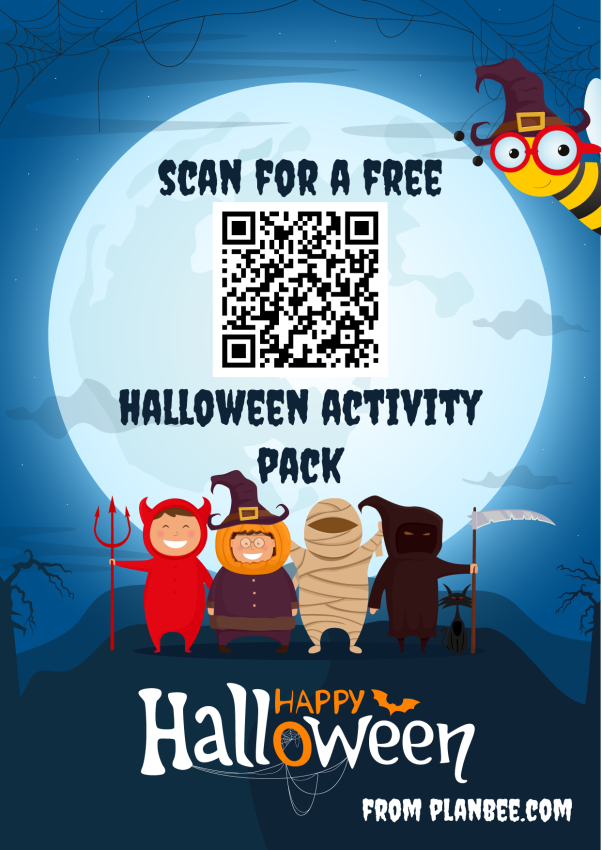
Many communities are organising a Halloween trail for their young trick-or-treaters. Instead of knocking door to door, why not take your children on a trail, too? If you would like to take part in a Halloween trail, or organise one yourself, you could put this spooky picture from PlanBee in your window.

Parents can scan the QR code in the picture to receive a free Halloween activity pack with colouring sheets, puzzles and activities.

Qr code

Description automatically generated

Take your children on walks around your local area and see how many Halloween pictures you can spot. You could give your child the chance to pick a treat from your own selection each time they spot a picture on the Halloween treasure hunt. 

And while you’re at it, this short guide to the history of Halloween will ensure you can answer any questions your youngsters might have about the origins of this popular autumn celebration.

  • It all started with Samhain, an ancient Celtic pagan religious festival that marks the end of the harvest and the start of winter. The celebrations included lighting bonfires and wearing costumes to ward off ghosts. This festival is thought to date back to Neolithic times, pre 2500 BC. 
  • In the eighth century, Pope Gregory III decided 1st November should be a time to honour all saints. The evening before All Saints Day was known as All Hallows’ Eve, and later Halloween. All Hallows’ Eve, is a Christian religious observance that includes going to church and lighting candles on the graves of the dead. Traditionally, Christians didn’t eat meat on this day and Potato Pancakes were a popular choice of food. 
  • Over time, Halloween became the more commercial and secular celebration we have today that includes trick-or-treating, carving pumpkins, wearing costumes and eating treats.

Clowning Around – an exciting new programme for Special Education Needs Schools

Hearts & Minds, award-winning charity and home of the Clowndoctors, is pleased to announce an exciting and fun new programme for special educational needs schools across Scotland.

Clowning Around is an art and play programme specifically designed for children with special educational support needs. Using the art of therapeutic clowning professionally trained artists engage children in play, music, dance, song, puppetry, games and storytelling. The Clowndoctors use improvisational skills and expertise in non-verbal communication and play to create tailored programmes to suit individual needs.

Clowning Around Programme

• Clowndoctor on Call: bespoke live interactive sessions delivered virtually by the Clowndoctors to individuals or a small group. • Clowndoctor Personalised Videos: Videos created for individuals or small groups. Tailored to suit the needs and interests of the children/young people.

• Clowndoctor in the Classroom: live visits in the classroom with the Clowndoctors. These will return when restrictions allow. 
• Laughing Around: Laughter Yoga workshop for staff. This fun practical workshop is designed to relieve stress, lighten the mood, and form positive connections.

Clowndoctor on Call virtual visits were developed in response to COVID 19 as face to face visits in the classroom had to stop and Hearts & Minds were determined to keep the connection with pupils & bring moments of joy and laughter into the classroom.

The virtual visits have begun at Fairview School, Perth where they have been a huge success with staff and pupils.

Leigh Verdot, Head Teacher of Fairview School said: “We are thrilled to still get our weekly fix with the Clowndoctors.  It is great to see the smiles and enjoyment from our pupils when they are engaging with the Clowndoctors on the ipads!

“Things are so different with COVID restrictions, so our weekly visits are one of the best parts of the week now.  All our staff are learning from the Clowndoctors too.  We couldn’t ask for a better start to the week!”

Rebecca Simpson, CEO of Hearts & Minds commented: “I am delighted to finally launch at our new school programme- Clowning Around. With 21 years’ experience of delivering our Clowndoctor programme it is exciting to be developing this work for schools across Scotland.

“The feedback we have received already has been overwhelmingly positive regarding the impact on the children. The programme is full of fun, laughter and creativity and will bring smiles to classrooms.”

The programme is open to all schools in Scotland who have pupils with complex learning needs and the programme can be tailored to suit the individual or a class. The team at Hearts & Minds will liaise with staff to provide a bespoke series of sessions.

For more information on Clowning Around visit:

https://www.heartsminds.org.uk/clowndoctors/clowning-around/

How to give children a taste for World Food Day

Watch out for World Food Day on Friday (October 16). The date commemorates the founding of the Food and Agriculture Organisation by the United Nations in 1945. This year’s theme is Grow, Nourish, Sustain, Together.

This is a great opportunity to do some fun activities at home with your children to give them a better understanding of how a sustainable supply of food relates to their own lives and the local area as well as those in far-away places. 

And the event is of particular significance this year because it takes place at a time when the COVID-19 pandemic threatens food security in many parts of the world. 

Former primary school teacher Oli Ryan of education resource experts PlanBee reports:

Four great ways to celebrate World Food Day 2020

1. Discover fascinating food facts

World Food Day Facts

  • Eight hundred million people around the world suffer from hunger.
  • In parts of the world where hunger is a big issue, life expectancy is shorter, infant mortality is higher, and productivity is lower.
  • Around the same number of people around the world suffer from obesity due to unhealthy diets.
  • Obesity kills more people than hunger.
  • Inefficient, unsustainable food systems harm ecosystems and contribute to global warming. Changing the way we produce food is key to tackling climate change.
  • As the climate changes, we will have to change the way we produce food: yields will decrease, and new food sources will have to be found.
  • In developed countries, tackling obesity would save hundreds of billions of pounds in healthcare costs.
  • In countries where hunger is an issue, eliminating hunger would dramatically increase productivity and national wealth.

2. Make it meaningful.

Food security and food poverty are significant issues in the UK too. It’s a good time to talk about food banks, free school meals and the importance of eating nourishing food for health, happiness and even for effective learning.

What is ‘food security’?
Food security means being having access to adequate supplies of food to live healthily. To have food security:

  • People must have enough money to buy food
  • Food must be affordably-priced
  • There must be reliable supply chains for food
  • There must be enough reserves of food, or reliable enough supply chains for a variety of foods, to ensure that access to food is not interrupted
  • The food available must be nutritious, so those who consume it can lead active, healthy lives

What are ‘sustainable food systems’?
Effective, sustainable food systems affordably provide an adequate amount of food to meet demand while also supporting the ecosystems they rely on for the production of food.

A good example are the new greenhouse system in Norfolk and Suffolk, set to produce 10 per cent of UK tomatoes.

The greenhouses will be heated by warm water pumped from nearby water treatment plants, producing far lower carbon emissions than traditional growing methods. It also reduces food miles and establishes a more reliable supply of food in the local area. Can you think of an example of a sustainable food system in your own area?

3. Link it to your local community

Church of England schools have a long-standing tradition of celebrating harvest festival by collecting store cupboard food items for the elderly and vulnerable in their community. This year, Sukkot, the Jewish harvest festival, is celebrated 2nd-9th October.

If there’s not much happening locally, why not arrange to do something to help those less well-off in your community? Find out where your nearest food bank is. Many will list the items they are most in need of each week on their website.

4. Make healthy, nutritious food together

Talk ‘around’ the recipe you choose to follow; for example, you might try to find out about the food journey of one or more of the ingredients. 

You can find out more about what’s happening during World Food Day 2020 by following the hashtags #WorldFoodDay and #FoodHeroes on social media.

For more activity ideas and resources for celebrating World Food Day, check out PlanBee’s World Food Day collection.

Former primary school teacher Oli Ryan is a senior member of the team at PlanBee, the education resources and lesson planning experts