If you’re curious to learn more about Lauriston Agroecology Farm – and especially about why we planted so many trees – come along to our farm tour on Saturday 1st February 11:30am (finishing 1:15pm with soup and bread).
Farming with trees (‘agroforestry’) was once commonplace, and nearly got swept away by large scale industrial agriculture and monocrop growing. We will share how we are reviving it here at Lauriston Farm, with all the hope and excitement this brings.
The farm tour will take in the:
– Community Orchard
– Woodland restoration area
– Agroforestry alleys (lines of trees that create sheltered and stable space to grow other crops, as well as bringing crops of fruits and nuts themselves)
You’ll hear from the folk who look after the trees on the farm – sharing what we’ve done, why we’ve done it, and what we’ve learned so far
+ then all return to the Community Kitchen for soup and chat.
Who is this For?
We welcome all curious visitors, including total newcomers, as well as farmers and growers and anyone interested in a career or volunteering in this type of work. This tour is aimed at adults or interested young people (the free community event in the afternoon is more suited to children).
Accessibility
This is a walking tour across the farm, lasting around 1.5hrs, potentially also suitable for all terrain/off road wheelchairs or mobility scooters, but not standard wheelchairs. The ground is rough, and will be wet and muddy in parts.
The standard rate ticket helps us cover our costs. We also offer solidarity options, so you can contribute more if you are able to, and take a discount if you need to:
Standard rate: £6
Solidarity +50% £9
Solidarity -50% £3
+ if the ticket cost is a barrier please get in touch with info@lauristonfarm.org as we have some limited free places available.
“Brexit a national tragedy that can be reversed,”says Scotland’s leading pro-EU group
2025 will see new Brexit barriers to British passport holders travelling for leisure or business. Exact dates for the start of new procedures are yet to be announced, but travellers need to be aware and have up to date passports if planning an EU trip.
First to arrive will be the EU Entry/Exit System, known as EES. A few months later sees the introduction of The European Travel Information and Authorisation System (ETIAS). Citizens of 60 nations, including the UK, will be subject to these new procedures.EU citizens and citizens of Schengen countries are exempt.
Because the UK chose to leave the EU and the European Single Market, Britain became a “third country.”
This means it is no longer in the EU, so British citizens don’t get the benefits EU citizens enjoy. Citizens of EU countries, including those resident in the UK, will not need an ETIAS certificate. Nor will they need to go through EES.
The dates for introducing the new procedures have yet to be announced. However, it is thought EES will begin operations during the first six months of 2025 and the ETIAS scheme will go live during the following six months. Best advice is to check with your travel provider.
David Clarke, chair of the European Movement in Scotland says the new rules and procedures show how badly misled voters were about leaving the EU. “People like Boris Johnson and Nigel Farage said there would be no downsides to leaving the EU. What we got was a smaller economy, less trade, less choice, dearer food and clothing and more complex and more expensive travel.
“Brexit is a national tragedy, but it can be reversed. We need to rejoin the single European market, as the first step to getting back what the Brexit side duped people into giving up.”
The ETIAS procedure will require all UK citizens (including children) to complete an online application, provide personal details, answer security questions and pay a €7 fee. This authorisation will be linked to the traveller’s passport and be valid for three years, or until the passport expires. The maximum permitted length of stay in any of the 30 countries operating the scheme is 90 days.
Known as a ‘short stay’ visa, ETIAS covers visits, holidays or business trips with a duration of up to 90 days and taken within a 180-day period.
People under 18 and over 70 are exempt from paying the €7 fee.
Those without an ETIAS will not be allowed entry into any one of the thirty European countries adopting ETIAS.
The EU Entry/Exit system is an electronic system that will replace the physical stamping of passports when you go through passport control when arriving at and leaving a destination. It will register all entries and exits, so it will register your movements every time you cross a border in or out of the EU/Schengen area.
The system will read traveller’s passports, take a picture and read a fingerprint (children under 12 are exempt from giving a fingerprint).
Which countries will the new rules apply to?
When EES comes in, these are the countries that will be using it:
Nationals of these countries/territories need to apply for an ETIAS travel authorisation:
Sight Scotland and Sight Scotland Veterans have unveiled an ambitious new three-year strategy, aiming to transform the lives of people with sight loss across Scotland. The strategy focuses on building an inclusive future where people of all visual abilities can thrive.
With over 180,000 people in Scotland impacted by vision impairment, the charities are determined to extend their reach, support, and influence to ensure no one faces sight loss alone.
Craig Spalding, Chief Executive of Sight Scotland and Sight Scotland Veterans, said: “We’ve been supporting people affected by visual impairment for over two centuries, but we know we can do more.
“Our new strategy is about building on our proud history to make sure we are ready for the future. Our vision is an inclusive Scotland where everyone, regardless of their sight, has the opportunity to thrive.
“By focusing on prevention, support, research, and campaigning, we will deliver real change for people impacted by sight loss, ensuring their voices are heard and their needs are met.”
Over the next three years, Sight Scotland and Sight Scotland Veterans will focus on five key areas:
Investing in impactful support that will prioritise initiatives that make the biggest difference to people living with vision impairment while securing the organisation’s long-term sustainability.
Putting its community at the heart of what it does by listening to and empowering people with lived experience of sight loss.
Campaigning for positive change. The charity will raise awareness of sight loss at both political and local levels, pushing for meaningful societal change.
Accelerating prevention and treatment by advocating for more investment to prevent avoidable sight loss and improve treatments.
Fostering a collaborative culture of innovation by investing in its workforce and fostering collaboration, the organisation will drive innovation and maximise its impact.
Craig Spalding continued: “We owe it to future generations to continue evolving. We want to reach more people, champion their needs, and invest in research that can transform lives.
“This strategy is our commitment to doing just that.”
Around 330,000 tonnes of edible food is wasted or fed to animals each year before leaving farms
Thousands of tonnes of food, including festive favourites like brussels sprouts and potatoes, that might otherwise go to waste will be delivered to those who need it most, thanks to a new £15 million UK government fund.
An estimated 330,000 tonnes of edible food is either wasted or repurposed as animal feed before leaving farm gates every year. While farmers would prefer for this to be destined for people’s plates, charities that redistribute food often lack the means to collect food from farms and get it to those who need it.
To strengthen the links between farms and charities and help solve the problem of farm food waste, a new scheme will see grants starting from £20,000 made available to the not-for-profit food redistribution sector in England. Throughout the year but especially over Christmas, the season of goodwill, this will help organisations like homeless shelters, food banks and charities fight hunger.
It will help British farmers to deliver good food for those that need it and reduce the costs they face when dealing with waste, while also increasing the capacity and capability of the redistribution sector to take on farm surplus.
UK Circular Economy Minister Mary Creagh said: “With families gathering to celebrate Christmas and the New Year, it’s important to remember those in our communities who may be going hungry this festive period.
“Nobody wants to see good food go to waste – especially farmers who work hard to put food on family tables across the country.
“Our new fund will help the charitable sector to work more closely with farmers, helping to find new opportunities to get their world-leading produce to those most in need within our communities.”
In a joint statement, Charlotte Hill, CEO of The Felix Project, and Kris Gibbon-Walsh, CEO of FareShare, said: “After years of campaigning by food redistribution charities, we are thrilled to see this fund come to fruition.
“We are pleased that the government has recognised that too much food goes to waste on our farms, and that it should be redistributed to feed people who need it.
“We look forward to acting quickly with the government, the charity sector, and farmers to maximise the impact of this initiative during British growing season, ensuring surplus food reaches as many people as possible.
“We have a proven model which funds farmers to redistribute their unsold food, which means that together, we can take meaningful steps toward achieving a zero-waste Britain.”
Harriet Lamb, CEO of global environmental NGO WRAP, said: “This is welcome support for farmers and redistribution organisations ensuring more quality food is rescued and can support more people and communities, while reducing the environmental impact of food waste on climate change.
“It gives a flying start to the New Year, ensuring that food charities and the farming sector can both make a difference immediately and can develop long term solutions. Every year, the amount of surplus food being redistributed is going up, but sadly the need is also increasing so this gives a much-needed boost.
“Last year, 191,000 tonnes of food from retailers, food manufacturers, the hospitality sector and UK farms – worth £764 million – was redistributed with the potential to make 450 million meals.”
The funding could go towards enabling successful applicants to buy new equipment, such as balers or hoppers, to allow bulky food items to be collected or processed into parcels, and technology to help donors and food redistribution charities work more closely. Money could also help provide more training to staff, to enhance their IT and food safety skills.
Information on when the fund opens and full eligibility criteria for applications will be confirmed in the New Year.
As set out in the Plan for Change, the government says it is delivering growth and economic stability for communities across the country. ‘We are supporting farmers to help grow the rural economy, while paving the way to a circular economy, where waste is reduced and growth is accelerated.’
To help end the throwaway society, the UK Government has formed a Circular Economy Taskforce, comprising of members from industry, academia, and civil society across the UK. They will lead on the development of a Circular Economy Strategy for England, which will be published next year outlining how individual sectors can contribute to ambitions in this area.
This is alongside continued support for the Courtauld Commitment 2030, managed by environmental NGO WRAP, which looks to deliver a more sustainable supply chain and reduce food waste in the home – tackling food waste, reducing greenhouse gas emissions and water usage.
Three people have been arrested in connection with pyrotechnics offences following incidents in Edinburgh yesterday (Boxing Day).
A 17-year-old and a 28-year-old man have been arrested and charged in connection with being in possession of pyrotechnics in the Haymarket area prior to the Hearts vs Hibernian match on Thursday, 26 December, 2024.
They are due to appear in court at a later date.
A 39-year-old man was arrested and charged in connection with setting off pyrotechnics in Russell Road. He too is due to appear in court at a later date.
Enquiries are ongoing in relation to four pyrotechnic smoke devices discharged within Tynecastle stadium during the Hearts vs Hibernian match on Thursday, 26 December, 2024.
Assistant Chief Constable Gary Ritchie said: “Setting off pyrotechnics in the street or within a sporting stadium is a criminal offence. I would ask people to think of the impact it could have on those around you, particularly people with medical conditions, young children and elderly.
“We will continue to work in partnership with football clubs to prevent fans from taking pyrotechnics into grounds and to pursue those who put other fans’ safety at risk.
“Anyone with information regarding persons using or being in possession of pyrotechnics is urged to contact Police Scotland on 101.”
Hibs came out on top in the Boxing Day derby match, beating their old rivals 2-1.
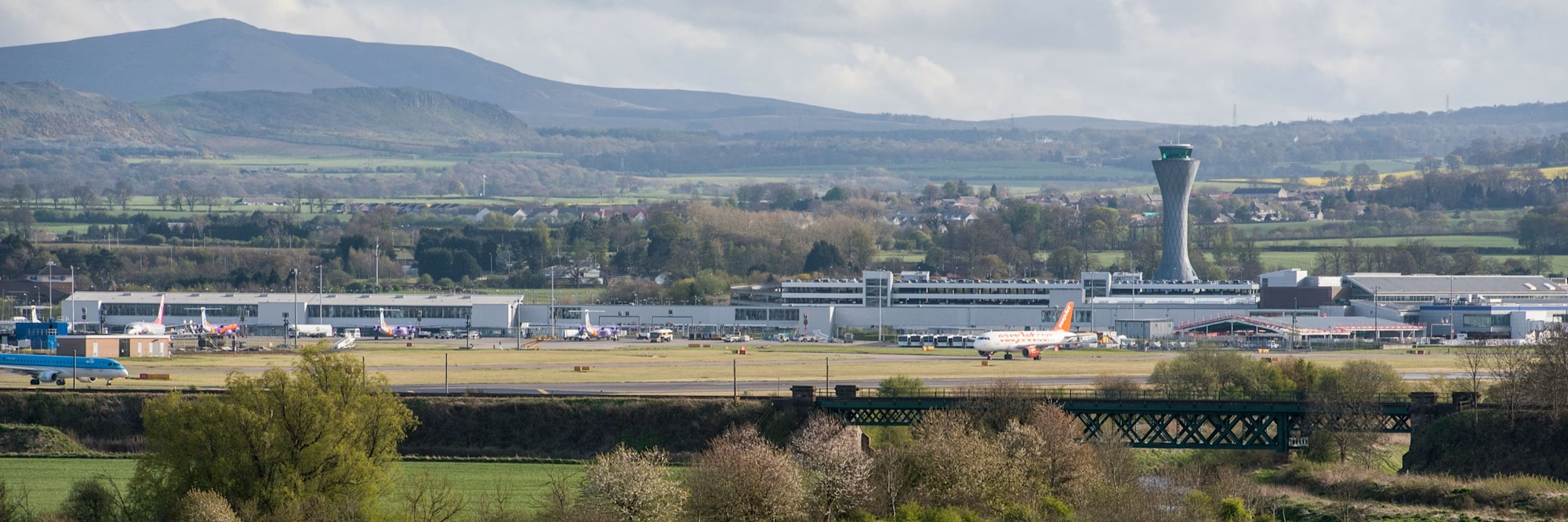
Edinburgh Airport, part of the VINCI Airports network, has welcomed a record 15 million passengers in a single year, a milestone achieved for the first time ever at a Scottish airport.
The milestone was reached earlier this month at Scotland’s busiest airport, marking the first time any airport in Scotland has recorded such numbers.
Edinburgh Airport is among the first airports in the UK to achieve growth in both passenger numbers and connectivity options following Covid.
The record-breaking year comes as the airport introduced new routes in 2024 and facilitated travel for major events. Key highlights include:
Emirates returning to Edinburgh with a daily service to Dubai.
JetBlue entering the Scottish market with daily flights to New York during the summer.
WestJet expanding its presence by adding Toronto and Halifax to its Calgary service.
Increasing frequency into and connections to Germany as the Tartan Army went to cheer on Scotland at Euro 2024.
Taylor Swift fans flying in from all over the world to attend her concerts at Murrayfield.
The airport has already announced new routes and airlines for 2025, such as the return of American Airlines and its Philadelphia route, JetBlue adding Boston to its options, and Austrian Airlines entering the Scottish market with its seasonal route to Vienna.
Work is also underway to improve facilities for passengers at the airport with an expansion to its check-in hall, and a range of new food and drink options being introduced in the coming months.
Gordon Dewar, Chief Executive of Edinburgh Airport said: “It’s great to hit this major passenger milestone that shows the clear interest that people have in tourism and travel, both to and from Scotland.
“Whether it was supporting Scotland at the Euros, being a Swiftie and singing your heart out at Murrayfield or travelling to a bucket list destination for that special holiday, we’ve been able to facilitate more than 15 million journeys this year at Scotland’s busiest airport.
“That’s an achievement that reflects the incredible spirit of our team, the excitement of our passengers to see the world, and the growing connections we’re proud to foster across Scotland and beyond. We’re already planning for 2025 and what it will bring, and we look forward to seeing even more people next year.”
Edinburgh-based renewable energy company donates £20,000 and time to local charity as applications for help reach record numbers
Red Rock Renewables and its Edinburgh-based team are proud to support Cash for Kids’ ‘Mission Christmas’ campaign for a second year running.
In addition to a £20,000 donation to the cause – funding enough gifts for around 800 children across Edinburgh, the Lothians, Fife & Falkirk – a group of employees also collected a huge haul of gifts and spent the day volunteering at the charity’s Mission Headquarters.
In the City of Edinburgh alone, 17,907 children are living in poverty (20.4 per cent of local children) – almost enough to fill Tynecastle football stadium.
Cash for Kids works to tackle child poverty all year round and is currently holding its annual Mission Christmas campaign to provide presents for local children who have been identified as being at risk of not receiving any gifts to open on Christmas morning.
This year, a record 23,368 local children have been applied for with just 2 days to go to ensure that every one of these applications is fulfilled.
Red Rock Renewables CEO, Xiaomeng Chen, said: “Christmas should be a joyful time for children, and it saddens us to think of those who may not have presents to open or something to look forward to.
“Our Edinburgh team is proud to support Mission Christmas again this year and help the dedicated Cash for Kids team spread joy this festive season.”
Charity Manager, Victoria Hendry added: “We cannot thank Red Rock Renewables enough for such a generous donation to our Mission Christmas campaign.£20,000 will allow us to ensure we have enough gifts to support hundreds of local children who would otherwise wake up to nothing at all for Christmas.
“Families are struggling for all sorts of reasons, whether they are living in poverty, homeless or fleeing domestic abuse and Christmas can increase the pressure they’re already feeling.
“By supporting Mission Christmas you are giving these children and their families more than just a gift, you are giving them special memories that will last a lifetime. They will know they are loved and cared for and that they haven’t been forgotten. Christmas will be a day that they receive a present and share the joy like everyone else.”
For more information on Mission Christmas and how you can support the campaign, visit www.forth1.com/mission
A member of NHS Lothian’s e-Health team is celebrating after winning two awards in a prestigious photography competition.
Thomas Lamont, Microsoft 365 Programme Manager, has scooped the People’s Choice Award in the Drone Category in the British Photography Awards, and has been named Scottish Aerial Photographer of the Year 2024/2025 at the Scotland Prestige Awards.
As a dedicated member of the eHealth team since 2007, Thomas spends his days contributing to the National Programme for the rollout of Office 365. By night, he transforms into “The Kilted Photographer,” capturing stunning images of nearby monuments, mostly with his drone, while proudly wearing his kilt.
The award-winning photograph showcases the National Wallace Monument in Stirling, near Thomas’s home, at sunset, whilst the monument was lit up orange to raise awareness of Battens Disease.
Thomas accepted his award at the prestigious ceremony held at the Royal Lancaster Hotel in London. In line with the awards’ charitable mission, he directed his contribution to the NHS Lothian Charity.
Thomas said: “It’s hard to put into words how I felt winning the award but probably shock, disbelief and happiness all at once. The calibre of other entries was fantastic! To be recognised in one of Britain’s prestigious photography awards for what I would say is my main tool for capturing photographs (drone) is incredible!
“I’ve always had a strong interest in photography, but it truly blossomed through a small camera club we had within eHealth/Digital. Photography has not only become a creative outlet but has also played a significant role in supporting my mental health and managing anxiety.
“Over time, I’ve expanded my knowledge, invested in new equipment, and ventured into drone and 360-degree photography.
“I also obtained my Operational Authorisation from the Civil Aviation Authority, which allows me to operate larger, more advanced drones in complex and challenging environments, such as city centres.”
If you want to have a look at more of Thomas’ photos, check:
From New Year’s Day 2025, National Galleries of Scotland is kicking off the 250th birthday of much-loved artist, Joseph Mallord William Turner (1775-1851), with a special celebration.
Visitors to the treasured Turner in January exhibition can marvel at a new selection of over 30 watercolours that have never been seen before in Scotland, in an exchange with the National Gallery of Ireland.
Turner in January: Ireland’s Vaughan Bequest, opens at the Royal Scottish Academy building in Edinburgh at midday on 1 January 2025. The free exhibition includes a watercolour of Edinburgh from 1801 that has never been displayed in the city before.
This once in a lifetime exhibition is a celebratory take on a keenly awaited and much-loved annual tradition that has been taking place since 1901.
Renowned art collector Henry Vaughan owned over 200 drawings, watercolours and prints by Turner, which he divided in his will between galleries in Edinburgh, Dublin and London. 38 of these watercolours were given to the people of Scotland, on the condition that they are only displayed in the month of January, when light levels are at their lowest. Because of this, these works still possess a freshness and an intensity of colour, almost 200 years since they were created.
Now, in an exciting exchange, simultaneous exhibitions will see Ireland’s Vaughan Bequest make a special trip to the National Galleries of Scotland, while Scotland’s Vaughan Bequest will go on display at the National Gallery of Ireland. Those familiar with Turner in Januaryare sure to notice how both collections complement each other. Visitors will be able to marvel in sweeping seascapes, dramatic landscapes and spectacular cities.
The most famous British artist of the 19th Century, Turner’s career spanned over 50 years. He experimented constantly with technique and colour, creating landscapes that still astonish today. In his younger years Turner toured Britain extensively, as war made travel to Europe impossible.
He first travelled abroad in 1802 and from 1819 onwards he undertook sketching tours abroad almost every year, visiting France, Belgium, Germany, Italy, Austria and Switzerland.
The panoramic Edinburgh from below Arthur’s Seat (1801) will be on display in the city it depicts for the first time. A moody view of Auld Reekie captured on Turner’s first visit to Edinburgh in the summer of 1801, dark storm clouds loom over Edinburgh Castle, rain pouring on the horizon as cows drink peacefully in the foreground.
When Turner first visited the Alps in 1802, the trip transformed his understanding of landscape, which was reflected in his boundary-pushing depiction of the mountains, rocks and glaciers.
In The Great Fall of the Reichenbach, Switzerland (1802), Turner emphasises the sublime drama and majestic height of the 200-hundred-foot waterfall by including a tiny, ant-like figure on a rocky outcrop to indicate scale.
Both the Scottish and Irish Vaughan Bequests include expressive watercolours painted on Turner’s visit to the Aosta valley in the Alps in 1836, where the artist uses a great variety of watercolour techniques – scratching out, sponging out and working freely in wet watercolour – to depict his beloved mountains.
Venice, city of light and water, held a special fascination for Turner. His third and final visit was in August 1840, when the stormy summer weather inspired a series of tempestuous watercolours recording dramatic atmospheric effects around the city. Storm at the Mouth of the Grand Canal (1840) comes to Edinburgh from Ireland’s Vaughan Bequest.
Also on exhibition will be The Doge’s Palace and Piazzetta, Venice (1840), a golden evening view of gondolas and fishing boats clustered against the backdrop of Venice’s most celebrated buildings.
Ireland’s Vaughan Bequest includes outstanding examples of watercolours created to be engraved and published as a print series. A highlight of the exhibition will be A Ship against the Mewstone, at the Entrance to Plymouth Sound (c.1814), from Picturesque Views on the Southern Coast of England.
A Royal Navy ship is shown labouring in heavy swell at a notorious danger point on the Devon coast. In this series, Turner aimed to record the landscape and working lives of places and people living along the south coast. In Clovelly Bay, North Devon (c.1822), another jewel-like watercolour from the same series, he shows in great detail the work of quarrying limestone.
Also on show will be A Shipwreck off Hastings (c.1825), which was probably produced for Turner’s Ports of England print series.
Turner in January: Ireland’s Vaughan Bequest truly is a first for Scotland, with most displayed in their original frames and even Henry Vaughan’s original display cabinet.
Charlotte Topsfield, exhibition curator at the National Galleries of Scotland, said: “Exchanging Vaughan Bequest Turners is an idea that Edinburgh and Dublin have been discussing for a long time.
“We are so excited to be working together on this historic swap in Turner’s anniversary year.
“It will be such a marvelous celebration for the people of Scotland to enjoy – a real once in a lifetime opportunity to commemorate a very special painter.”
Anne Hodge, exhibition curator at the National Gallery of Ireland said: “I am delighted that in January 2025 visitors to the National Galleries Scotland will be able to see Turner’s wonderfully expressive vision of a rainy Edinburgh along with all 31 watercolours that Henry Vaughan decided to leave to Dublin.
“It is a great privilege for me to have worked so closely with colleagues in Edinburgh to make this project a reality.”
Turner in January: Ireland’s Vaughan Bequest opens at the Royal Scottish Academy building at 12pm on 1 January and is free to visit.
This exhibitionhas been created in partnership with the National Gallery of Ireland. It is supported thanks to players of People’s Postcode Lottery and Sir Ewan and Lady Christine Brown.