2. 91% of country’s firms are planning to invest in their business in the next 12 months
3. Top of Scotland businesses’ New Year’s resolutions are retaining current staff (42%), improving productivity (39%), and upskilling existing staff (35%)
The majority of Scottish businesses expect 2023 to be more successful than 2022, despite challenging economic forecasts, according to the latest data from Lloyds Bank.
Almost two-thirds of the country’s firms (63%) said they are confident they would have greater success in the coming 12 months, compared to the past year. A fifth (20%) were not confident about being more successful in 2023, and one in seven (14%) expected their business to perform at the same level in the next year. The research was carried out between December 1 and December 14 as part of additional polling for the monthly Lloyds Bank Business Barometer.
Firms in Scotland projected a more upbeat outlook for 2023, with more than half (58%) expecting a higher turnover than in 2022. A quarter (25%) of businesses expect turnover to increase by between 5% and 19%, and almost a fifth (18%) anticipate turnover to increase by more than 20%.
When businesses were asked what they would do to fuel growth, 91% said they were planning an investment drive. Businesses reported that funding would be used to generally grow their business (43%), invest in energy efficiency measures (42%), develop their company (41%), and increase wages for employees (29%).
Alongside investment, Scottish businesses plan on making several New Year’s resolutions. These include retaining current staff (42%), improving productivity (39%) and upskilling existing staff (35%). 14% said they are set to invest in paying bonuses and short-term incentives. A quarter (26%) are intending to target growth from their existing customer base.
Chris Lawrie, area director for Scotland at Bank of Scotland, said: “It’s certainly been another year of constant challenges for Scottish firms, but that so many are preparing for greater success and further growth as we approach 2023 is yet another sign of their unwavering resilience.
“As well as growth, businesses must also ready themselves for further challenges ahead, including by effectively managing cashflow and reviewing overheads and expenditure to check whether any changes or cuts can be made.
“Whatever their New Year’s resolutions or goals, we will remain by their side to help them to realise their ambitions and overcome any obstacles ahead.”
“Housing concerns make up over a quarter of my casework – the Scottish Government urgently needs to start prioritising housing for Scotland”
Over the past year, housing issues have made up a significant amount of my casework – currently, approximately 25% of casework is concerned with housing issues (writes Labour Lothian list MSP FOYSUL CHOUDHURY).
Most housing issues that constituents are writing to me about relate to the lack of suitable council accommodation, with many having to live in temporary accommodation.
Recently, a coroner reported that the tragic death of two-year-old Awaab Ishak was a direct result of the black mould in the flat he lived in and constituents have, understandably, been concerned about black mould in their properties.
The Tory Government has inflicted chaos on the country this year, with a staggering display of financial mismanagement. However, funding for local authorities in Scotland is set by the Scottish government, and it is SNP-inflicted austerity that has left Scotland’s local services under threat.
There has been a cut of more than a quarter to the house building budget. This is a disgraceful dereliction of the duty of this Government to solve our ongoing housing crisis and will lead to less homes being built for those families stuck in temporary accommodation, people sleeping on the streets, or languishing on social housing waiting lists for year after year.
Rapid rehousing transition plans and homelessness prevention are flat, meaning that there will be no more support available for local authorities to deal with the continuing crisis of homelessness, made worse by the supply of new homes being cut off.
NHS waiting times, health issues (including delayed discharge), continue to be a major problem in Lothian, with approximately 11% of my casework being related to these issues.
In Scotland, the length of time that people are having to wait for hospital procedures, outpatient appointments and diagnostic tests has shot up to 776,341 – equivalent to 1 in 7 Scots. Figures have revealed that at the end of September 2022, 2,114 people referred for an outpatient appointment and 7,612 patients waiting for a day case, or inpatient procedure had already been waiting for over two years.
These shocking figures have been reflected by the high number of constituents who have contacted me about the length of time that they are having to wait for appointments, hospital procedures, or the length of time they have had to wait in A&E.
For example, some in Lothian are being told that they may have to wait approximately 70 weeks for some eye laser treatments and over 110 weeks for some exploratory gynaecological operations.
The stress and anxiety caused by such long waits can lead to other mental and physical problems or exacerbate conditions that are already present. Constituents have also contacted me about delayed discharge from hospital due to the lack of social care available, or places in care homes.
Despite the SNP promises to end delayed discharge back in 2015, this practice has soared and in October 2022, an average of 1,898 bed days were lost every day – the worst figure on record.
I will continue to press the Scottish Government on these and other important issues, like the cost of living crisis, and will continue to make representations on behalf of my Lothian constituents as we head into the new year.
Police Scotland has a new tool at its disposal to assist in investigating bike thefts and returning lost and stolen cycles to their rightful owners.
Since early December, all frontline officers have been able to upload the Bike Register database app to their mobile devices, providing them with a comprehensive list of all bikes registered throughout the country.
The app allows any police officer the opportunity to run the VIN number of any bike they locate to establish who the real owner is.
Police Scotland and Bike Register have worked together for several years and policing teams across the country have undertaken bike marking and registration events across Scotland where they encourage cyclists to register their bikes on the database.
With New Year coming up, anyone who purchases or receives a new bike, either for recreation, fitness or commuting, is urged to ensure they upload their details to the Bike Register database to help ensure police can return it in the event of it becoming lost or being stolen.
Sergeant Carly Bryce from Police Scotland’s Acquisitive Crime Team said: “Our partnership with Bike Register has been really successful over the years, allowing us to help the public mark and register their bikes, but up until recently whenever we came across a potentially lost or stolen cycle, we would have to contact Bike Register directly and get them to check if the bike was on the database.
“Thanks to the development of the app for police mobile devices, we can instantaneously carry out a check ourselves and if the bike is registered and found to be in the possession of someone who is not the owner, we can respond swiftly and appropriately.
“We know that bikes are an expensive commodity and the last thing anyone wants to think about it their valued present, training equipment or mode of transport being lost or stolen, but should such an issue arise, it’s really important that the bike is registered on the database.
Over the last year, there have been over 308 physical and verbal assaults on the Scottish Ambulance Service’s staff by members of the public, new data from the Service has revealed.
Data from November 2021 to November 2022 shows that there has been 160 physical and 148 verbal attacks on our staff, including crews and those who work in our control rooms.
As the Service faces sustained pressure over the busy winter period, it’s urging the public to be respectful of staff when they call 999 or when crews arrive in their homes.
Pauline Howie, Chief Executive of the Scottish Ambulance Service said: “The number of serious assaults our crews have experienced over the last year is extremely concerning. As we head towards Hogmanay, where there is a general increase in alcohol consumption, it’s more important than ever to raise awareness of this issue.
“Our staff have been working incredibly hard over the last couple of years, and they should be able to do their job safety, without fear of assault when treating patients, or when handling calls. Sadly, we’ve seen incidents occur in other parts of the NHS and against our police and fire colleagues too. We provide support to staff to report incidents to Police Scotland, so that they can take the matter further, but violence, whether physical or verbal, has a lasting effect.”
The Service has a range of measures in place to help protect staff, such as training in managing aggression and assessing risk. If crews have experienced violence in a particular area or at an address, then this will be flagged up and taken into consideration as to whether our crews need to attend with back-up from Police Scotland.
HOGMANAY is always a popular night for gathering, and after a couple of years of scaled back celebrations, this year’s NYE is expected to be a big one.
If you’re having a night in and choosing to host a party, it’s important to ensure electrical safety is upheld, even when you’re caught up in the festivities of the evening. Research carried out by NICEIC concluded that 42% of homeowners pay more attention to aesthetics over safety. People are easily preoccupied with planning the event, and can be focused on how everything looks, but NICEIC is putting safety back at the top of the agenda.
Paul Collins, Head of Technical Services at NICEIC, advises: “When decorating for your New Year’s party, its crucial to check any decorative lights for damage and ensure that you don’t hang additional festoons from fairy lights.
“Many decorations are highly flammable and attaching them to your lights is a fire hazard. Also, be mindful to not overload any socket-outlets or extension leads when hooking up sound systems or maybe that extra wine cooler.
“If you’re hosting the festivities in your garden, take care that any outside socket-outlets are RCD protected for safety. An RCD (residual current device) works by switching off the flow of electricity should something go wrong. In addition, any electricals used should be suitable for outdoor use and avoid trailing wires through windows and doors.
“Finally, make sure lights are turned off when you’re out, or asleep, to avoid them over-heating and to save on your energy bills. New Year’s Eve is supposed to be a night to celebrate and we don’t want your evening (or potentially your home) ruined by an unsafe home.”
For more information or to search for a NICEIC certified business in your area, visit niceic.com.
Do you ever wonder what kind of information your favourite online shops collect about you? It’s probably a lot more than you think!
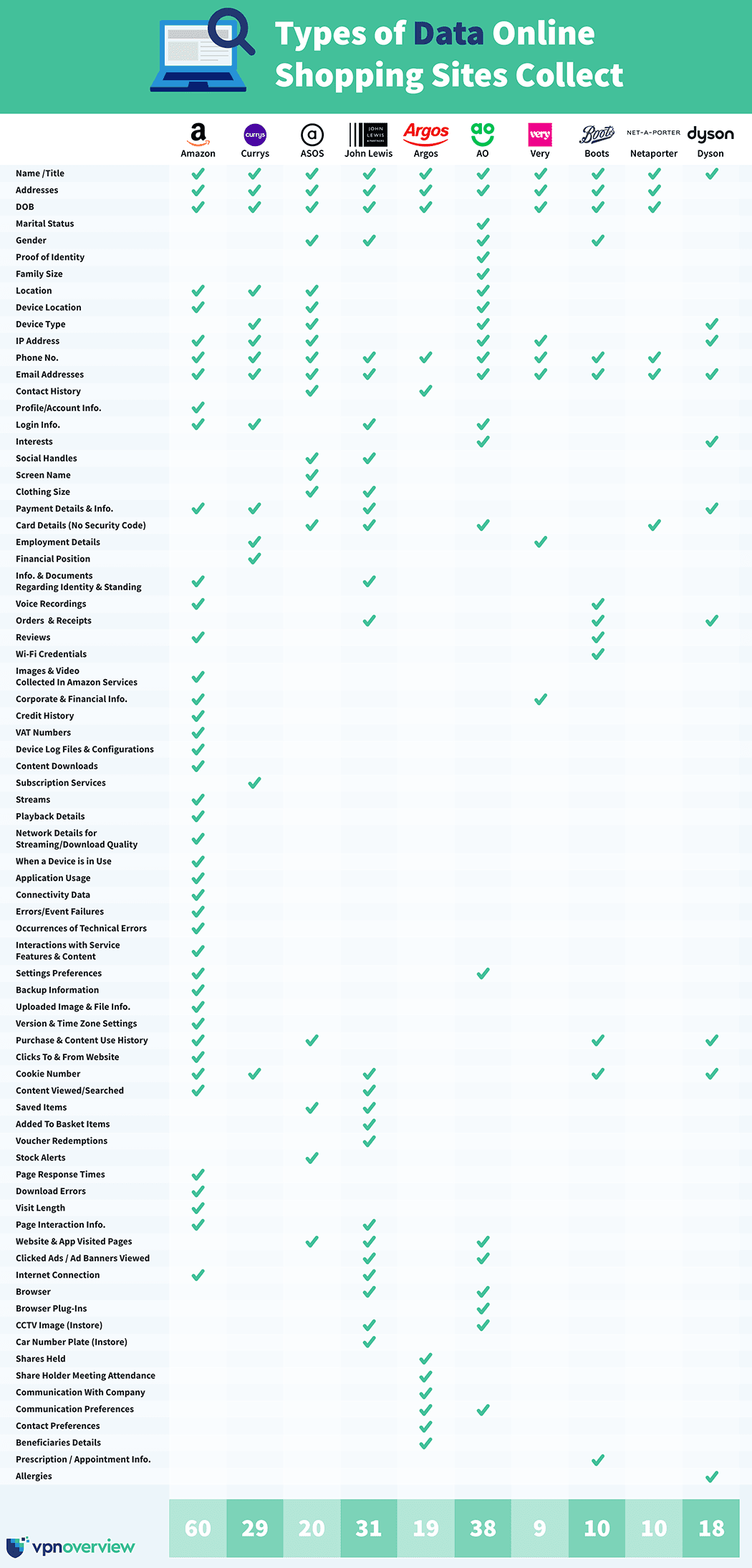
Cyber security experts at VPNOverview have analysed the privacy policies of some of the biggest online retailers in the UK to establish which sites compromise your privacy the most.
Despite the ease of shopping from the comfort of your home, online shopping comes with its own hazards, and your online privacy is always at risk. It turns out that when you press the checkout button, it’s not just money that is taken from you; online shops save everything from your phone number and location to your date of birth and bank details.
Detailed below are the top five companies that collect the most data from their customers*:
Overall, Amazon was found to be the site with the most points of data collected. The online retailer giant took a staggeringly high £23.19 billion of revenue in 2021 in the UK alone. But that’s not the only valuable thing they took from their customers: Amazon’s website collects 60 different pieces of personal information. This ranges from the basics of name, address, and phone number to Alexa voice recordings, your friend’s emails, and even your credit history information from credit bureaus.
2. AO: Trade your personal information for tech
For those who are looking to give home and tech gifts this year, AO’s sales might be on your radar already — but AO has its eyes on you, too. The site is responsible for collecting 38 elements of your private information, earning it a second place on the list.
The data collected ranges from expected info like your name and address to your preferences, the size of your family, and how affluent you are. You’re not alone if you’re wondering why AO needs all of this information. Does the company really need to know your gender and marital status to send you your orders? We sincerely doubt it.
3. John Lewis: From social media handles to your ID
If you’re planning on ordering homeware, fashion, and electricals online, you may be heading to John Lewis’ website. We found that this luxury retailer took the third-largest amount of data from its visitors, collecting 31 elements, including your social media handle, clothing size, and identification documents.
In some cases, it makes sense for the company to be aware of this kind of information. Their privacy policy mentions that your social media username will be known to them if you interact with the company through those platforms. However, they actively store and use this information to tailor your shopping experience — in other words, to hopefully get you to spend more money.
4. Currys: Share your financial position with Currys
The homeware appliance and technology online shop collected 29 pieces of information from their customers, the most notable being subscription services and your financial position. They even collect the date and time of texts and calls you receive on their network and your location at the time they take place.
Although Currys comes in at number 4 on our list, some of the details they might be gathering about you are particularly alarming. Not even Amazon asks you for data about your current job or financial status. This information might seem trivial but imagine how uncomfortable you’d feel if the person behind the counter asked you how much you earn before handing you your change.
5. ASOS: Data collection — but make it fashion
For those of you heading to ASOS this winter, be wary. This clothing retailer is another top contender for collecting the most data on its customers. It ends up closing our top five with 20 kinds of personal data.
The research found that the clothing site collects basic information and records your body shape and size, screen name, saved items, and past purchases.
Tips to Keep Your Data Secure While Online Shopping
If you don’t want these big corporations to gather so much information about you, you can take some easy steps to minimise the amount of data that websites collect on you. Here are the three most effective steps:
Disable and delete third-party cookies: Next time you go online shopping, don’t click “allow all cookies” without a second thought. If you do, you give these websites permission to track you. Third-party cookies are used to track your activity between sites, so they can create a scarily accurate profile on who you are and what you like. If you can, disable these third-party cookies (along with other unnecessary trackers) and delete the existing ones from your browser.
Think twice before you share personal details: Many platforms allow you to create your own profile with a profile picture, date of birth, checkout details, and a variety of other facts about your life. Before you fill this in, always consider whether the website actually needs that information for the service they offer. If you have the option, don’t fill out these details and leave them blank instead.
Use a VPN: Some people might advise using your browser’s incognito mode to stay anonymous online, but this doesn’t work. “Private mode” isn’t enough if you don’t want your data to be saved anywhere. Instead, consider getting a VPN (Virtual Private Network). A VPN encrypts your information and hides your IP address, meaning that websites won’t be able to read your location and other bits of personal information as easily.
In short, if you want to stay safe while online shopping, you need to watch your cookies, think critically, and use the right technology.
This will give you excellent protection against big corporations and their data collection schemes.
A representative from VPNOverview commented on the study: “Online shoppers must be careful when navigating these sites and making purchases online. Although some of the information being collected is essential to the site’s functionality, having your financial status or the number of family members you have to be shared with faceless corporations can be rather alarming.In most cases, customers have no idea where that information could end up or how it could be used.
“If you’re looking for a VPN to try, we recommend Surfshark. This VPN provider is relatively cheap and works well on desktops, smartphones, and countless other devices.
“Moreover, Surfshark might even enable you to get better deals and escape price discrimination. If you’re interested, you can always check out the Surfshark website.”
VPNOverview are a dedicated team of cybersecurity and privacy professionals offering guidance on these topics in the most accessible way possible.
Edinburgh locals encouraged to join the conversation on land reform
THE SECOND instalment of a popular free online webinar series has returned to coach people across Scotland on how to make the most of opportunities with the land and buildings around them.
After the first instalment was a major success, the 45-minute, informal lunchtime sessions will explore topics such as what Common Good land is and how it is managed. Other topics including rural housing and vacant and derelict land will also be covered.
The series will run fortnightly on Wednesdays from 18 January to 29 March and will share knowledge with attendees on how they can get involved in local land use decision-making to make a positive change.
Emma Cooper, Head of Land Rights and Responsibilities at the Scottish Land Commission, said: “The positive feedback from the first series of sessions highlighted how eager people across Scotland are to learn about and engage in discussions about the land around them and the role they can play in it.
“It’s crucial that we provide individuals with the tools and knowledge around land rights and responsibilities to ensure they know how to make a positive difference.
“As we look to do that, our ‘Land @ Lunch’ series aims to share ideas, allow people to join in on discussions, stimulate action and signpost people to useful tools and support a range of land reform topics.”
The Scottish Land Commission’s webinars aim to offer people the knowledge and tools to understand how Scottish land is used and manged and allow participants to engage in conversation relating to topical issues at the heart of Scotland’s land. The webinars are free, open to everyone, and informal, so participants are invited to take part whether they are at home or at work.
The Scottish Land Commission’s Land Right and Responsibilities Protocols set out practical advice on how land owners, land managers, and communities can work together to make better and fairer decisions about land use.
The Scottish Land Commission provides advice and recommendations for law and policy as well as leadership for change in culture and practice, working to create a Scotland where everybody can benefit from the ownership and use of the nation’s land and buildings.
To find out more information about the Land @ Lunch webinar series and to book your place, visit: landcommission.gov.scot/events.
To find out more about information about the Scottish Land Commission, visit: landcommission.gov.scot.
The founder of Fair Fuel UK has called for a new consumer price regulatory body to ensure fairness for motorists at the petrol pumps.
Howard Cox says his Pump Watch initiative has “huge backing” and that he will be sending a letter to Jeremy Hunt signed by 25 MPs.
Speaking to GB News, transport campaigner Mr Cox said: “I’ve been saying for the last four or five years that we’ve been ripped off in the fuel supply chain. “There’s definitely opportunistic profiteering going on. It’s further up the fuel supply chain where it’s happening.
“It’s not the independent retailers, as most of them are actually tied to very, very strict contracts with wholesalers. It’s the wholesalers and oil refineries and the big oil companies. I’m afraid they are basically fleecing every driver.
On whether supermarkets were “missing a trick” by not reducing their prices at the pumps, he continued: “Yes, they are. Around 50% of fuel dispensed comes through supermarkets. Yet for some reason we are not seeing any reductions, and I think it must be because they’re not making so much profit on their other core areas of their business.
We used to see supermarkets give you something off per litre if you put say 50 quids worth of shopping through their outlets, but that sort of a deal seems to have disappeared.
“Now you’re seeing how independent retailers are actually cheaper than supermarkets at the moment. And it’s even worse because supermarkets buy direct from the refinery. They don’t buy through the wholesalers. So they’re making huge profits on drivers.”
Issuing a direct plea to the Government he added: “We’re still the highest taxed drivers in the world. That’s why we’re calling for a body called Pump Watch. There’ll be a letter going to Jeremy Hunt signed by 25 MPs asking for a body to actually get some transparency and fairness at the pumps.
“And the other thing we’re calling on is for the Chancellor and for Rishi Sunak to come clean and say there’s no planned increase in fuel duty in March. Because at the moment, they’re just playing these ‘will they, won’t they’ games. They seem to be enjoying upsetting drivers and upsetting businesses that need to plan for the next three to four months.”
Minister urges those eligible to apply for support with the cost of living
Scottish households have saved more than £3 billion in council tax since the Council Tax Reduction (CTR) scheme was introduced almost ten years ago.
The latest figures published by the Scottish Government show 456,790 recipients received CTR in October 2022, meaning around one-in-five households were benefiting from the scheme.
People on low incomes are eligible for CTR if they live in Scotland – there is no equivalent benefit in England where most councils require each household to contribute a minimum amount of council tax, irrespective of ability to do so.
People who receive CTR save on average £750 a year and become eligible for up to 35% off their water and waste charges.
Public Finance Minister Tom Arthur said: “The Council Tax Reduction scheme celebrates its tenth anniversary in April 2023 and these latest figures show the scale of support it has provided to people in Scotland over the last decade.
“The cost of living crisis is disproportionately affecting poorer households and now, more than ever, it is important everyone is aware of the help that is available.
“Some people are also eligible for other council tax discounts or sometimes full exemptions, including students, people with disabilities and carers amongst others.
“I urge people to check their eligibility for council tax reduction and other financial support by visiting our online resources or by contacting their local council.”
People can check whether they are eligible for Council Tax Reduction through mygov.scot or by contacting their local council. Details of other help available including extra financial support or for things like food, heating and electricity can be found on the Scottish Government’s cost of living crisis support website.
FESTIVE ARRANGEMENTS: Clinics will be closed from 24th to 27th December and again from 31st December to 3rd January. Please check individual clinics for additional information before arranging your visit.
Area
Site
Days
Drop-in times
East Lothian
Edington Cottage Hospital
Monday to Friday
Closed from 24th December to 8th January
8.30am – 4.30pm (Closed 10am to 10.30am and again from 12.30pm to 1.30pm)
East Lothian
Haddington Corn Exchange
Monday to Sunday
8.30am – 4.30pm(Closed 12pm – 1pm)
East Lothian
Musselburgh Primary Care Centre
Monday to Friday Closed from 24th December to 8th January
8.05am – 4.50pm (Closed 10am to 10.20am and again from 12.30pm to 1.15pm)
Edinburgh
Fort Kinnaird (SAS Bus – next to Currys)
Monday 19th – Friday 23rd December
9.30am – 4pm
Edinburgh
The Gyle
Monday to Sunday
9.30am – 6.30pm
Edinburgh
Ocean Terminal
Monday to Sunday
9am – 6.30pm
Edinburgh
Waverley Mall
Monday to Sunday
10am – 5.30pm
Midlothian
Gorebridge Leisure Centre
Wednesdays, Thursdays and Fridays
Closed Thursday 22nd December onwards, reopens Wednesday 4th January