

DROP IN VACCINATION CLINIC ALL WEEK
Craigroyston Community High School
Monday 5th – Sunday 11th July
8.30am – 4pm

DROP IN VACCINATION CLINIC ALL WEEK
Craigroyston Community High School
Monday 5th – Sunday 11th July
8.30am – 4pm

Celebrities including Jim Broadbent and David Walliams have joined forces to encourage everyone to get their coronavirus (COVID-19) vaccines in a new uplifting film released today.
Set to the toe-tapping tune The Rhythm of Life, written by Cy Coleman and Dorothy Fields, from the 1966 classic musical, Sweet Charity, and donated by the Cy Coleman estate, the heart-warming film will celebrate the success of the vaccination programme in supporting the easing of restrictions as outlined in the roadmap.
Conceived and directed by Josie Rourke, the former artistic director of the Donmar Warehouse, the short film, written by Rourke and James Graham, is being released ahead of the NHS’s 73rd birthday.
It first sees Jim Broadbent enter an empty theatre before a star-studded cast of David Walliams, Asa Butterfield, Colin Salmon, Derek Jacobi, Don Warrington, Nicola Roberts, Russel Tovey, Sandra Marvin and West End dancers – dressed in iconic NHS blue – take to the stage to passionately perform the song
In-between the dancing, Asa Butterfield calls on viewers to “get that vaccine”, Don Warrington advocates “I’ve had mine!” and Jim Broadbent delivers the final “just get that vaccine” concluding plea to encourage people to play their part in getting us back to the ‘rhythm of life’.
The film was produced by Charles Finch and Peregrine Kitchener-Fellowes at Standalone Pictures.
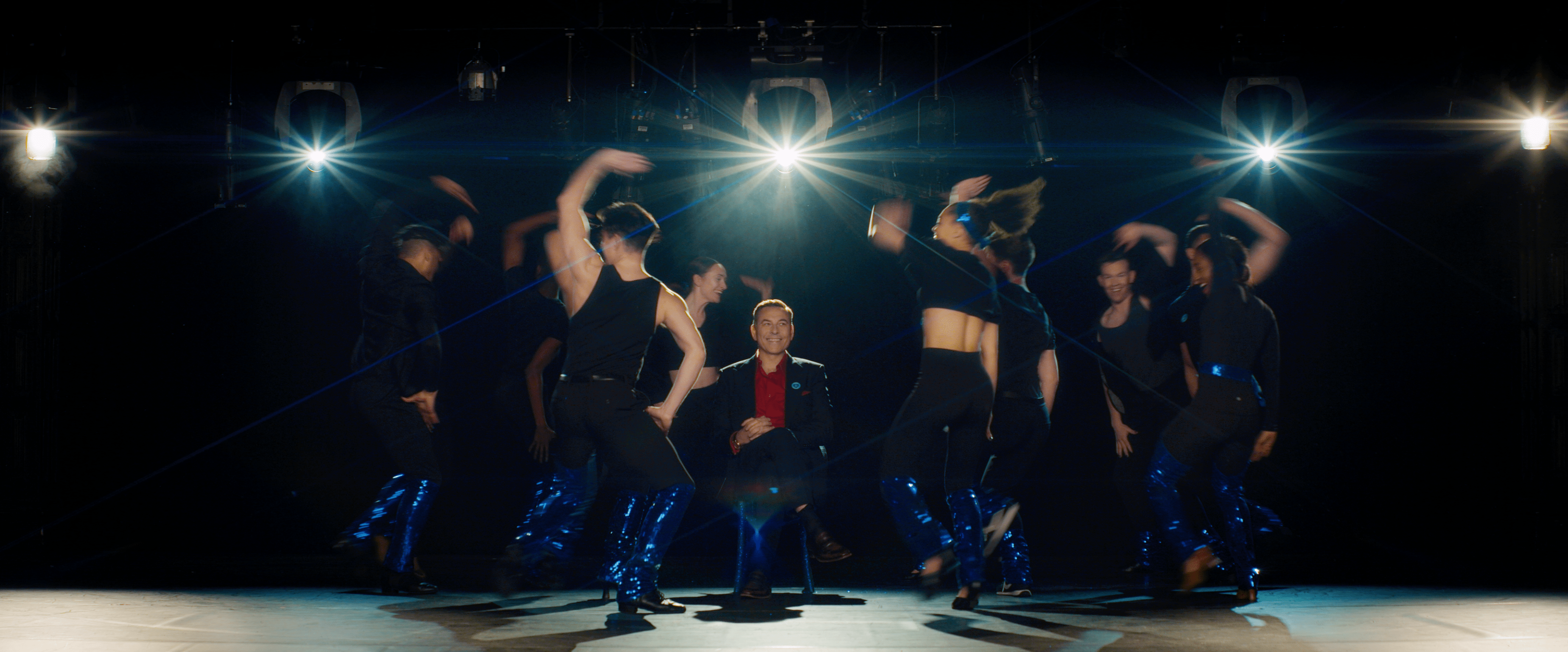
Comedian, writer and actor David Walliams said: “The NHS has done an absolutely fantastic job rolling out COVID-19 vaccines at such speed and, as we do in the film, I want to implore everyone to get their vaccine when called, so we can get back to the all-singing, all-dancing, rhythm of life that we love.“

Actor Jim Broadbent said: “The film gave us the chance to show our appreciation and celebration for the vaccine roll-out in the best way we know how.
“Thank you to the millions who have already received their vaccinations and please ‘just get your vaccine’ to the rest. Vaccines are helping us get back to everything we love and every industry – including the arts – couldn’t be more grateful to each and every person for getting their vaccine.”
The film follows the launch of a national campaign urging people to get their vaccine and join the millions of people who have already received their jabs, as ‘every vaccination gives us hope’.
Health and Social Care Secretary Sajid Javid said: “Vaccines save lives so it is fantastic to see some of our most beloved stars in entertainment back the vital vaccination roll-out, which is helping this country fight this pandemic.
“The evidence is clear: the vaccine is the best way to help protect yourself and your loved ones, so if you get the call do not delay in booking your appointment as we do everything we can to get back to normal life.”
Vaccinated people are far less likely to get COVID-19 with symptoms and even more unlikely to get serious COVID-19, to be admitted to hospital, or to die from it and there is growing evidence that they are less likely to pass the virus to others.
In June, the Prime Minister announced that second doses for all over 40s will be accelerated by reducing the dosing interval from 12 weeks to 8 weeks.
The move follows advice from the independent experts at the Joint Committee on Vaccination and Immunisation (JCVI), which has considered the latest available evidence and has recommended reducing the dosing interval to counter the threat of new variants of concern.

Vaccines Minister Nadhim Zahawi said: “I’m extremely humbled every day when I see how many people are booking and receiving their jabs, joining the millions of adults who have already received theirs, as the country continues to play its part in helping us defeat this virus.
“Vaccines have prevented an estimated 7.2 million infections and 27,000 deaths in England alone, and each vaccine delivered is another step forward in helping us get out of this pandemic as we fight it together, side by side.”
Latest modelling analysis from Public Health England (PHE) and Cambridge University’s MRC Biostatistics Unit suggests that the COVID-19 vaccination programme has so far prevented an estimated 7.2 million infections and 27,000 deaths in England alone.

Culture Secretary Oliver Dowden said: “Vaccines are saving lives, protecting the NHS and will ensure we get bums back on seats safely. Every adult in the country can now get their jab.
“Thank you to all these stars for getting the message out. Let’s get them back on stage by finishing the job with the vaccine roll-out.”
ONS polling also shows the UK continues to top the list of nations where people are willing to have a COVID-19 vaccine or have already been vaccinated and ONS data published on 2 July shows that more than 9 in 10 (96%) adults reported positive sentiment towards the vaccine.
Vaccines are available free of charge and from thousands of vaccine centres, GP practices and pharmacies.

The NHS urgently needs a rapid increase in bed numbers if it is to meet potential demand this winter according to new analysis from the Royal College of Emergency Medicine.
The College’s new briefing document ‘RCEM Explains: Hospital Beds’ looks at how bed numbers have declined in the past decade, the impact of covid, and the potential number of beds needed this winter, based on previous levels of demand.
The briefing uses the ratio of emergency admissions to beds to model the numbers of beds that will likely be needed, based on the levels of demand seen each winter prior to the pandemic.
In the last five years in England this figure has fluctuated between 11.07 admissions per bed (winter 2015/16) and 12.50 (winter 2018/19). Excluding the most recent winters (both of which saw demand and capacity fall due to the pandemic), there was an average of 11.77 admissions per bed.
If the NHS is to achieve a similar ratio this winter, and there are a similar number of admissions as in the winter of 2017/18, the NHS will need just over 7,500 additional beds. If demand is similar to 2018/19, then this figure rises to 15,788 extra beds.

President of the Royal College of Emergency Medicine, Dr Katherine Henderson said: “We are currently seeing record levels of attendances at Emergency Departments and if this continues into winter – an extremely likely situation – the NHS will have too few beds to be able to cope.
“The consequences of having too few beds could be dire. If we do not have the capacity to admit patients into hospitals, then A&E waiting times will go up, patients will end up being treated in corridors – a very real threat to their safety before the pandemic, but now with the added risk of hospital acquired infection – and the elective backlog will grow further as beds earmarked for surgeries will be used for emergency patients.”
The briefing also makes clear the relationship between high bed occupancy and an increased rate of cancelled elective operations.

Dr Henderson said: “Too few beds means higher rates of occupancy, which in itself puts patient safety at risk, but it is clear that this has a huge knock-on effect on elective care. Lack of beds is one of the top reasons for cancellation of surgeries and if we do not address the shortage now, before winter, the elective recovery will fail.
“We know that access to services is an issue throughout the NHS at the moment with resources short all-round, but Emergency Departments act as the safety net for the NHS – if they cannot function properly the entire system stalls – so it is vital that the new Secretary of State does all he can to enable the NHS to expand hospital capacity.
“The safe restoration of bed capacity to pre-pandemic levels is no easy fix though – as we’ve seen with the Nightingale initiative, capacity cannot be expanded if we do not have enough doctors, nurses, and clinicians.
“The capacity and staffing issues we face now have been over a decade in the making. Social care is still unfixed. Waiting lists are growing. Structural reconfiguration is in progress. Covid is less of an immediate threat but is unlikely to disappear. The Secretary of State has much to do, but he must start by making the beds.”

All mainland health boards will offer drop-in coronavirus (COVID-19) vaccination clinics from Monday as the programme nears completion of first doses for all adults in Scotland.
Everyone aged 18 and over can attend for their first dose or – if eight weeks have passed – their second dose. Separate queues will be in operation for those with a scheduled appointment.
From Monday, mobile vaccination units run by the Scottish Ambulance Service will visit local communities and busy city centre spots in Edinburgh and Glasgow for a two week period.
Anyone who has not yet received an invitation or would like to rearrange an existing appointment can continue to self-register on the NHS Inform site.

Health Secretary Humza Yousaf said: “Our route out of this pandemic is getting as many people vaccinated as quickly as possible, that is why I am urging people to get jagged in July.
“The vaccination programme continues to progress at pace and, as always, I want to thank everyone involved and all those who have taken up the offer of vaccine.
“As we approach the final stages of the first COVID-19 vaccination programme we are increasing the options available for how and when you choose to be inoculated.
“You can attend one of the drop-in clinics being run in all mainland health boards or pop into a mobile unit. You can also rearrange the location of your appointment online if, for example, it is more convenient for you to be vaccinated closer to your work than home.
“You can find out where your nearest drop-in clinics are by visiting NHS Inform which will direct you to the latest information from your local health board.
“All those aged 18 and over can also self-register to receive their appointment by text or email which will be convenient for anyone who has recently moved house or is new to Scotland.
“All of the evidence says that the vaccines are working as we continue to battle the faster-transmitting Delta variant which is now dominant so I urge everyone to take advantage of the vaccination programme which is open to every adult in Scotland.”
Mr Yousaf’s appeal follows the announcement of 4234 new cases in Scotland yesterday – a new record.


Don’t let the delay to the easing of Covid-19 restrictions stop you getting active this summer. If the Euros and Wimbledon are inspiring you to get moving, Edinburgh Leisure’s Summer Pass has everything you need for a sport filled summer and to stop you from being a couch-potato.
The ‘Summer Pass’, which goes on sale today, offers unlimited access to the city’s 12 state of the art gyms, 9 swimming pools, and 800+ fitness classes, and climbing at the EICA for £60 only. The pass lasts six weeks from the date of purchase, with the last day a customer can purchase a pass being 31 August 2021.

James Stockton, Sales Manager at Edinburgh Leisure, said: “With so many people having staycations this year, why not use this opportunity to get fit at the same time. Our Summer Pass is less than £10 per week to stay active, without committing to a membership.
“Classes like Zumba or Sh’bam are brilliant fun and a great way to get you in the mood to party, while a workout at the gym will boost your energy for the night ahead.
“We’ve also got some quick hit X-press gym classes, which use high intensity interval training (HIIT) methods with explosive bursts of speed and activity to achieve a total workout in a short period of time, as 30 minutes. And our digital boditrax machine, available at the Royal Commonwealth Pool gym, which gives you a full-body composition analysis, could help you track your progress.”
Edinburgh Leisure’s Summer Pass is available to buy online on the Edinburgh Leisure website – www.edinburghleisure.co.uk

New CAPACITAR online wellbeing sessions to launch on Zoom next week.
Email admin@pchp.org.uk for login details

As pandemic restrictions begin to ease people in Scotland are encouraged to join over 30,000 others who have already turned to Scotland’s Service Directory in 2021 as a convenient way to find support services for health and wellbeing at their fingertips.
Scotland’s Services Directory has been developed by NHS 24 in association with Macmillan Cancer Support and health and care charity The Alliance. The online directory offers contact details for local, quality-assured, health and care services across all regions in Scotland. Every Health and Social Care Partnership has a number of services listed.

Scotland’s Service Directory is available on NHSinform.scot providing easy access on a wide range of health and wellbeing groups and services, including how to stay active, cancer services, dementia support, social activities for mental health, and money advice. NHS services are also listed.
A national campaign promoting the Directory will run over summer.


Adoption UK in Scotland is warning of a mental health emergency amongst some of the country’s most vulnerable children, caused by failings in a system that is not set up to meet their needs.
This year’s Adoption Barometer report reveals that two-thirds (64%) of people in the UK aged 16+ have sought help with their mental health, and the numbers are rising. In Scotland, more than half (51%) of adopted people aged 16-25 were involved with mental health services in 2020. Yet most say they have been unable to access the support they need.
Most adopted young people suffered abuse, neglect or violence in their early years, with lasting impacts on relationships, learning and health, leaving their adoptive families to pick up the pieces when professional support is not provided.

Fiona Aitken, Adoption UK Director of Scotland, said: “For the third year running, over two-thirds of Scottish Barometer respondents said they face an ongoing struggle for support.
“Scottish children and families are being failed by a system that does not provide the ongoing help and support children need to overcome early experiences, and the lifelong impact that adoption has then fades into the background.
“We owe it to these children and their families to provide ongoing support throughout their lives, to help them to achieve the best possible outcomes that they deserve.”
The survey results highlight the consequences of failure to provide early and consistent support for adopted young people.
More than a third (38%) of adopted 16-25-year-olds in Scotland were not in positive destinations (education, employment or training) at the end of 2020. Involvement in high-risk and criminal activities has steadily increased since the first Adoption Barometer in 2019.
Problems are often compounded by children falling through the cracks between child and adult services. Almost three-quarters of parents in the UK said their child’s support reduced or ceased when they aged out of services for adolescents.
Julian Thomson, aged 29, said: “When I was 13 I was diagnosed with mild depression, but my GP was unwilling to prescribe antidepressants due to my age.
“There were a very narrow range of options available at that time, and it didn’t help that my medical records weren’t passed on after I was adopted. Because of that, a whole host of things were missed – it was like I didn’t have a life before adoption.
“Neither I nor my adoptive family were offered any real mental health support after that. I did have some sessions with an NHS counsellor, but that didn’t get to the root of the problem and I feel the sessions were not focused on trauma. It was only when I was 27 that I was diagnosed with complex post-traumatic stress disorder (PTSD) stemming from historical abuse.
“I am currently going through the process of being diagnosed with an autistic spectrum disorder. Had this been picked up when I was in care it may not have impacted upon my life the way it did. I believe there is a real need for psychological assessment for all adopted children.”

The Barometer survey also shows that contact with birth family often looms large during adolescence and early adulthood.
In Scotland, 28% of 13-18-year-olds had direct contact with a birth family member outside of any formal agreement. For some, this has devastating consequences for mental health and family stability.
When families do get support, their assessments of its quality and the impact on their family have increased on all indicators since last year - a considerable achievement considering the pandemic.
In Scotland, parents who had accessed Adoption UK services said the support they received had been crucial to their wellbeing. Adopter experiences in Wales have improved at both approvals and matching stage, and among families with older children, due to investment in adoption services in 2019.
The emergency Covid adoption support fund in England has been widely praised by families.
Fiona Aitken added: “This year presents real opportunities to re-set support for adoptive families.
“The Promise to Scotland’s Care Experienced children as a result of the Independent Care Review and the debate about Covid recovery are real opportunities to improve our systems and services for families to ensure our more vulnerable children receive an equal chance in life.”
Adoption UK is setting out a six-point plan to improve the life chances of adopted young people. It includes multi-disciplinary assessments and support plans for every child placed for adoption and the extension of adoption services to at least age 26.

Heart Research UK Healthy Heart Tip, written by Dr Helen Flaherty, Head of Health Promotion at Heart Research UK
Gardening for Good Health

Gardens and greenspaces have been hugely important to many people during the challenges of the Covid-19 pandemic, with many people finding their refuge through gardening.
Here we explore some of the health and mental wellbeing benefits of gardening:
Stress relief

Gardening is a fantastic stress reliever and can cultivate feelings of empowerment, connection, and calm. Being in touch with nature and the great outdoors can help you feel more removed from the daily stressors of life.
Work out

Gardening is exercise and working in a garden can use every major muscle group in the body. While activities such as raking and cutting the grass may be light exercise, shovelling and digging can be counted as vigorous exercise.
Grow your own

There is nothing quite like eating your own fresh home grown produce! Not only are many fruits and vegetables very easy to grow, but they are also more nutrient-dense, free of pesticides and tasty. By growing your own, you are also helping to preserve the environment.
Get the kids involved

It can sometimes be a challenge to get children to eat healthy foods and enjoy them. Growing vegetables not only teaches children valuable lessons about the work that it takes to grow them, but it can also help them to gain a keen interest in eating them too.
Work with what you have

Whether your patch is large or small, a raised bed, a community garden or window box – make the most of it by researching the best plants for your space and sunlight exposure. You can grow a range of things with very little space and maintenance, whilst still reaping the benefits.
Happy gardening! You can find lots more tips, recipes and health advice at https://heartresearch.org.uk/


