For the first time since the financial crisis, NatWest Group plc (formerly Royal Bank of Scotland Group plc) is no longer under majority public ownership following a £1.2 billion sale of part of the government’s shareholding back to NatWest.
This is the government’s fifth sale of its NatWest shareholding bringing its level of ownership down from 50.6% to 48.1%. This is a landmark in the government’s plan to return to private ownership the institutions brought into public ownership as a result of the 2007-2008 financial crisis.
The Economic Secretary to the Treasury authorised the sale of approximately 550 million shares in NatWest at 220.5p per share raising a total of £1.2 billion. The shares were bought back by NatWest and the process was managed by UK Government Investments.
The Economic Secretary to the Treasury, John Glen said: “This sale means that the government is no longer the majority owner of NatWest Group and is therefore an important landmark in our plan to return the bank to the private sector.
“We will continue to prioritise delivering value for money for the taxpayer as we take forward this plan.”
NatWest chief Alison Rose said the share buyback is an “important milestone” for the bank.
Ms. Rose said: “The deal is a good use of capital for the bank and our shareholders. Reducing government ownership below 50% is an important milestone for NatWest Group and a further demonstration of the progress we are making as we continue to deliver for our customers and shareholders.”
‘A failure of courage, a failure of compassion and a failure of justice‘ – Peter Kelly, The Poverty Alliance
Chancellor announces Spring Statement tax cut for 2.4 million Scottish workers through rise in National Insurance thresholds – saving the typical employee over £330 a year.
Unveiling plans to give families further help with the cost of living, Rishi Sunak also slashes fuel duty on petrol and diesel by 5p per litre for the next 12 months.
Spring Statement also sets out measures to help businesses boost investment, innovation, and growth – including a £1,000 increase to Employment Allowance to benefit around half a million SMEs across the UK
The UK Government is providing an additional £45 million to the Scottish Government next year as a result of measures announced by the Chancellor today.
The Chancellor delivered a Spring Statement today that ‘puts billions of pounds back into the pockets of hard-working people in Scotland’– unveiling a series of tax cuts to ease the cost of living.
Rishi Sunak announced that National Insurance starting thresholds will rise to £12,570 from July, meaning hard-working people across the UK will keep more of what they earn before they start paying personal taxes.
The cut, worth over £6 billion, will benefit 2.4 million working people in Scotland with a typical employee saving over £330 a year, whilst the typical self-employed person will save over £250. This means the UK now has some of the most generous tax thresholds in the world.
Mr Sunak also announced that fuel duty for petrol and diesel will be cut by 5p per litre from 6pm tonight (23 March) to help drivers across the UK with rising costs. Worth £2.4 billion, this is the biggest cut ever on all fuel duty rates and means a one-car family will now save on average £100.
As a result of a cut to the basic rate of income tax for savings income, taxpayers in Scotland will see benefits worth £3 million. As other income tax rates are devolved in Scotland, the Scottish Government’s funding is automatically increased as a result of this tax cut as set out in the agreed Fiscal Framework. This is initially worth £350 million in 2024-25.
The Chancellor also set out a series of measures to help businesses boost investment, innovation, and growth – including a £1,000 increase to Employment Allowance to benefit around half a million businesses.
As a result of measures in this Spring Statement the UK Government is providing the Scottish Government with an additional £45 million through the Barnett formula next year.
Chancellor Rishi Sunak said:“We’re slashing taxes for millions of hard-working people in Scotland, getting pounds in people’s pockets and helping pay cheques to stretch further – from July more than 2.4 million in Scotland will get a tax cut with the typical employee keeping £330 more each year.
“By cutting fuel duty, we’re making it cheaper for people in Scotland every time they go to the pump, which together with the freeze means people save £100 per car on average a year.
“We’re boosting small business growth by increasing the Employment Allowance – a tax cut worth up to £1,000 for thousands of businesses.”
To grow the world’s very best talent in AI, the UK Government will partner with industry and academia to create 1,000 new AI PhDs. The Government will invest £117m to create PHDs across the UK at Centres for Doctoral Training, building on the existing three sites in Scotland. This will train a new generation of AI researchers who will develop and use AI in areas such as healthcare, climate change and creating new commercial opportunities.
Delivering the statement, the Chancellor made clear that our sanctions against Russia will not be cost-free for people at home, and that Putin’s invasion presents a risk to our economic recovery – as it does to countries all around the world.
However, announcing the further measures to help people deal with rising costs, he said the extra support could only be provided because of the UK’s strong economy and the tough but responsible decisions taken to rebuild our fiscal resilience.
The immediate financial support for people and businesses comes as part of a wider tax plan announced by the Chancellor that will create better conditions for growth and will share proceeds from growth more fairly – ensuring people can keep more of what they earn.
Mr Sunak also announced that the Scottish Government will receive £41 million more funding as there will be an extra £500 million for the Household Support Fund, which doubles it’s total amount to £1 billion to support the most vulnerable families with their essentials over the coming months.
The Chancellor also reduced the VAT on energy saving materials such as solar panels, heating pumps and roof insulation from 5% to zero, helping families become more energy-efficient.
This cost of living support comes on top of the measures that the Chancellor has already announced over the recent months to support families. This includes an over £9 billion energy bill rebate package, worth up to £350 each for around 28 million households, an increase to the National Living Wage, worth £1,000 for full time workers, and a cut to the Universal Credit taper, worth £1,000 for 2 million families.
The Spring Statement also confirms that:
A new Efficiency and Value for Money Committee will be set up to cut £5.5 billion worth of cross-Whitehall waste – with savings to be used to fund public services.
£50 million new funding to create a Public Sector Fraud Authority to hold departments to account for their counter-fraud performance and to help them identify, seize and recover fraudsters money.
Local residents across the UK will benefit from a fresh set of infrastructure projects as we open the second round of the £4.8 billion Levelling Up Fund. It will continue to focus on regeneration, transport and cultural investments.
Chancellor’s statement ‘a failure of courage and compassion’, says Poverty Alliance
Reacting to today’s Spring Statement, Peter Kelly, director of the Poverty Alliance, said: “Government should be about compassion and justice, and making sure people are able to live as full a life as they can.
“The Chancellor said his Spring Statement today was all about security. Yet his plans show a failure to comprehend the situations being faced by households across the country, leaving them with insecure and falling incomes in the face of rising costs.
“Amid a rising tide of poverty, the Chancellor could have thrown a lifeline by increasing benefits in line with inflation and by scrapping the unjust benefit cap. Instead he has provided additional funding of only £500m to the Household Support Fund which, although welcome, will quickly be consumed by the rising cost of living for families on the lowest incomes.
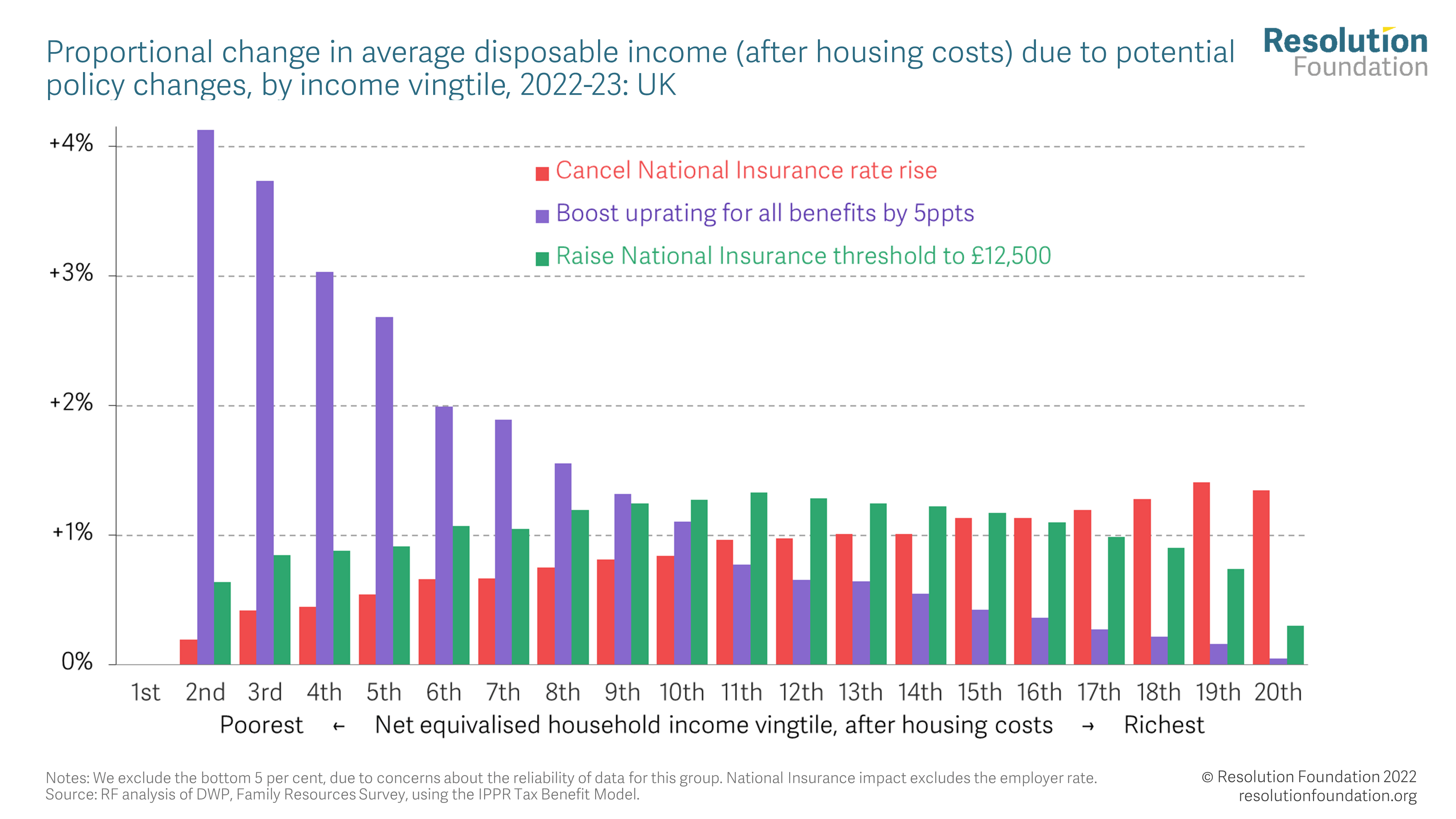
“The increase in the National Insurance threshold has also been presented as a support to people living on low incomes. In reality two thirds of this effective tax cut will go to middle and higher income households.
“By ignoring the tidal wave of rising living costs that is pulling so many people into poverty, the Chancellor has made clear his priorities. His tax cutting agenda will generate positive headlines, but could see another 400,000 people across the UK swept into poverty.
“Ultimately, the Chancellor’s statement is a failure of courage, a failure of compassion, and a failure of justice.”
The UK Government has not delivered the support and help that families and businesses need today, according to Finance Secretary Kate Forbes.
Responding to the Spring Statement, Ms Forbes said the Chancellor failed to help thousands of worried households facing poverty as a result of soaring energy bills and a cost of living crisis.
In 2018/19, the Scottish Government introduced a more progressive approach to tax, including a 19% starter rate band below the basic rate, ensuring those who can afford to pay a little more do so.
Ms Forbes said: “The Spring Statement has failed to address the biggest challenges facing households today. With soaring energy bills and a cost of living crisis, the Chancellor has not used his Spring Statement sufficiently to provide lifeline support that could prevent households facing fuel poverty.
“The Scottish Government is providing a further £10 million to continue our Fuel Insecurity Fund into 2022-23, which supports people struggling with their energy bills. Most powers relating to the energy markets remain reserved and Scottish Ministers have repeatedly called for the UK Government to urgently take further action to support households – including a reduction in VAT on household energy bills and support for those on low incomes.
“We are doing all we can to tackle the cost of living crisis – including doubling the Scottish Child Payment from £10 per week per eligible child to £20 next month. The UK Government should have followed our lead and matched the 6% uprate on social security benefits which the Scottish Government is adding to eight of the benefits we deliver. The Chancellor failed to match that commitment which could have provided lifeline support to thousands of households.
“On taxation, we have already acted to introduce a 19% starter rate of income tax below the basic rate, in line with our commitment to progressive taxation, which makes Scotland the fairest taxed part of the UK. We will continue to take that approach when we set taxation policy in future budgets.”
In the midst of the biggest wages and bills crisis in living memory, Rishi Sunak’s Spring Statement has failed families who need help NOW, says the TUC.
He didn’t stand up for families. He didn’t take the opportunity to stand up to the bosses who’ve sacked hundreds of workers at P&O. And he didn’t set out a plan to get wages rising – leaving the average workers facing a wage cut of over £500 this year.
Fund efforts towards a peaceful solution to the conflict in Ukraine
Take additional measures to support families in the UK with rising energy prices
Deliver the long-term changes needed for a high-wage, high skill, high productivity economy
Below we set out how the spring statement matched up to our tests and assess what it means for working people.
The Chancellor didn’t deliver an immediate boost to pay
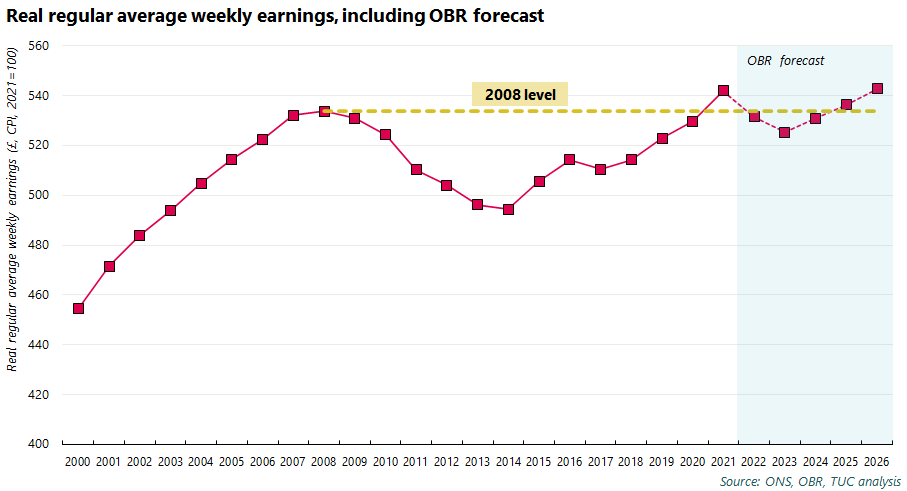
Workers’ pay prospects from the statement don’t look good. The OBR forecasts real weekly wages to fall by £11p/w (2.0 per cent) in 2022, and fall again in 2023. This will put wages back below their 2008 levels (after a brief recovery in 2021), where they’ll stay until 2025. And even this contains some optimistic wage forecasts, with the OBR forecasting pay before inflation to rise by as much as 5.9 per in Q3 2022.
The OBR forecasts that the 2022-23 financial year will see the biggest fall in living standards since records began in 1956-57, explaining that the “failure of nominal earnings growth to keep pace with rising inflation” is a “key factor” in this.
It adds that the policy measures announced since October only “offset a third of the overall fall in living standards that would otherwise have occurred in the coming 12 months”.
But there was no action to tackle falling pay in the Chancellor’s statement: nothing on raising the minimum wage, or funding public sector pay rises, and no recognition that collective bargaining (and union presence) is the most sustainable way to get wages rising.
Measures to support families in the UK with rising energy prices and the cost of living were totally inadequate
The spring statement offers little good news for struggling families, especially those in receipt of benefits.
Benefits uprating
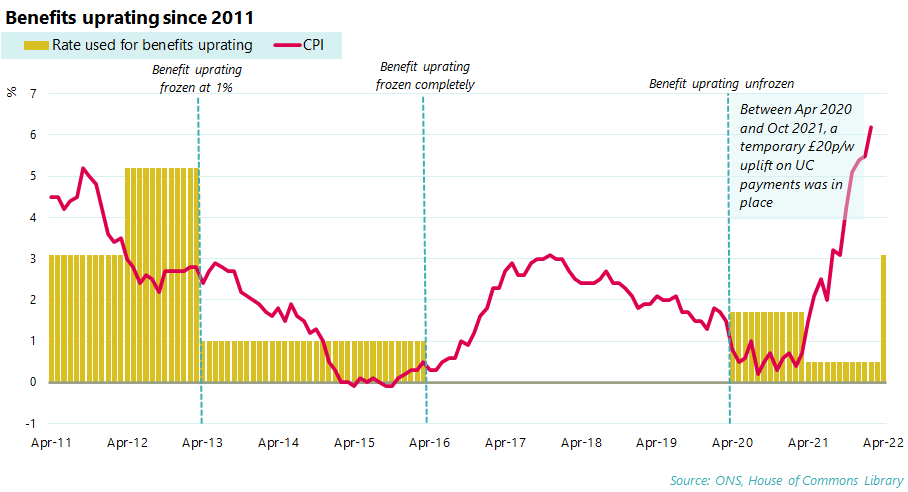
Worst of all there was no increase in the basic rate of benefits. As it stands, the standard allowance for Universal Credit and legacy benefits is set to rise by 3.1 per cent in April 2022. But this is far below the latest inflation figure (CPI is 6.2% in Feb 2022 and RPI is 8.2%), with inflation forecast to rise higher in the coming months.
This will leave those on benefits facing a real terms cut at a time when energy bills are rising by 54 per cent. The families who need the most help have been left totally out in the cold by the Chancellor today.
The decision not to cut benefits in real terms will particularly impact those who are unable to work. This reflects a wider ignorance of the equalities impact of the cost of living crisis.
We also didn’t see a reversal of the decision to suspend the state pension triple lock. The decision to abandon the pensions triple lock will cost pensioners almost £500 a year. Pensioners are particularly vulnerable to price hikes as they spend a higher percentage of their income on food and fuel.
Targeted support
The big new announcement for targeted support for low-income households was £500 million in additional funding for the Household Support Fund – a temporary discretionary fund run by local authorities. This scheme was set to end this month, and the initial funding was £500 million.
This extra money is worth less than £10 each to the six million families claiming Universal Credit – in the unlikely event they hear about it and are able to jump through the hoops needed to claim it. And contrast this £500 million to the £10 billion cut to benefit spending in 2022-23 as a result of not uprating benefits in line with inflation.
Income tax and national insurance threshold
Changes to tax cuts won’t help the families who need it most now. Raising the National Insurance threshold mostly benefits middle earners and, compared to increasing benefits payments, does little to help those with low income. This can be seen in the chart below, from the Resolution Foundation.
And promises of income tax cuts tomorrow do nothing for families facing cuts to their living standards now.
And the Chancellor has missed another opportunity to raise sick pay and make it available to all. Living with Covid requires decent sick pay for all, yet we’re still waiting for government to take action on this.
VAT-free insulation and solar panels
Alongside this was the removal of the 5% Value Added Tax currently applied to building materials, like home insulation and solar panels. But this only benefits families who own a home and can afford to renovate it anyway.
The Chancellor should’ve taken the opportunity to invest in home retrofits at scale. Improving the average UK home’s energy efficiency to band C would reduce the country’s gas demand by 15% and cut hundreds of pounds off fuel poor homes’ energy bills. A massive social homes retrofits programme, delivered by local authorities, could also create over a quarter million good jobs over two years. But here again the Chancellor failed to act.
Transport
The 5p cut on fuel duty does next to nothing to support those at the sharp end of the wages and bills crisis. Analysis by NEF estimates that a third of this tax cut will go directly to the richest 20% of households, while the poorest 20% will on average only receive £5 per month. To make transport truly affordable for everyone, Government should be expanding bus and rail services in the public sector.
The Chancellor didn’t talk about the long-term changes needed for a high-wage, high skill, high productivity economy
We heard nothing on reforms to corporate governance, industrial strategy or expanding the public sector workforce to deliver the decent public services we need to level up.
The Chancellor did announce a review of the apprenticeship levy. We believe that any changes to the levy should focus on significantly increasing the number of high-quality apprenticeships and widening access to groups facing long-standing barriers. A review must not be an exercise in allowing employers to duck their responsibilities on apprenticeships.
And much more than this is urgently needed to tackle the shortfall in training, including increased government skills funding and new workplace training rights to expand opportunities for everyone to upskill and retrain.
The Chancellor didn’t stand up to the scandalous behaviour by bosses P&O
The Chancellor talked about security but did nothing to take on the bosses who take every measure to undermine their workers’ job security. He could’ve made it clear that no employer who treats workers with the contempt shown by P&O Ferries would receive a penny of public money until they reinstate their workforce, including by taking freeports contracts off DP World, the parent company of P&O.
Yet once again the Chancellor failed to mention the issues that matter to working people.
The government’s response to those fleeing conflict and war is inadequate
The Spring statement document outlines the £400m in humanitarian support the government has given to Ukraine, and says it has committed “to provide local authorities with £10,500 per person for support services, and between £3,000 and £8,755 per pupil for education services depending on phase of education, as well as £350 per month for sponsors for up to 12 months”.
But it’s clear that the government’s support for the people fleeing war and conflict is worse than inadequate. The Ukraine for Homes scheme is no substitute for a properly funded system that provides universal refugee protection. And yesterday, the Government’s nationality and borders bill, passed a vital stage in the House of Commons, meaning that those fleeing conflict may find themselves treated as criminals and deported, instead of finding sanctuary.
The Chancellor let families down today.
Families are facing soaring bills at a time when their incomes have been squeezed by years of wage cuts and attacks on the social security system. The wages and bills crisis is a consequence of decisions taken by successive governments. Today the Chancellor chose to make the pain last for longer.
THERE WAS SOME PRAISE FOR SUNAK’S MINI-BUDGET, HOWEVER:
Simon Roberts, Chief Executive Officer, Sainsbury’s said:“We know our customers and colleagues are concerned about increases to the cost of living and at Sainsbury’s we are doing everything we can to support them.
“We really welcome today’s changes to fuel duty and national insurance. We are passing a 6 pence per litre cut in fuel across our forecourts from 6pm tonight as we know fuel costs are one of the biggest pressures everyone is facing right now.
“We were pleased to welcome the Chancellor to one of our stores today to discuss what we are doing to offer customers great value and to invest over £100 million in increasing pay for our colleagues with a new hourly rate of £10 per hour nationally and £11.05 in inner London.”
Michelle Ovens CBE, Founder, Small Business Saturday said:“Moves in today’s Spring Statement to increase the employment allowance, reduce fuel duty and raise the National Insurance threshold are welcome, and will go some way to help businesses deal with rising costs.
“In particular, It is good to see the immediacy of this rise in employment allowance.”
Martin McTague, Chair, Federation of Small Businesses, said:“We are very pleased to see the Chancellor adopting our top ask for this Spring Statement: uprating the Employment Allowance to help small employers with national insurance costs.
“We originally put forward the Employment Allowance as a targeted measure to help small firms, and it has now been expanded three times since its creation.
“Together with a cut to fuel duty, these measures will provide crucial breathing space for our embattled small employers.
“This Spring Statement marks a good starting point, with welcome measures on business rates, net zero and energy investment taking effect next month.
“With steep inflation, energy bills increasing fast, without the same support in place as enjoyed by consumers, and hiring pressures landing hard on small firms, more of the right stuff will be needed in the autumn given this challenging backdrop.
“We’ve seen a VAT cut on net zero investments for households today, which is good for small firms involved in their installation.
“However, a high street shop or local bar cannot access the same support that consumers do when dealing with the same energy supplier, and they should have access to the same assistance to reduce energy use and support the move to net zero.
“We look forward to working with the Chancellor on his new tax plan. Achieving the new culture of enterprise vision he rightly aspires to, alongside levelling up aspirations, will mean putting community small firms and sole traders front and centre of reforms.
“That means taking more of them out of the business rates system, protecting SME R&D investment incentives and delivering on commitments to end an endemic late payment culture that destroys thousands of firms a year.”
Alex Towers, Director of Policy and Public Affairs, BT Group said:“We welcome the Chancellor’s focus on tax reforms for business investment, given how central this is to UK infrastructure and growth.
“This is particularly important for BT Group as we make once in a generation investments to build the UK’s full fibre broadband and 5G networks. The existing super-deduction has already helped us to significantly increase and accelerate that investment.
“We agree that longer-term incentives are now needed, to support this country’s growth and competitiveness, and we will be keen to contribute evidence to aid the Government’s decision-making.”
Dr Clive Hickman OBE, Chief Executive, the Manufacturing Technology Centre said: “We welcome the Spring Statement, which outlines concrete steps to ensure that the manufacturing sector remains competitive, sustainable, and resilient.
“The Government’s commitment to cut tax rates on business investment is important if the UK is to boost manufacturing productivity and create high-quality jobs. In addition, the reform to R&D tax credits is a very positive step that will enable the scheme to be more effective, better value for money, and more generous.
“These measures will be crucial to spur innovation and encourage investment across the country.”
Julian David, Chief Executive, TechUK said: “Rightly the majority of the Spring Statement focused on addressing the cost of living concerns resulting from the war in Ukraine and rising inflation. Along with this vital action, the Chancellor also outlined a welcome package of consultations and policy programmes aimed at boosting businesses investment.
“In our recent Digital Economy Monitor Survey UK tech companies said increasing support to invest in R&D would be their top ask of Government, with 76% saying R&D is important to their business operations in the UK.
“The proposals unveiled today to further expand R&D tax credits and consult on ways to maintain the tax deduction for capital expenditure have the potential to unlock more investment into UK innovation.
“However, to get this right the Government must ensure that the software and intangible assets that power modern business investment are kept in scope. Otherwise, the Government risks missing an opportunity to unleash the potential of tech led growth.”
Dom Hallas, Executive Director, COADEC said:“Better R&D tax credits would mean more innovation from startups and innovative companies.
“We’re delighted the Chancellor recommitted to expanding it to cover cloud and data costs – and look forward to discussing the many ways to improve the credit further.”
Irene Graham OBE, Chief Executive, ScaleUp Institute said: “In the face of increasing pressures of inflation and wider international uncertainties, it is very good to see the Spring Statement continues to recognise the importance of business growth and innovation.
“It reaffirms policies targeted towards R&D, people and skills, investment, and innovation including the new Innovation Challenge across central government departments. We will continue to work closely with the Government on the evolution and development of these policies which are so vital to our scaleup economy.”
Michael Moore, BVCA Director General, said:“Increased business investment is key to the future of the UK economy and we welcome the measures announced by the Chancellor today which support this objective.
“Private capital’s focus on sectors like AI, robotics and fintech has helped the UK to become a world leader in these areas – further reform of R&D tax credits will help businesses to drive further innovation and strengthen the UK’s position in this new economy.”
Fuel Duty
Edmund King, President, the AA said: “The AA welcomes the cut in fuel duty. However, we are concerned that the benefit will be lost unless retailers pass it on and reflect a fair price at the pumps. Average pump prices yesterday hit new records- despite the fall in wholesale costs.
“The Chancellor has ridden to the rescue of UK families and businesses who use their vehicles, not for pleasure, but to function in their daily lives. Since the start of the year, the 20p-a-litre surge in pump prices has been the shock that rocked the finances of families, and particularly young drivers, pensioners and lower-income workers who need to commute each day.
“AA research showed that even in November, when petrol pump prices set new records at around 148p a litre, 43% of drivers were cutting back on car use, other spending to compensate or both. That rose to 59% among young drivers and 53% among the lower-paid. Petrol started this week averaging 167p a litre.
“On top of the duty cut, there has been a substantial reduction in wholesale road fuel costs feeding through to the forecourts since 9 March. That needs to drive lower pump prices also. The road fuel trade shouldn’t leave the Treasury to do the heavy lifting when cutting motoring costs.”
Elizabeth de Jong, Director of Policy, Logistics UK said:“With average fuel prices reaching the highest level on record and rising inflation, there has been an unstainable burden on logistics businesses which operate on very narrow margins of around 1%; the Chancellor’s decision today will help to ensure operators can continue to afford supplying the nation with all the goods it needs, including food, medicine and other essential items.
“Fuel is the single biggest expense incurred by logistics operators, accounting for a third of the annual operating cost of an HGV. The cut in fuel duty of 5ppl will result in an average saving of £2,356 per year per 44-tonne truck; this move will help to strengthen the UK’s supply chain during a time of ongoing financial and operational challenges.”
Zero rating VAT in energy efficiency measures
David Cowdrey, Director of External Affairs, MCS said:“The Chancellor has used the Spring Statement as an opportunity to kick-start the home heating revolution by zero rating VAT on home energy efficiency and renewable technologies for five years.
“This announcement allows people to insulate their homes and save on our fuel bills, making houses cheaper to run, especially when gas prices are at a record high.
“The government’s bold move to zero rate VAT can help the UK meet its net zero targets by using proven, off the shelf, zero carbon domestic energy solutions, such as solar and heat pumps, which are ready to be upscaled now.“
Professor Robert Gross, Director, U.K. Energy Research Centre, Professor of Energy Policy, Imperial College said:“The VAT cut on energy efficiency products is a great first step in helping households adopt simple measures to help cut fuel bills for the coming winter.
“Better insulated houses need less energy to keep warm and this is good for our bills, energy security and the environment.”
Amy MacConnachie, Director of External Affairs, Association for Renewable Energy and Clean Technology (REA), said:“The REA warmly welcomes today’s announcement to remove VAT on domestic renewables for five years. We have long campaigned for this change because we know these installations will help protect people from volatile gas prices and reduce their energy bills, while also supporting the transition to Net Zero and providing a catalyst for new jobs and investment across the country.
“The move to bring forward business rate exemptions for green technologies from April 2022, including solar panels and heat pumps, will help to further drive down costs and support the decarbonisation of buildings.
“We now want to see the Government clarify and go further on the range of technologies included as Energy Saving Materials, particularly energy storage, but this is a positive package of measures for our sector.
“We stand ready to deliver an energy future which is independent, secure, and stable.”
Chancellor expected to unveil Spring Statement that builds a stronger, more secure economy for the United Kingdom.
Rishi Sunak will set out further plans to support people with the rising cost of living and pledge to continue to “stand by” hard-working families during the challenging times ahead.
He will say that freedom and democracy remain the best route to peace, prosperity, and happiness and that a strong economy is fundamental in enabling us to counter the threat Russia poses to our values.
The Chancellor will today deliver a Spring Statement that ‘builds a stronger, more secure economy for the United Kingdom’.
With people across the UK facing growing pressures exacerbated by the war in Ukraine, Rishi Sunak will pledge to continue to “stand by” hard-working families and outline further plans to help with the rising cost of living.
Alongside Britain continuing its “unwavering” support to Ukraine, he will add that a stronger economy is vital in responding to the threat of President Putin and that freedom and democracy remain the best route to peace, prosperity, and happiness.
Delivering the Spring Statement, Chancellor Rishi Sunak is expected to say:“We will confront this challenge to our values not just in the arms and resources we send to Ukraine but in strengthening our economy here at home.
“So when I talk about security, yes – I mean responding to the war in Ukraine. But I also mean the security of a faster growing economy.
“The security of more resilient public finances. And security for working families as we help with the cost of living.”
The Chancellor’s statement is also expected to set out how the government plans to create a new culture of enterprise, with the private sector training more, investing more, and innovating more.
The Spring Statement will build on UK government support worth around £21 billion this year and next to help families with the cost of living.
That includes the £9.1 billion Energy Bills Rebate, putting an average of £1,000 more per year into the pockets of working families via changes to Universal Credit and freezing fuel and alcohol duties to keep costs down.
The Government is also raising the National Living Wage to £9.50 per hour from April, meaning people working full time on the National Living Wage will see a £1,000 increase in their annual earnings.
And the Government’s Plan for Jobs is also helping people into work and giving them the skills they need to progress – the best approach to managing the cost of living in the long term.
Bold action needed to tackle cost of living
The UK Government must take bold and decisive action to help protect people from soaring living costs, according to Holyrood Finance Secretary Kate Forbes.
Speaking ahead of the Spring Statement, Ms Forbes said the Chancellor of the Exchequer must use every tool available to provide support through what is expected to be a turbulent period of economic uncertainty.
Finance Secretary Kate Forbes said: “This is not a time to be ducking the considerable challenges we face, and I expect the Chancellor to use the Spring Statement to outline significant actions to support households and businesses, considering that most of the relevant powers are reserved to the UK Government.
“The Scottish Government is doing all it can to help those most in need. We are uprating eight Scottish benefits by 6% from 1 April as well as doubling our Scottish Child Payment to £20 per week per eligible child. I call again on the UK Government to follow our lead and uprate social security benefits by 6%.”
The Scottish Government has called on the Chancellor to:
increase benefits at a higher rate, closer to inflation
implement business relief on National Insurance contributions
provide immediate funding to sectors directly impacted by the Russia/Ukraine conflict
remove/reduce VAT on household energy bills
take VAT off energy efficient and zero emissions heat equipment and products
provide powers to implement flexible working, to get more people into jobs
deliver two extra Cold Weather Payments – one immediately and another in winter 2022-23 when energy bills will have risen again.
Commenting on today’s (Wednesday) inflation figures, which show CPI inflation rising to a 30-year high of 6.2% in February, TUC General Secretary Frances O’Grady said: “The Chancellor must respond to high inflation today with much greater help for families with soaring bills and a plan to get wages rising.
“Families need grants, not loans to help with soaring energy bills. These should be funded by a windfall tax on excess profits from gas and oil. Universal credit should get a boost to help families keep up with the rising cost of living.
“And we need a comprehensive plan to get wages rising, including new pay bargaining rights for workers and their unions.”
Scotland’s Finance Secretary writes to Treasury ahead of Spring Statement
People and businesses need urgent UK Government support to mitigate the rising cost of living, says Finance Secretary Kate Forbes.
In a letter to the Chancellor of the Exchequer Rishi Sunak ahead of the Spring Statement, Ms Forbes called on UK Ministers to match the 6% uprate on social security benefits which the Scottish Government is delivering on eight of the benefits it delivers, and for further payments to be made to low income households through the Cold Weather Payment
The letter to the UK Government also calls for:
more targeted funding to business sectors directly affected by the conflict in Ukraine
relief to business on National Insurance Contributions
the removal of VAT from energy efficient and zero emission heat equipment and products
greater powers for the Scottish Government to work with employers to implement flexible working
full replacement of EU funding lost to Scotland as a result of Brexit, as promised by the UK Government
The Scottish Government ‘stands ready’ to work with the UK Government, which holds the powers to tackle the most pressing issues, to put a package of support in place.
Ms Forbes said: “In Scotland we are doing all we can to ensure people, communities and businesses are given as much support as possible to deal with the rising cost of living and the potential economic implications of Russia’s illegal invasion of Ukraine.
“However, many of the powers required to really tackle these issues are reserved to the UK Government, which is why I am calling on the Chancellor to take much needed action in his Spring Statement.
“The Scottish Government is uprating eight Scottish benefits by 6% from 1 April as well as doubling our Scottish Child Payment from £10 per week per eligible child to £20. We are using our powers to help those who need us most in these difficult times and it is time for the UK Government to follow our lead and uprate social security benefits by 6%.
“I would also ask for further immediate support to be delivered through the Cold Weather Payment, with an additional payment now and another next winter when we know energy bills will have risen again.”
The Covid Corporate Financing Facility, which provided a quick and cost-effective way to raise working capital for large firms, comes to an end with every penny repaid.
The Bank of England facility provided almost £38 billion of support to more than 100 of the UK’s biggest firms, and made a profit for the taxpayer whilst protecting millions of jobs.
Firms that employ almost 2.5 million people were directly supported including those in the car industry, travel, hospitality, and high street stores.
The Chancellor has hailed the success of a Covid scheme that provided almost £38 billion of support to some of the UK’s biggest employers during the pandemic, protecting millions of jobs whilst making a return for the taxpayer, as it comes to an end today.
Household names, such as Gatwick Airport, the Football Association and the National Trust, were among more than 100 of the UK’s biggest employers that benefitted from the Covid Corporate Financing Facility (CCFF). The scheme has recouped every penny that was lent – plus a profit of over £60 million.
Rishi Sunak said the Bank of England administered scheme, which was launched in March 2020 at the start of the pandemic, was another example of the government offering support at unprecedented speed to protect millions of jobs and taxpayer’s money simultaneously.
Chancellor Rishi Sunak said: “We not only took unprecedented action but did so at unprecedented speed to protect jobs and businesses throughout the pandemic.
“The CCFF scheme ensured that many of the UK’s biggest employers could continue to pay wages and suppliers, protecting millions of jobs – and on top of that every penny has been repaid.”
The final CCFF repayments were made today, with all companies paying back what they owed. The scheme has made a profit of over £60 million for the taxpayer because the rate of interest applied to the cash provided by the Bank of England was priced at rates comparable to the market before Covid. Companies therefore paid back a slightly larger amount at maturity compared to the finance they borrowed initially.
Peter Vermeulen, Chief Financial Officer at the National Trust, said: “The HM Treasury team did an amazing job during the height of the pandemic. The National Trust, like many other large organisations, experienced an unprecedented liquidity squeeze, accompanied by enormous levels of uncertainty around the future.
“The CCFF was set up swiftly and in a highly transparent manner. The team at HM Treasury issued clear guidance and worked tirelessly to support us with the application and the associated legalities.
“We cannot commend the team highly enough for the excellent work they have done. It was an essential lifeline for the National Trust and has safeguarded some of the essential work we do on cultural and natural heritage, for the Nation. Thank you.”
Mark Burrows, Chief Operating Officer at The Football Association, said: “The pandemic was a serious challenge for The FA. We were faced with huge losses from cancelled events and competition disruptions affecting our broadcasting rights.
“As a not-for-profit organisation that reinvests its surplus into grassroots football, being able to rely on the security of CCFF as a quick and cost-effective way to raise working capital meant we were able not only to continue to support our business, but grassroots football across the country.”
Through the purchasing of short-term corporate debt – known as commercial paper – the CCFF provided a quick and cost-effective way to raise working capital for companies who were fundamentally strong but were at risk of experiencing severe disruption to cashflows.
Because it lent directly to large companies, the scheme also provided banks with the space to lend to a wider population of firms who could have otherwise gone bust during the pandemic.
The scheme helped companies across a range of sectors including the car industry, travel, hospitality, and high street stores. It kept cash flowing and delivered on the government’s commitment to do everything it could to support the economy and protect jobs.
Calls for radical, transformative changes to Scotland’s economy in order to ensure wellbeing for all within our environmental limits have been backed by almost 40 leading economists and climate change academics.
In advance of the publication by the Scottish Government of its new economic strategy on Tuesday 1 March, these experts have endorsed Ten Points for a Transformative Economic Strategy produced by the ‘Transform Our Economy’ alliance.
These ideas outline a new purpose at the heart of our economy: providing wellbeing for all within environmental limits. They will require the government to set the trajectory for the economy and present a credible plan for delivery using all the powers at their disposal.
The alliance, comprising Scottish Environment LINK, Friends of the Earth Scotland and Wellbeing Economy Alliance Scotland, is also calling for much more extensive public debate about the direction of our economy and believes that participation from workers, affected communities and those who are in greatest need of economic transformation has been lacking.
Matthew Crighton, Sustainable Economy Adviser at Friends of the Earth Scotland said: “”In the midst of climate and nature emergencies, with too many people trapped in poverty and businesses still reeling from the impact of the pandemic, there is no question that economic transformation is needed.
“In the face of these challenges, the Scottish Government must plot a new direction in building a truly sustainable and just economy that can meet people’s needs.
“Recent history has shown us there is a persistent gap between high-level aspirations and the actual performance of the government in effectively intervening the economy in Scotland. The fear is that the new economic strategy won’t redesign the economy, but will instead continue to deliver inequality and environmental destruction.
“New ideas are sorely needed for a transformative economic agenda which can provide sufficient investment to deliver a just transition to zero carbon, integrate the protection of nature into economic decision making and ensure social equity and participation by currently marginalised groups.”
Professor Tim Jackson, Professor of Sustainable Development, University of Surrey and acclaimed author of Prosperity Without Growth backing the plan said: “With the forthcoming 10-year Strategy for Economic Transformation the Scottish Government has a unique opportunity to make Scotland a global example of an economy that is fit to address the challenges of the 21st century, delivering wellbeing for all within environmental limits.
“To do that, the Strategy needs to put at its heart care for people and planet, it needs to build on meaningful participation of those at the sharp end of our economy, and it needs to put in place measures which will give priority to ensuring people’s wellbeing rather than the pursuit of GDP growth for its own sake.”
The ten points proposed by the ‘Transform our Economy’ group offer a robust framework for building such a strategy. The Scottish Government would be well advised to take note.”
Professor Jan Webb, Professor of Sociology of Organisations, University of Edinburgh, and one of the 38 signatories, said: ““Orthodox economic strategy aims to maximise GDP, and then to make some adjustments for fairness and environmental harms.
“A transformative strategy, fit for addressing climate emergency and major inequalities, has to direct all economic action to achieving a fair, and sustainable, society.
“This means all investment prioritises decent work, zero waste, biodiversity and climate protection. I hope the Scottish Government will respond promptly and constructively to the Transform Our Economy alliance.”
The headings of the Ten Key Points are: 1. The goal: wellbeing for all within environmental limits 2. Setting specific economic objectives to care for people and the planet 3. Using all the tools available to government to meet those objectives 4. Policies must show how the objectives can be achieved 5. Combat economic pressures which are helping cause the problems 6. Public priorities must lead the direction of development of the economy 7. Clear tests for all investment programmes 8. Measure performance through metrics which matter 9. An economic strategy for all sectors – economic transformation as a national mission 10. An inclusive and participatory process
The full text of the Key Points can be read below:
‘For two years now, we have demonstrated incredible resilience as a Council’ – Finance Convener Cllr Rob Munn
A budget ‘designed to support residents through the cost-of-living crisis and invest in local communities’ has been set by the City of Edinburgh Council.
Agreed by elected members on Thursday (24 February), millions of pounds from the Council’s annual budget for 2022/23 will be spent towards shaping a more sustainable, fair and thriving future for Edinburgh post-pandemic.
A fair city?
Councillors have agreed to direct an extra £1.1m towards easing the cost of living crisis for the city’s most vulnerable and £150 for 33,000 low-income households across the city at a total cost of £4.95m. This is on top of national cash grants announced by the Scottish Government.
Alongside this, an extra £100 will be provided for every child within a low-income home (identified via free school meals qualifications) and an additional £450k will be made available by the Council in crisis grant funding.
Frontline services will continue to be protected and the Council’s rent freeze for tenants will remain in place for another year.
Together with the Council’s ongoing £2bn programme to build 5,500 sustainable, quality Council homes and invest £1.3bn over the next 15 years in a new, green, well-connected neighbourhood at Granton Waterfront, around half a million pounds will be spent to provide social care adaptations to people’s houses to allow them to live more independently in their own homes.
£112k has been earmarked to make sure every school in the city is equipped with a life-saving defibrillator, and the Council will continue to invest £454m in capital investment for new school facilities across the city over the next ten years, together with an annual £48m to help families access 1,140 hours of funded early learning and childcare.
The roll out of 40,000 digital devices to school pupils across the city to close the digital divide will also continue, thanks to investment of nearly £18m. In recognition of pressures faced during Covid, £1m of additional funding will be provided for Children’s Services, while a further £2m will be invested adopting the recommendations of the Tanner review.
A welcoming city?
A one-off £1.1m ‘deep clean’ will remove graffiti and address street cleansing in the city centre and local wards, while quarter of a million pounds will see a new, Neighbourhood Action Team created to tackle hot spot areas of unkept land and deal with issues like overgrowth and fly tipping.
An extra £1m will be set aside for road and pavement maintenance to improve movement around the city and £450k will help to improve park facilities, creating even better green spaces in every ward and improved lighting. Meanwhile an extra £325k will be invested in playparks and £130k in expanding provisions for food growing across the city.
There will be £200k invested towards temporary toilets in select parks – repeating successful arrangements from summer 2021 – and £60k will be set aside to provide seasonal improvements and rangers to Pentland parks. An additional £60k will be contributed towards works to complete the restoration of the Portobello Kilns.
This is alongside £150k to be spent regulating and monitoring short-term lets in Edinburgh and related issues of anti-social behaviour.
A thriving and sustainable city?
An additional half a million pounds will support Edinburgh’s Net Zero ambitions, accelerating the city’s One Million Tree City programme, and £200k will be invested in Energy for Edinburgh, the Council’s publicly owned ESCO, to allow a zero-carbon energy project to move forward.
Up to £100k will be spent through Participatory Budgeting, supporting local communities to be involved in the running of the city, and £200k will be used to support local community festivals, including Edinburgh’s Diwali and the Leith Festival.
A commitment of £60k will support the re-opening of the city’s libraries after use as Covid testing facilities and the new Meadowbank Sports Centre will open later this year.
Spend of £160k will be directed towards taxi regulation and enforcement; £180k of funding will be set aside to cover potential costs relating to the temporary Hostile Vehicle Mitigation arrangements protecting the city centre; and £50k will be used to upgrade the ForeverEdinburgh website to further drive footfall to local businesses as Edinburgh recovers from the pandemic.
Finance and Resources Convener SNP Councillor Rob Munn said: “This Budget signals a more sustainable, fair and thriving future for Edinburgh post-pandemic.
“For two years now, we have demonstrated incredible resilience as a Council and as a City, banding together to support those who have needed extra help. We have been at the forefront throughout and as life finally – and thankfully – starts to return to normal, we will continue to safeguard our services and focus on getting things back up and running.
“Our city centre and local high streets have suffered through lockdown restrictions and due to the cost of living, families on low incomes are struggling to make ends meet. The decisions we’ve made today aim to challenge these disadvantages and help our City and communities thrive in the year ahead.
“We’ll direct £1.1m each towards a ‘deep clean’ of the city centre and local areas and improving roads, helping to make Edinburgh a more welcoming place to be, and a further £1.1m will address poverty and inequality to create a fairer future.
“These are just a few of the very welcome spending decisions we’ve been able to make and I’m grateful to members in all parties for shaping these plans, but we do need to remain prudent. Times are hard and we know that the impact of Covid on our budget will continue into future financial years and significant savings will have to be made.”
Vice Finance and Resources Convener Labour Councillor Joan Griffiths said: “This Budget is about giving Edinburgh the chance to recover and grow as we safeguard our frontline services.
“The impact the pandemic continues to have on residents, on businesses and in our communities is clear. We’re now facing a cost of living crisis and it’s vital that we prioritise support for those who need it most.
“As we recover from everything the last two years have brought, investment enabled by a modest increase in Council Tax rates will help people in every single one of our communities, with the extra money raised used to maintain critical frontline services.
“We’re determined to use this budget to help us close the poverty gap, and we’ve also committed to keeping rents frozen this year for Council tenants. We’re putting more money into crisis grants, into new schools and new homes – while spending millions on community improvements.
“All of this will go towards making Edinburgh the most welcoming, thriving, and sustainable place it can be.”
This will be the SNP-Labour ‘Capital Coalition’s’ last budget before May’s council elections.
New Council Tax rates will be brought into effect on 1 April 2022 as follows:
Students facing financial hardship due to the cost of living crisis and rising energy costs can apply for more support.
This week more than £5 million has been distributed to help Higher Education students in financial hardship with basics like heating and other household costs. This is part of a £37 million hardship funding provided by the Scottish Government since June 2021.
The Scottish Funding Council (SFC) will meet colleges’ Further Education student support funding requirements, and have also provided a further £6 million for financial support for FE students, in this academic year.
Higher and Further Education Minister Jamie Hepburn has written to college and university principals, asking them to encourage students most in need to apply and to prioritise allocation of funding.
To further support students, Mr Hepburn has announced:
a £350 loan uplift for 2022-23 in higher education. This means that the most disadvantaged students can access £8,100 per year through bursary and loan
the introduction of a new 12 monthly payment option in 2022-23 for higher education students receiving the Care Experienced Bursary, so support is also available over the summer months
Mr Hepburn said: “Many students are facing higher energy bills and increased financial hardship as a result of the cost of living crisis.
“I have written to university and college principals asking them to ensure that discretionary funds remain accessible for students most in need and that in distributing funds, they should take account of the impact rising energy prices will be having on students, particularly those in private rented accommodation.
“I have also asked them to add students facing rising energy bills to the priority groups so they can access the funds. Students can also apply for support through the Fuel Insecurity Fund, which is distributed through third sector organisations.”
During yesterday’s session of the Joint Executive Committee (JEC) with the Chief Secretary to the Treasury Simon Clarke, Finance Secretary Kate Forbes outlined some of the challenges needing to be addressed as part of the forthcoming joint review of the Scottish Fiscal Framework.
Chairing the meeting in London, Ms Forbes highlighted the need for further collaboration on fiscal flexibility, including consideration of further financial powers as part of the forthcoming Fiscal Framework review.
The meeting follows the UK Government’s Council Tax Energy Rebate announcement and the consequential funding for the Scottish Government.
The Spring Budget Revision has also been published showing that the Scottish Government has spent almost £15 billion on measures to respond to COVID-19 since the beginning of the pandemic. It represents the final decisions made in the Scottish Government budget allocations for this financial year despite the challenges due to late notification of consequentials.
Speaking following the JEC, Ms Forbes said: “I have had a constructive conversation with the Chief Secretary to the Treasury this afternoon, where there was a frank exchange of views on what is quickly required from the Fiscal Framework Review and the need for further fiscal flexibility for Scotland.
“Our experiences of dealing with both the health and economic impacts of the pandemic and supporting those struggling with the cost of living crisis clearly demonstrate how difficult it is to take actions we deem vital without sufficient fiscal powers and often with late notice or lack of engagement when further funding is coming.
“This has been proven once again today. Whilst I will always welcome funding, the net change to our budget isn’t clear yet – we are awaiting urgent clarity on this from the Treasury and how it will impact our final settlement for the current year.
“As the First Minister has said, we will pass on the full consequential funding to support people struggling with the current costs of living. Council Tax is already lower in Scotland and our current support such as the single Council Tax Reduction Scheme protects 470,000 lower income households.”
And the UK Government’s take on yesterday’s meeting:
Chief Secretary to the Treasury Simon Clarke held talks with the Scottish Government’s Cabinet Secretary for Finance and the Economy Kate Forbes yesterday to discuss the upcoming review of the Scottish Government’s Fiscal Framework.
The ministers agreed they were close to finalising arrangements for an independent report on the Scottish Government’s Block Grant Adjustment arrangements which will inform the review.
They shared the ambition to get this first stage launched as soon as possible.
The Chief Secretary and Cabinet Secretary also agreed that the Fiscal Framework review should be guided by principles set out in the Smith Commission agreement. They discussed the importance of several principles, including fairness and consistency, as well as the need to have a framework that is implementable, sustainable and operates effectively in practice.
Both ministers expressed a desire to avoid unnecessary delays to starting the Fiscal Framework review, and agreed to continue a dialogue and joint preparations for the review while the independent report is underway.
Ministers also discussed financial impacts relating to the income tax personal allowance.
Chief Secretary to the Treasury Simon Clarke said: “Today was an enjoyable and productive meeting. We are working closely with the Scottish Government and engaging in regular discussions on the Fiscal Framework review, making good progress on our approach to the Scottish Government’s future finances.”
An amendment will be brought forward during Stage 2 of the Budget Bill to allocate an additional £120 million to local authorities. The funding represents the equivalent of a 4% Council Tax rise.
Finance Secretary Kate Forbes said whilst councils have full flexibility in setting local council tax rates, there is no requirement for any inflation-busting increases in 2022-23.
The money is being made available after the UK Government advised that the Scottish Government should anticipate further funding for 2021-22, funding which will be confirmed at the Spring Supplementary Estimates next month.
Speaking during the Stage One Budget Bill debate, Ms Forbes said: “I am in no doubt about the important role local authorities play in our communities and in helping manage our ongoing response to the pandemic. I also understand the financial challenges they face.
“The 2022-23 Scottish Budget remains fully allocated and for weeks the UK Government has been telling us not to expect further funding. That has now suddenly changed and the UK Government has advised that we should anticipate further funding for 2021-22 which will be confirmed at the Spring Supplementary Estimates next month.
“Consequently I now have some new flexibility and am pleased to confirm my intention to utilise the Scotland Reserve to carry forward sufficient funding to allow me to allocate a further £120 million of resource to local government. Councils will have complete flexibility to allocate this additional funding as they wish in 2022-23.
“Councils asked for an additional £100 million to deal with particular pressures. We have heard them and listened and we are going to go further. This will allow them to deal with the most pressing issues they face.
“At a time when people are understandably worried about the cost of living, I would point out this increase in funding would be equivalent to a 4% increase in Council Tax next year, so whilst councils have full flexibility in setting local council tax rates, I do not believe that there is a requirement for any inflation-busting increases next year.”