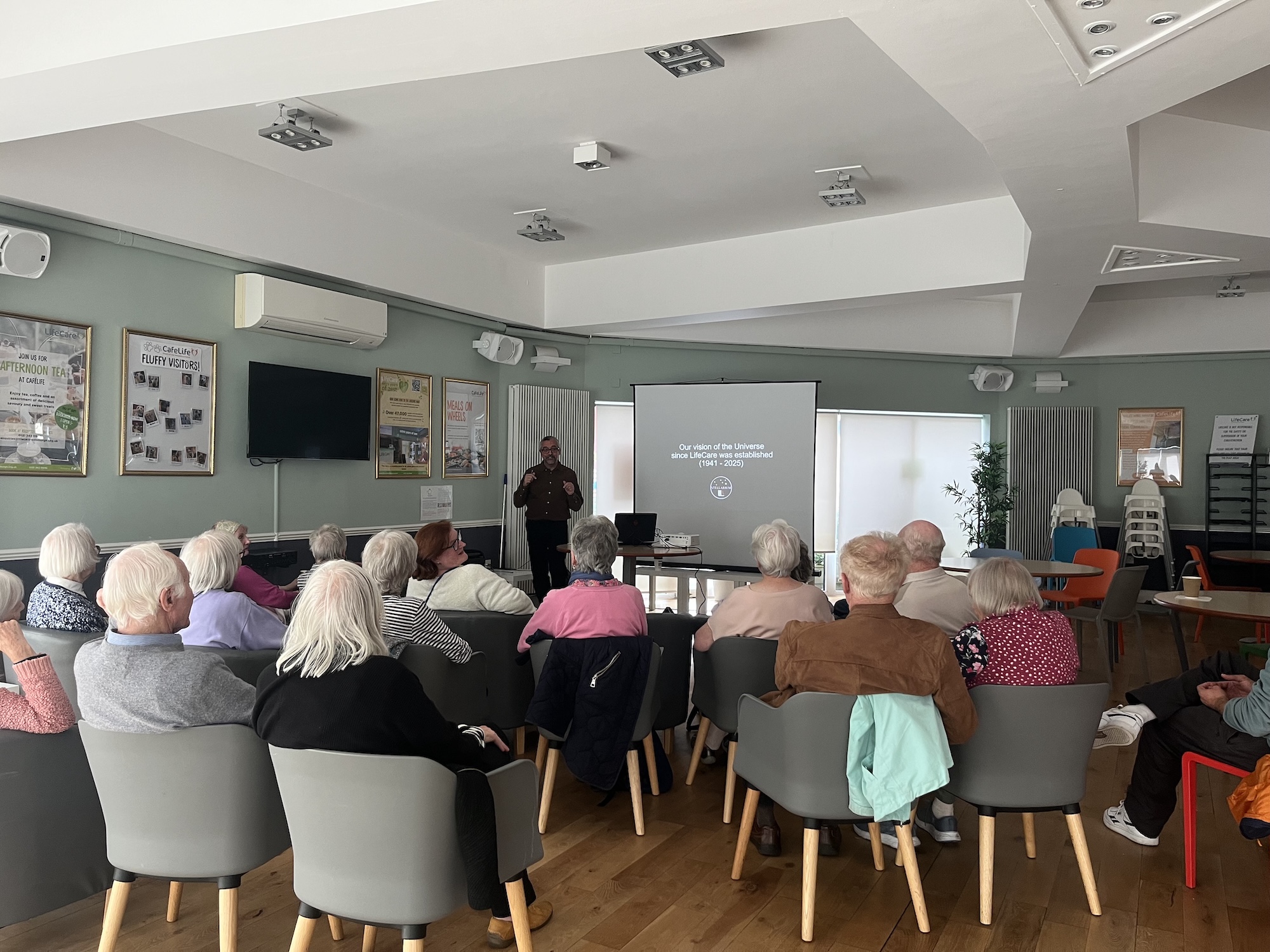
Local charity LifeCare is inviting parents, grandparents and carers to join a free, practical paediatric first aid session at its Stockbridge hub this Friday (11th September).
The session will cover basic first aid for infants, including how to deliver CPR and what to do in the event of choking. It is designed to give people who care for young children the confidence and practical knowledge to respond calmly in an emergency.
Taking place from 3pm to 5pm at CafeLife, LifeCare, 2 Cheyne Street, Stockbridge, EH4 1JB, the informal session is open to anyone who looks after children and would like to learn some essential first aid skills.
There is no need to book, and the session is completely free to attend. Tea and coffee will also be available, with donations welcome to support LifeCare’s work.
Set up in September 1941, the charity is celebrating its 85th anniversary of delivering transformative support within our local communities this month.
Sarah Duckmanton, Activities Coordinator at LifeCare said: “We want to make it as easy as possible for families and carers to access useful, practical information in a friendly and welcoming setting. Knowing what to do in an emergency can make a real difference, and this session is sure to be a great opportunity to learn some important skills.
“This event forms part of our free Talks at LifeCare programme, where we have covered everything from Edinburgh Street Style to the Water of Leith. Everyone is welcome. Thanks to everyone at the National Lottery Community Fund Scotland for helping make these free talks possible!”
CafeLife is fully accessible with lots of space for buggies, prams and wheelchairs. If you’re interested in getting involved or would like to learn more, please get in touch sarahduckmanton@lifecare-edinburgh.org.uk.
Event details
What: Paediatric First Aid – including choking and CPR When: Friday 11 September, 3pm–5pm Where: CafeLife, The LifeCare Hub, 2 Cheyne Street, Stockbridge, EH4 1JB Free but donations are always welcome
Nationwide is the first banking provider to roll out public access defibrillators and bleed control kits across all branches1 – as it becomes Britain’s biggest branch network
All 605 Nationwide branches to have a defibrillator and a bleed control kit installed by end of the year
Life-saving training for Nationwide colleagues and communities across the UK run by St John Ambulance
87% of people would feel safer with local life-saving equipment: 97% state importance of free, life-saving first aid sessions
Forms part of Nationwide’s commitment to High Street and follows promise to keep all branches open until at least 2030
Nationwide is installing life-saving defibrillators and bleed control kits across its 605 branches, while rolling out life-saving first aid sessions in Britain’s local communities.
In what is thought to be the UK’s largest-ever combined rollout, the initiative builds on Nationwide’s long-term commitment to communities.
Britain’s biggest building society, which now has more branches than any other banking provider after overtaking Lloyds Banking Group, has promised to keep all branches open until at least 2030. The rollout, which will see the kits installed from now until the end of the year, is being done in partnership with Visa, with St John Ambulance working alongside Nationwide to offer life-saving training for colleagues and local communities.
The importance of having life-saving equipment readily available locally for emergency services to deploy if needed – and the crucial role the public can play – is made clear by the facts: without first aid intervention, a severe bleed or cardiac arrest can lead to death within minutes.
Severe bleeding remains a leading cause of death after traumatic injury in the UK, with knife- or sharp instrument-related offences totalling around 53,000 in 2024/20252. And of the 40,000 out-of-hospital cardiac arrests in the country each year, fewer than one in 10 people are estimated to survive3.
Yet, if a patient is defibrillated within three to five minutes of collapse, survival rates increase by up to 70 per cent4.
A national poll of over 2,000 people conducted by Nationwide highlights the gap in emergency support within communities:
87% of people would feel safer knowing there is life-saving equipment available in their local area.
88% say life-saving equipment should be as common as fire extinguishers in public – just 27% know the location of their nearest defibrillator and 9% their nearest bleed kit.
89% of people specifically want more public access to bleed control kits due to the rise in knife crime.
56% would find it easier to remember equipment locations when associated with a well-known brand.
97% believe it’s important to have life-saving first aid training available for free in their local area, with over three quarters (77%) of people saying they would attend nearby free sessions.
Despite the need and support for life-saving equipment, there is a gap around public confidence in using resources. More than one in four (27%) wouldn’t feel confident stopping a severe bleed, while 31 per cent wouldn’t feel confident using a defibrillator. Despite the need for urgent intervention, 42 per cent wouldn’t step in for fear of making the situation worse. It is perhaps why over half (51%) don’t believe a stranger would come to their aid in a health emergency.
The lack of confidence is most prevalent among younger people – 18-24-year-olds are more than twice as likely than over-55s (10% vs 4%) to panic in a life-threatening health emergency.
To help build public confidence, Nationwide is working with St John Ambulance to roll out volunteer-led training in life-saving skills. This opportunity will be offered to 4,000 branch colleagues before expanding into ‘Heart of Community’ sessions, giving local people the knowledge and confidence to carry out CPR, use defibrillators and understand how to treat a severe bleed in an emergency.
Amanda Beech, Nationwide’s Director of Retail Services, said:“Nationwide’s unique reach as the UK’s largest branch network gives us the ability to put life-saving equipment where it matters most – in places people already know and trust in their communities.
“By transforming our branches into visible, emergency hubs, we’re making it easier to access help when every second counts.
“Crucially we’re also offering training to all our branch colleagues, before extending that training into the communities we serve. We want more people to feel prepared, confident and ready to act when it matters most.”
St John Ambulance Chief Medical Officer, Professor Andrew Hartle, said: “We’re so pleased to work with Nationwide and Visa on this project, which so perfectly meets St John Ambulance’s mission to put the power of first aid into everyone’s hands.
“With hundreds more public access defibrillators and bleed control kits across the UK, and thousands more people confident to use them, I am confident many more lives will be saved in our communities.”
The kits will be available 24/7 unless within a shopping centre and can be accessed by the public as directed by 999. For more information on where our branches are located visit Nationwide Branch Finder.
So far defibrillators and bleed control kits have been installed across nine Nationwide branches: Tooting, Peacehaven, Seaford, Eastbourne, East Ham, West Wickham, Maidstone, Northampton Kingsthorpe, and Redhill.
The children of Amazon employees in Dunfermline are one step closer to becoming lifesavers after taking part in a special first aid and CPR training session at the Amazon fulfilment centre in Dunfermline.
The mini medics course welcomed 23 Amazon employees and their children for a fun and interactive session that introduced them to essential first aid skills, learning how to check for danger and practising CPR techniques.
Mini Medics is a basic first aid course designed for children between the ages of seven and 16. The course introduces children to health knowledge, lifesaving skills and administering first aid.
Jamie Strain, General Manager at the Amazon fulfilment centre in Dunfermline, said: “First aid and CPR are important skills for young people to have and I’m pleased that our mini medics course has been so popular with our employees and their families.
“I’d like to say a big thank you to our colleague, Anna, for facilitating the training for our team.”
Anna Soltysiak, an associate at Amazon in Dunfermline who led the training, added: “The children who attended our mini medics events were enthusiastic and keen learners. I had a great time teaching them about first aid.
“It’s important for young people to have basic medical skills, as it may one day help save a life.”
Community donations and employee volunteering are just two of the ways Amazon supports the communities where it operates. Amazon co-founded The Big House Multibank in Fife with former UK Prime Minister Gordon Brown to support families in need.
The Multibank network has now donated more than 12 million surplus goods to over 800,000 families across Scotland, Wales, Greater Manchester, London, Tees Valley and Birmingham. This year, the Multibank will send 1 million orders to families across the UK.
Amazon has supported more than one million students across the UK with free STEM education programmes through Amazon Future Engineer and helps community organisations transport meals and other essentials to families in need through its pro bono logistics programme, Amazon Local Good.
Amazon partners with Comic Relief and is the official home of the charity’s iconic Red Nose. Together with its employees, customers, and partners, Amazon has raised over £4.8 million to fund projects that support people across the UK, and around the world.
February is Heart Month – a time to reflect on and act upon how heart and circulatory diseases affect around twice as many people in the UK as Alzheimer’s and cancer combined.
Here at the British Heart Foundation (BHF), we urgently need your help to fund the cures of tomorrow, so we are asking readers to Go Red in Heart Month.
Whether it’s a big ball, an office dress-up day, a coffee morning or a red-themed quiz, red is a great theme to have some fun with.
By fundraising for the BHF this Heart Month, you can help get us closer than ever to a world free from the fear of heart and circulatory diseases and help to keep hearts beating. Too many of us have felt the pain of heart and circulatory diseases – losing a loved one to a cardiac arrest, supporting a child with congenital heart disease or coping with the devastating impact of heart failure.
We are also encouraging your readers to learn the lifesaving skill of CPR in just 15 minutes, through our digital tool RevivR.
Using just a cushion and a phone, you could learn the skills to help save a loved one’s life in the event of a cardiac arrest.
Police are working with the Scottish Ambulance Service and Save a Life Scotland to provide virtual training sessions on CPR.
As part of a Save a Life Scotland, Restart a Heart Live initiative, the sessions will be live streamed via the Save a Life Scotland Youtube channel on Thursday, 10 October, 2024. They will hourly from 9am.
The initiative aims to equip as many people as possible with the technique, allowing them to help if someone nearby goes into cardiac arrest.
The sessions will cover what to do in the event someone goes into cardiac arrest, how to administer CPR, and how to use a defibrillator. Participants will also be able to ask questions throughout the sessions.
Detective Constable Liam Myers said: “Working alongside partner agencies, we hope to demonstrate that anyone is capable of learning and performing CPR. It is a highly valuable skill that can ultimately save a life.
“I hope participants will come away with the confidence to assist if they see someone in cardiac arrest.”
Further information can be found on the Save a Life Scotland website.
The Scottish Ambulance Service (SAS) and Save a Life for Scotland (SALFS) are calling for members of the public to learn CPR and help set a Guinness World Record on Thursday 10th October.
A livestream event – Restart a Heart Live – will be hosted on YouTube and needs 1,500 people to tune into one of the sessions to set the new record. Members of the public are encouraged join one of the sessions, which are running on the hour from 9am to 8pm.
In addition to CPR training, each 25-minute session will provide education on how to use a defibrillator and what to expect when you dial 999.
The world record attempt is being led by Lee Myers, SAS Paramedic Clinical Team Leader who has trained hundreds of primary and secondary students across the Scottish Borders in CPR skills and defibrillator awareness over his career so far.
Lee said: “Currently only one in ten people in Scotland survive an out of hospital cardiac arrest and the likelihood of that person surviving drops by 10% for every minute someone does not attempt CPR. The key to more people surviving is training in schools and with the public.
“Through Restart a Heart Live we want to train as many people as possible in how to do hands only CPR and how to use a defibrillator. By taking part in this training, we hope that people will have the confidence to attempt CPR on someone who’s life depends on it. So, join us on Thursday 10th October to support your community and be part of a Guinness World Record attempt.”
Lisa MacInnes, Director of the Save a Life for Scotland campaign said: “Learning how to help someone in the event of a cardiac arrest is one of the ways we look out for each other.
“Everyone in Scotland should know how to do CPR and use a defibrillator. Join us on October 10th to learn how.”
Dad saved by his children urges others to learn vital skill with BHF this Heart Month
Scots are leading the way in CPR with 71 per cent having learned the skills to save a life, compared to over half (57 per cent) of respondents across the UK.
New figures released today by the British Heart Foundation (BHF) Scotland, show even more – 82 per cent – in the 16-26 age group (Gen Z) know how to perform CPR. Half (50 per cent) of this age group have learned the vital skill in school.
Almost all respondents who have learnt CPR in locations other than school (98 per cent)1 believe it is important that CPR be taught in schools.
The figures have been revealed as the medical research charity calls on the whole nation to learn CPR during Heart Month in February, with the message to help protect the heart of someone you love.
With around 80 per cent of out-of-hospital cardiac arrests happening in the home, you’re often likely to perform CPR on a loved one.
https://twitter.com/i/status/1752005729924329572
Despite the success in Scotland, a survey carried out for the BHF by Censuswide, also suggests an alarming number of households in Scotland still don’t have anyone who knows how to perform CPR.
Of those respondents who answered that they hadn’t learnt CPR, just over half (51 per cent) said that no-one in their household had learnt the lifesaving skill.
The survey also found generational differences in CPR awareness in Scotland:
· Gen Z (age 16-26) is best trained in CPR, with 82 per cent having learnt, compared to 75 per cent of Millennials (age 27-42), 67 per cent of the Gen X generation (age 43-58) and 65 per cent of the baby boomer (age 59-77) generation.
· 95 per cent of Scots believe that learning CPR is important1, yet only 49 per cent of respondents could pick the correct first step of CPR – making sure it’s safe to approach and checking for a response from an unconscious person.
There are over 3100 out-of-hospital cardiac arrests every year in Scotland. Tragically, just one in ten people survive, a statistic the BHF Scotland is determined to improve by giving everyone the opportunity to learn CPR.
Performing immediate PR and defibrillation in the event of a cardiac arrest can be the difference between life and death.
The charity’s free and innovative online training tool RevivR can teach CPR and the correct steps of defibrillator use in just 15 minutes. Quick CPR and defibrillation can more than double the chances of survival.
Learning CPR came second only to budgeting, in a list of important life skills1:
Q: How important, if at all, do you think it is to learn the below life skills?
Learning to budget
98%
Learning CPR
95%
Learning to disinfect a cut
94%
Learning to do laundry
92%
Learning to use a washing machine
91%
Learning to change a light bulb
88%
Learning to change a tyre
85%
Learning DIY
81%
Michael’s story
The Welsh family celebrate Christmas 2023
In the early hours of 2 January last year, Alison Welsh, from Broughty Ferry, Dundee was woken by the sound of husband Michael, 55, making a terrible noise.
“I thought he was snoring but when I turned round, he was purple and staring at me. I screamed for the children, who ran through, we got him off bed and started CPR immediately,” she recalls.
Her son Christopher, now 30, took the lead, beginning CPR, assisted by sister Rachel, 23, and his girlfriend Chloe, 27, who was staying at the house. All three had been members of their university canoe clubs, where they’d learned to do CPR.
“While I was on the phone to the ambulance the three of them just took over,” adds Alison. “They were incredible, taking it in turns when they got tired. Without them, Michael would not be here today. There are genuinely no words to express what my children did to save their dad, and how amazing they are. Every day we wake up thankful that he is here.”
Michael has not had any problems since the episode but now has a defibrillator fitted to monitor his heart rhythm and to deliver a shock if a dangerous, abnormal heart rhythm is detected.
He says: “Learning CPR is a simple activity that can mean the difference between life and death. I was one of the lucky ones, thankfully people were around who knew what they were doing.”
1’Very important’ and ‘Quite important’ answers combined
@CHSScotland have launched an advice line with trained healthcare professionals to listen and help you process what you’ve experienced and provide advice, support and a friendly, listening ear.
Chest Heart & Stroke Scotland has partnered with the Scottish Ambulance Service and the Resuscitation Research Group at the University of Edinburgh (RRG) to launch a pilot service to support those who witness or provide CPR to someone who experiences cardiac arrest at home or in the community.
The Out of Hospital Cardiac Arrest (OCHA) Aftercare project is funded by the Scottish Government and will provide access to support for anyone participating in CPR or witnessing CPR outwith a hospital setting.
It is estimated that between 3,000 and 6,000 Scots are involved in providing CPR after cardiac arrest to members of the public each year. This can be a traumatic experience, which can impact on their wellbeing and result in emotional and social challenges.
Chest Heart & Stroke Scotland has produced wallet-sized cards promoting the service for paramedics, police, and firefighters to give directly to members of the public at the scene of the incident. Each card includes the Chest Heart & Stroke Scotland Advice Line number, so people can immediately call an advisor to talk through what happened.
Speaking at the launch of the OHCA service, Chest Heart & Stroke Scotland Chief Executive, Jane-Claire Judson, said: “Every year, thousands of Scots carry out CPR or witness CPR being performed on someone at home or in a public place. This can be a traumatic experience, and until now there has been little support available.
“We are delighted to be launching this pilot service in partnership with the Scottish Ambulance Service and funded by the Scottish Government. Emergency services staff giving out our advice line cards at the scene of the incident means people can get help immediately, or at whatever point afterwards they feel they need it.”
Steven Short, Programme Lead for Out-of-Hospital Cardiac Arrest for The Scottish Ambulance Service said: “Performing or witnessing potentially life-saving CPR can be a difficult experience to process. The launch of this innovative pilot service means that all individuals who are affected by out-of-hospital cardiac arrest can easily and quickly access support and, if needed, further aftercare.
“Ambulance service clinicians who respond to these cardiac arrests will have the wallet cards to give out on scene. The details on the cards will enable those who need it to access the advice line to talk through what has happened with an advisor and help them process the events.”
Dr Gareth Clegg, Principal Investigator, RRG, University of Edinburgh commented: “Attempting to help save the life of a loved one or neighbour by performing CPR or using a public access defibrillator is the right thing to do, but helping out can leave bystanders with questions, and sometimes a need to talk things through.
“This groundbreaking initiative signals a commitment to caring for those who have been willing to step up when someone in their community has suffered an OHCA.”
Lived Experience – Lynsey Duncan
Lynsey Duncan is the Chest Heart & Stroke Scotland Deputy Head of Clinical Services. A registered nurse, she lives in Buckie with her husband and two daughters.
In November 2021, Lynsey’s father-in-law John collapsed at home after a cardiac arrest. Lynsey battled for 20 minutes to save his life, performing CPR, before paramedics arrived. Sadly, their efforts were in vain and John, 70, passed away.
As a nurse, Lynsey had been involved in CPR before, but the aftermath of John’s death was different because she’d never had to administer the treatment to a member of her own family. The experience left her upset but she didn’t want to share her feelings with her grieving loved ones.
That’s why Lynsey fully supports the Out of Hospital Cardiac Arrest Aftercare project. Here she explains why.
“My father-in-law John was a farmer and he’d been diagnosed with farmer’s lung – that’s a respiratory disease caused by exposure to dust from hay, straw and grain. We’d seen a deterioration in his health over a few years, and he and my mother-in-law, Pat, moved from the farm into Buckie, near to where my husband Steven and I and our two girls live.
“We’d been on a family holiday with them two weeks’ earlier, and I noticed John was quite unwell and struggling to breathe. About a week later, he was given oxygen to have at home to help his breathing.
“On that day – it was November 5, 2021 – my girls had friends over for tea. I was busy making food and Steven had taken the dogs for a walk. He called me and told me to get to his mum and dad’s immediately. I knew something was seriously wrong, so I jumped in the car and headed over.
“Pat met me at the front door and told me John had fallen. He was in the bathroom. As soon as I saw him, I knew he hadn’t fallen. I knew he’d collapsed. Pat was on the phone to 999, telling them John had fallen, but I took the phone and explained he had arrested, and we needed help right away.
“I started to perform CPR. I’m a nurse. I’ve done this before. But it’s very different to be doing this to someone you know, someone you’re close to.
“He had been propped up against the toilet. I got him on to the floor and started chest compressions. I spent 20 minutes doing this. And throughout all of this, my mother-in-law was standing watching. It was an awful experience.
“We live in Buckie, which is fairly rural, so the first people to come were the wildcat responders. They are volunteers who are trained to provide early CPR and defibrillation. One of them took over from me as I was exhausted. Then the paramedics arrived and took control.
“My husband had arrived by then, too. I just ran to him and had a bit of a meltdown. I told him not to go through to the bathroom and kept saying to him ‘I tried, I tried’ because I knew John was gone.
“The paramedics worked on John for another 30 minutes, but it was too late. It was horrific for all of us, especially Pat. She kept saying ‘John wouldn’t want this’. She’d said that to me, but I’m a nurse – once I’d started the compressions, I couldn’t stop. And the paramedics were the same. They had to do everything possible.
“We then had to wait for the police to come because obviously this was a sudden death. And it was only when I was speaking to the police about what had happened that the enormity of it hit me.
“I kept going over it in my head, thinking ‘what just happened?’ I had bruises on my hands and cuts on my knees from the force of sitting on the bathroom floor doing CPR for so long. I even lost a toenail because I’d been leaning so heavily on my toes.
“But I couldn’t share any of this with my family because they were grieving. I didn’t want to tell them I was worried I hadn’t done enough. I felt guilty even though I had no reason to.
“That’s why I think this initiative is so important. I’m a trained medical professional, but when a nurse friend called me the next day, I broke down when I told her what had happened. What I really needed was to talk to someone who wasn’t emotionally attached who could reassure me I’d done what I could. And that is hopefully what the Advice Line will be able to do for anyone involved in an out of hospital cardiac arrest.
“I’ll never underestimate what my mother-in-law went through. She wasn’t only witnessing the death of her husband but her daughter-in-law trying to save him. I can only imagine the emotions she was feeling. If the emergency services had been able to give us both a card that said the Advice Line was there for support, I think she might have made that call. That might have been further down the line for Pat, but for me, it would have been immediately.
“Pat and my husband and my sister-in-law are fully supportive of me telling John’s story like this. They had no idea how this had affected me until they watched the video I made. They want to make sure everyone is supported when they need it after an incident like this.”
Anyone wishing to contact the CHSS Advice Line can do so on 0808 801 0899 or at adviceline@chss.org.uk
It took just 15 minutes for Victoria Esson, Libby Bance, and Sarah Ewens to learn CPR using the British Heart Foundation’s free online RevivR training tool.
Rangers Charity Foundation has partnered with British Heart Foundation and pledged to raise £25,000 and to encourage as many people as possible to learn CPR.
For Victoria Esson, 32, the New Zealand-born goalkeeper who joined Rangers in 2022, it is a particularly personal cause as she was diagnosed with Wolff-Parkinson-White (WPW) syndrome, a condition which causes the heart to beat abnormally fast.
“It can beat up to 200-300 BMP and in the worst-case scenario, it can lead to a heart attack,” she explains.
“I could feel it happening, but I didn’t know any different as I’d always had them as a kid. When you say to someone my heart is beating fast, it doesn’t always flag up an issue. I remember trying to explain that I’ve got a stitch in my heart, but I didn’t really know how to explain it as a child.
“It was picked up at some pre-World Cup screening back in 2010, so I was lucky. It made sense and became clear when they identified it, and I finally knew.
“It was told it was inherited but no-one else in the family had it. I had surgery within a couple of days and again six months later, and I’m all clear now.”
Victoria believes that learning CPR is a vital lifesaving tool that everyone should know:“You may need it when you are least expecting it.
Above: Victoria Esson
“It’s not something that you can plan for, whether it’s a loved one or a family or a friend or just a person that is sitting beside you in the stand here at Ibrox – it could save someone’s life.”
Libby Bance, 20, who joined the team in September 2023 on loan from Brighton, agreed: “My grandad had a heart attack a few years ago. You hope you never have to use CPR but I’m glad I know how to do it should I ever have to. I like to think I could help someone now. Knowing how to do it is important.
“It only took 15 minutes and that can give someone their whole entire life back, so it’s definitely worth it.”
Striker Sarah Ewens, 31, also welcomed the chance to learn the vital skills: “Before today I would not have had the confidence, but the training means I’d now definitely step in and help someone if they needed it.”
Over 700,000 people in Scotland have heart and circulatory diseases, which also cause the deaths of nearly 50 people in Scotland every day.
L-R Sarah Ewens, Libby Bance, Victoria Esson
Less than 1 in 10 people will survive an out of hospital cardiac arrest and performing the emergency lifesaving procedure can more than double their chance of survival.
RevivR allows people to learn CPR in just 15 minutes and aims to give people the skills and confidence to save a life. It teaches people how to recognise a cardiac arrest, gives feedback on chest compressions and outlines the correct steps in using a defibrillator. All people need is a mobile phone and a firm cushion.
David McColgan, head of BHF Scotland, said: “Heart and circulatory diseases are some of Scotland’s biggest killers and we hope this partnership will help us raise awareness in Scotland’s footballing community about the importance of looking after your heart health, while also enabling more people to learn lifesaving CPR skills.”
It couldn’t be simpler – you just need your mobile phone or tablet and a cushion to practise on.