The Leith Collective launches Christmas tree and festive food exchange
With the cost of living rising ever higher, many of us are scrutinising our spending and cutting back. Frivolous non-essentials are the first things to be struck off the shopping list, and there is a genuine fear this could mean many families will be forced to sacrifice their Christmas in order to make ends meet.
However, one local Community Interest Company is working hard to ensure those in need can still experience and enjoy the spirit of Christmas. Tuesday 1st November will see The Leith Collective launch its Christmas tree and festive food exchange across its three Scottish stores.
Locals are being urged to search their homes for any unwanted Christmas trees and decorations that may be languishing in cupboards and attics.Non-perishable store cupboard essentials and festive treats are also being accepted. All items will be available for anyone to collect at Ocean Terminal, Fort Kinnaird and St Enoch Centre completely free of charge, no questions asked.
The Christmas initiative comes just a month after the launch of The Leith Collective’s winter coat exchange which has received an overwhelming response so far, with over 1,000 coats donated and collected by locals.
The Leith Collective founder, Sara Thomson, explains why she is keen to build on the momentum of the winter coat exchange and go further to help those who are struggling;
“For many people, 2022 has been a real financial struggle, and buying a Christmas tree and festive food will prove to be too much of a stretch this year. These things aren’t ‘essentials’, and it’s highly likely that for them Christmas will be yet another casualty of the cost of living crisis.
“But I believe everyone deserves to have a nice Christmas, and what better way to spread festive cheer than by donating to others and lifting their spirits when they need it most.”
Christmas trees and non-perishable festive food can be dropped off or collected at The Leith Collective at Ocean Terminal, The Leith Collective at Fort Kinnaird, and The Clydeside Collective at St Enoch Centre during opening hours.
It is hoped that by hosting the Christmas tree and festive food exchange in these accessible locations that those currently experiencing difficulties will be able to receive a much-needed helping hand.
This week has seen the appointment of a new Prime Minister, but in terms of economic news it has been a far less tumultuous week than recent ones (writes EMMA CONGREVE, Deputy Director and Senior Knowledge Exchange Fellow at the Fraser of Allander Institute).
Both the UK and Scottish governments announced the postponement of planned budget events. The Scottish Government’s decision not to go ahead with its ‘Emergency Budget Review’ at this time was not surprising. However, there are questions around what budgetary changes will be made this financial year in response to inflation’s impact on public spending.
As highlighted in an article last week, that includes understanding the detail of employability cuts (announced back in September), and indeed the detail of where else the Scottish Government is eking out savings. We need better transparency over how these decisions have been made and the impact on people providing services and the people they support.
If/when the Emergency Budget Review goes ahead is unclear. It may well end up being rolled into the draft Scottish budget announcement for 2023/24, due on the 15th December.
The UK government’s decision to postpone its planned fiscal statement (now rebranded as the Autumn Statement) from the 31st October to the 17th November is justifiable given the prime ministerial change (and in light of the decisions of the incoming Chancellor Jeremy Hunt the previous week).
Delaying the fiscal statement should also mean that the outlook for borrowing costs should be slightly better than it would have been had the statement been published next week since it shifts the reference period for bond yields that the OBR will use in its forecasts.
The publication of the UK Autumn Statement on 17th November means there will be a window of four weeks between the UK Autumn Statement and the Scottish budget on 15th December.
Assuming the UK Autumn Statement is definitive about spending plans in 2023/24, this should provide adequate time for the Scottish government to prepare its 2023/24 by the 15th. There is little scope to push back the draft budget statement into January due to the timescales required to get the Budget Bill through the Scottish Parliament in time for the 2023/24 financial year.
With an expectation of further fiscal tightening by the UK government, the Scottish Government will be braced for more difficult decisions.
Until we see the UK Autumn Statement however, it remains very uncertain how the UK government will prioritise different tax and spending measures, and over what timescales, and hence the implications for the Scottish budget in 2023/24 and beyond.
As always, we will be looking for evidence-based rationales and transparency in how spend has been prioritised from both governments; a subject we will no doubt return to in the coming weeks.
More detail on the impact of the cost of living crisis
As we discussed last week, CPI inflation for September was estimated at 10.1%. This week, the ONS have published supplementary analysis on how rising prices are affecting adults across Great Britain.
9 in 10 people surveyed reported that their cost of living had increased compared to a year ago and the survey asked questions on the extent to which this had impacted their lives.
Around 45% of adults in both GB and Scotland reported finding energy bills somewhat or very difficult to pay and around 30% of GB and 25% of Scottish adults reported finding rent and mortgage payments difficult to afford.
Other breakdowns by protected characteristics showed different experiences. For example, 55% of disabled people, 69% of Black or Black British adults, 59% of Asian or Asian British adults and 60% of renters were finding it somewhat or very difficult to pay energy bills (compared to the population average of around 45%).
These differences are likely to be linked to socioeconomic status: around half of those with a personal income of less than £20,000 per year said they found it difficult to afford their energy bills which reduced to 23% for those with a personal income of more than £50,000.
This week, the ONS also published a ‘highly experimental’ (their words!) analysis of low-cost groceries. For half of the sampled items, the average lowest price goods increased at a faster rate than the official CPI inflation measure for food and non-alcoholic beverages over the past year.
The highest rising prices were for vegetable oil (65%); pasta (60%) and tea (46%). Bread and milk were among other items that rose by more than the CPI average.
The pressures are also of course affecting businesses. The latest Scottish Government analysis of the BICS survey found that 49.8% of businesses reported that the prices of materials, goods and services bought in September 2022 were higher than in August 2022. Around 60% of businesses reported absorbing these costs, and around 35% reported that at least some of the price increases were passed on to customers.
Going back to the previous survey of GB adults, the most significant behavioural changes reported were ‘spending less on non-essentials’ (62% of adults in GB and in Scotland) and ‘using less fuel such as gas and electricity in my home’ (52% of GB adults, 57% in Scotland). If the latter prevails into the colder season, there is of course a concern that this will have serious adverse impacts on health.
Upcoming webinar for your diary
On the subject of health impacts, the Fraser of Allander Institute, in collaboration with MRC/CSO Social and Public Health Sciences Unit at the University of Glasgow and the Health Foundation are holding a webinar on the 15th November (3 – 4.30pm) to discuss trends in health and the socioeconomic drivers of health in Scotland.
Our report on the trends in socioeconomic determinants of health over the past twenty years will be out in the coming weeks.
Click here to sign up to the webinar to hear all about it.
Scottish Labour MSP, Sarah Boyack, has called on the Tory UK Government to get on with delivering their cost of living support package as who do not have a domestic electricity contract are still waiting for details of the support they will receive, despite payments already being made to residents with a domestic energy contract.
People without domestic electricity contracts are still waiting for confirmation that they will receive the £400 Energy Bill Support and how this will be paid to them
In a policy paper, the UK Government confirmed that the support will be provided to those who do not have a direct relationship with an electricity supplier – however, there is still no clarity about the process.
Sarah Boyack, Scottish Labour MSP for Lothian, said: “While there is revolving door for Prime Ministers and Ministers, the Tories are failing to deliver for local residents here in Edinburgh.
“Local residents who do not have a direct relationship with their energy supplier are still waiting for the clarification on how and when they will receive the £400 Energy Bill Support, as the winter weather starts to come in.
“The cost of living emergency is already starting to bite as more and more families are having to make the choice between heating and eating.
“I have written to the Secretary of State for Business, Energy and Industrial Strategy to announce details as soon as possible which will provide certainty to families.”
Environmental campaigners have reacted to the announcement that oil giant Shell has made £8.19bn ($9.5 Billion) in profits in the third quarter of this year.
Campaigners say that the forthcoming Scottish Energy Strategy is a chance for Scotland to ‘chart a clear path’ away from the oil and gas companies who are harming people and the planet to instead create an energy system that runs on renewable energy.
Climate science is clear that we urgently need to transition away from our broken fossil fuel energy system in order to stay within safe climate limits. Analysis has shown that renewable energy is 9 times cheaper than new fossil fuel energy.
Independent climate advisors have made it clear that increasing UK supply of oil and gas will have almost no impact on UK bills as prices are set by the international market. However, continued reliance on volatile fossil fuels will leave millions vulnerable to spikes in their prices.
Shell’s profits for the previous 3 months of 2022 (Q2) were £9.5billion ($11.5billion).
Friends of the Earth Scotland’s Oil and Gas campaigner Freya Aitchison said: “The announcement of yet another obscene profit for Shell shows the scale of the pain that these companies are inflicting on the public.
“While oil companies continue to make record breaking profits, ordinary people are facing skyrocketing energy bills and millions are being pushed into fuel poverty.
“Bosses and shareholders at Shell are being allowed to get even richer by exploiting one of our most basic needs. Shell is also worsening climate breakdown and extreme weather by continuing to invest and lock us into new oil and gas projects for decades to come.
“The Scottish Government must use the opportunity of its forthcoming Energy Strategy to chart a clear path away from fossil fuels and towards an energy system that is built on clean, reliable renewables.
“They must listen to the science which tells us that to meet climate targets in a fair way, fossil fuel extraction needs to be phased out in the next decade.”
Drivers currently paying £463 on average following a recent spike
Drivers in central Scotland have seen the biggest increase to their car insurance premium over the past 12 months. The current cost stands at £505, on average, following a £73 (17%) rise.
Drivers in the Scottish borders are currently paying the cheapest rates for their car insurance. Premiums are £391, on average, despite a 20% price increase in the past 12 months.
Although FCA changes to regulation have made pricing fairer to customers at renewal, further research highlights that this does not necessarily protect customers from price increases. More than 2 in 5 (41%) UK drivers who received a renewal quote in the past 3 months said that they saw an increase of £38, on average(1).
However, those who shopped around using a price comparison website were able to save £50 on their car insurance, on average.
With the current cost-of-living crisis affecting millions across the UK, Confused.com recently launched its money saving hub to support consumers and give advice on how to manage recent price hikes.
In light of the recent price increases, Louise O’Shea, CEO at Confused.com emphasises the importance of shopping around for the best deals and why drivers shouldn’t settle for auto-renewal.
That means motorists are seeing a £69 increase compared to this time last year. That’s according to the latest car insurance price index (Q3 2022) from Confused.com, powered by WTW. Based on 6 million quotes a quarter, it’s the most comprehensive car insurance price index in the UK.
However, some drivers in Scotland could be paying more than the national average, depending on the region in which they live. The latest data shows that drivers in central Scotland are currently paying the most for car insurance.
Their current premium is £505, following a £73 (17%) year-on-year increase. Despite facing an annual increase of £64 (20%), drivers living in the Scottish Borders pay the cheapest rates for their car insurance, with an average premium of £391.
Meanwhile, drivers in East and North East Scotland are paying £431, on average, for their car insurance. That’s as drivers faced a £69 (19%) increase in the past 12 months. And as for drivers in the Scottish Highlands and Islands, the current car insurance premium is £420, on average, following an increase of £61 (17%).
Region
Average Premium
YOY £
YOY %
Scottish Borders
£391
£64
20%
Central Scotland
£505
£73
17%
East & North East Scotland
£431
£69
19%
Scottish Highlands & Islands
£420
£61
17%
It’s a similar picture across the rest of the UK, where prices continue to rise. In fact, premiums have risen by £72 (14%) in the past 12 months alone.
The current UK premium stands at £586, on average, and is the highest annual increase in the past 5 years.
With the latest data revealing that premiums are on the rise, some drivers might think that they’re better off sticking with the same insurer when it comes to renewal. But further research conducted by Confused.com finds that some insurers don’t seem to be doing enough to protect their existing customers.
In a survey of 2,000 UK drivers, data reveals that more than 2 in 5 (41%) drivers who considered sticking with their current insurer received renewal quotes £38 more expensive than the previous year, on average(1). That’s despite the fact that more than a quarter (28%) of drivers who have renewed so far this year thought that their insurance quote would be cheaper this time around.
However, some motorists are taking action after receiving a more expensive renewal and are really seeing the benefits of switching. More than a quarter (27%) of drivers who chose to shop around using a price comparison site were able to save £50, on average. In fact, the Financial Conduct Authority (FCA) is actively advising consumers to shop around when it comes to buying insurance for this very reason.
Earlier this year, the FCA made important changes to stop ‘price walking’ and ensure all customers were treated fairly, but it seems some motorists remain complacent as a result. One in 5 (20%) drivers told Confused.com that they were less inclined to shop around because of these changes.
However, these new regulations don’t mean that better deals still can’t be found elsewhere and, as research shows, consumers are saving money by switching.
While the cost of car insurance premiums is on the up, there’s no ignoring the fact that the general cost of living is increasing, too. That’s why it’s more important than ever to shop around for the best deals. And as we head into the colder months, it’s clear that money will be tight for many.
With difficult months ahead, Confused.com has launched a money saving hub to help people understand where they can save money on bills to balance out price hikes. The hub focuses on a variety of insurance options, but also includes advice on how to be more fuel efficient and keep car costs down.
Its aim is to provide useful and digestible information that will help customers save money, without necessarily having to compromise and give up essentials.
Louise O’Shea, CEO at Confused.com, comments: “With costs currently rising all around us, I’m sure it comes as no surprise that the cost of car insurance is increasing, too.
“However, the pace at which it’s rising will be a real worry for many. The latest figures reveal a true example of how volatile the market currently is, which is why I need to stress just how important it is to shop around when it comes to renewing any insurance policy.
“As we head into winter, money is going to be tight. With concerns over the rising costs of energy, fuel and even food, millions of us will be looking for new ways to number-crunch and save money where we can. In recent months, the FCA have really amplified the importance of shopping around to help find some of the best deals out there during this time.
“Research shows that customer loyalty doesn’t always pay off, which is why it’s always encouraged to shop around and see what else is out there. If you switch insurers using Confused.com, there’s some fantastic rewards available that could help during a difficult time.
“A £20 voucher could pay towards a food shop in Lidl or even go towards an MOT or service in Halfords. And we even guarantee to beat your renewal(5). If we can’t, we’ll give you £20, plus the difference. Either way, you’re better off just by using a price comparison service.
“I cannot emphasise enough just how important it is to take time, do your research and compare insurance prices. You might be missing out on fantastic deals and it will really help in the long run.”
The First Minister has convened a second summit with energy companies and advice organisations.
Further actions to support consumers and businesses through the winter have been agreed at yesterday’s virtual summit between energy companies and advice organisations and Ministers.
The energy cost crisis summit discussed this week’s reversals to UK Government measures set out since the previous summit, and agreed longer-term certainty is urgently needed ahead of the anticipated energy price cap increase, currently due in April.
First Minister Nicola Sturgeon said: “The curtailing of the Energy Price Guarantee by the Chancellor of the Exchequer earlier this week has eradicated what meagre certainty people and businesses had over their bills and finances in the short to medium-term.
“Even the current cap of £2,500 until April – while better than a rise to £3,500 – is still a very significant increase for households who are already struggling to pay their bills and heat their homes. Without further mitigation the increase to £2,500 under the Energy Price Guarantee will see an additional 150,000 households in extreme fuel poverty.
“The deficiencies in the UK Government’s package mean we are still in an emergency situation. The economic outlook has been made far worse by other aspects of the mini-budget – most of which have now had to be reversed entirely.
“The Scottish Government is working hard within its limited powers and finite budget to support people, business, public services and the economy. Part of that work will involve ongoing engagement with energy companies and advice organisations throughout the winter to see how, individually and collectively, we can alleviate the huge challenges people are facing as well as signposting existing schemes and support that is available.
“It is clear however that more substantial reform of the energy market is needed to address the issue in the long term, and the power to do so lies with the UK Government.”
ADT shares guidance on protecting homes amid rise in property crime
ONS has recently released its property crime data, which shows that 23% of the UK have been victims of household theft from April 2021 to March 2022 – up 2% from last year.
As the nights get darker earlier, and clocks change, the security experts at ADT have provided top tips to ensure your property is fully protected this winter.
Glenn Amato, Managing Director, Subscriber UK&I at ADT UK said: “The latest data from ONS shows a rise in household theft over the last year, with 23% of the UK being victims of it – though this isn’t wholly surprising, given that there are less people working from home full time now.
“That said, when paired with the deepening cost of living crisis, the potential of a looming recession and moving into the winter season and darker nights, it’s understandable how some people might be starting to feel concerned about the safety of their homes.
“In the 2008 recession, we saw rates of personal theft increase by 25% and burglaries rise 4%, so if the country heads into another recession, property crime could sadly increase again.
“Historically, when the cost of living has increased, there has also been increases in ‘snatch and steal’ type crimes. “
The good news is that there are many precautions homeowners can take to protect their properties and feel safer:
1. Double lock and double check – one lock on the door often isn’t enough to protect the home, burglars can use their foot to check whether there is a deadlock on the door. Invest in a second lock and always double check both front and back doors are locked when leaving the house.
2. Social Media awareness – If a burglar has access to your name through old post or personal information, they can easily find your social media accounts too. Sharing posts whilst you’re away visiting relatives during the Christmas season, or posting so-called holiday countdowns are an open invitation for burglars to head into your home with the knowledge that they won’t be disturbed.
3. Think twice about lights – While leaving your lights on may signal an occupied house to potential intruders, it can increase the cost of bills, as well as making valuable belongings more visible to thieves. Consider using smart plugs to turn lights on, only when necessary and you’re away from your home to give the impression of occupancy. Make sure curtains or blinds are closed at night so that potential burglars don’t have a direct line of sight into your valuables and the layout of your home, and only leave on dim or energy saving bulbs.
4. Invest in your security – Having an up-to-date digital alarm system is the best way to prevent burglaries. It’s worth investing in home security that is professional installed and monitored by trusted professionals, which signals directly to an alarm receiving centre when it detects an intruder. Smart home security systems are also a great option for people looking for protection. Systems like ADT’s Smart Home system integrate entry sensors and sirens to a range of devices like lights, smart plugs, doorbells, cameras and remote mobile apps, by connecting through WiFi and GPRS.
5. Forget hiding a key – Most people have managed to lock themselves out at least once but hiding a key in the vicinity of a home – whether under a flowerpot or above the doorframe – simply isn’t worth the risk. If a spare must be kept outside, at least keep it in a locked key safe, which requires a code.
THIS week the government replaced one catastrophic plan with another (writes TUC’s GEOFF TILY). A new course to placate financial markets is traded off against likely massive hits to household budgets and fears about the future.
Support for energy bills was cut, public services already stretched beyond breaking point will be hit again, little was offered on soaring borrowing and mortgage costs, and nothing about already deeply inadequate benefits and universal credit falling further behind inflation.
There is another way to deliver an economy that works for working people, but the government couldn’t be further from it,
Dealing with failure
The Truss government were right about one thing, the economic policies of the past decade and more have been a disastrous failure. As Kwasi Kwarteng admitted, growth has been ‘anaemic’. In the ONS words: the UK is the only G7 economy yet to recover above its pre-coronavirus pandemic level in Quarter 4 2019. The UK has the lowest investment as a share of GDP (see our ‘companies for the people report’, Figure 7) In Spring OECD figures showed UK real wages would fall furthest of all G7 economies.
Mini budget catastrophe
But the mini budget was catastrophically wrongheaded. Truss and Kwarteng took the fundamental problem of an economy serving wealth not work and turned it into the solution. The flip side of support for energy bills, was lavish tax breaks for those least in need – under the spurious and long discredited fallacy of ‘trickle down’.
On top of this their intention was to borrow to fund this extreme project. They did so the day after the Bank of England had confirmed that they would be reducing support for government borrowing, and implementing a £80billon programme of ‘quantitative tightening’ [i.e. selling back government bonds to financial markets] from the start of October. (Regardless of anything else this revealed staggering lack of coordination on the part of both institutions – the excellent Daniella Gabor called this ‘uncoordinated class war on the British public’.)
Financial markets took fright and instead of buying started to dump government debt, but this was also intimately connected to a third factor. The complex financial strategies – so-called liability driven investments (LDI) – that pension funds have been deploying (unnoticed by most) for the past 20 years began to unravel in the face of these rate rises.
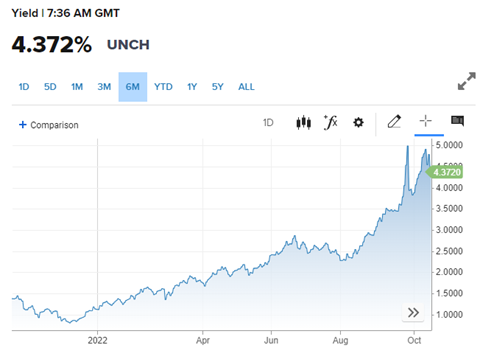
The Bank of England was obliged to step in to halt a vicious cycle – or doom loop – of bond sales leading to higher interest rates and so more bond sales. The spike in the chart below of interest rates on UK 30-year bonds shows how the episode was at least momentarily brought under control.
And in the meantime the government came under sustained assault for ‘fiscal irresponsibility’.
U-turn to a worse economy
After two U-turns (on the 45p top rate and corporation tax reductions), yesterday they U- turned on pretty much the whole thing.
But reversing a wrong doesn’t make a right, far from it.
We are now on the brink of a deep and damaging recession that threatens millions of jobs. But the latest Conservative chancellor has now announced the same basic approach that got us into this mess.
He warned of “more difficult decisions” on tax and spending to come. And immediately that “Some areas of spending will need to be cut”.
The Chancellor not only announced austerity. He not only sought once more – as did his George Osborne – to make a political virtue about imposing misery. He even invited George Osborne’s favourite adviser Rupert Harrison (now at Blackrock, one of three key institutions in LDI strategies) back to the Treasury to head a new panel of ‘economic advisers’ to deliver this reborn monstrosity.
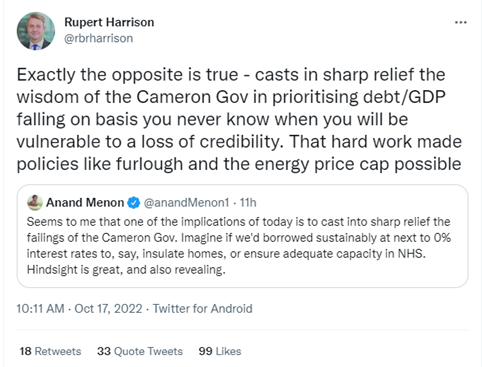
Yesterday morning Rupert gave his City-oriented perspective on austerity
But this is a seriously misleading statement. The Osborne government did not repair the public finances. Over 2010-2019 the public debt ratio increased by 22 percentage point of GDP – the worse performance over a decade of economic recovery for a century (here).
For workers, this meant the worst pay crisis for 200 years. As Frances O’Grady spells out today, now expected (and this was before yesterday) to last at least two decades.
But the context for policy today is even more worrying than in 2010. Central banks, led by the Federal Reserve in the United States, are engaged in a forceful (their word) tightening of monetary policy.
This amounts to ending a strategy that has been in place since the start of the global financial crisis. In the wake of the last increase to 3.0 to 3.25 per cent, a Fed committee member has pointed to rates at up to 4.5 to 5 per cent. Fear of the impact of these rate rises on mortgage rates is likely common to all countries – for example in the US rates on a 30-year mortgage are up from 2.7 per cent at the start of 2021 to 6.9 per cent now.
And while in the UK the spike was brought under control, government interest rates are still seriously elevated and will carry on feeding through to mortgages.
In the UK money expert Martin Lewis has offered a grim rule of thumb: “For each 1 percentage point your mortgage rate increases, expect to pay roughly £50 more a month (£600/year) per £100,000 of mortgage debt.” The Resolution Foundation reckoned five million families would see annual payments rising by an average of £5,000 between now and the end of 2024.
Standing further back, the Financial Stability Board (Dietrich Domanski on the Today programme, 6 Oct.) have warned of the challenges of raising interest rates to deal with inflation under the conditions of the high global indebtedness that prevail today.
Likewise the IMF last week warned of “hidden leverage”, “waves of deleveraging”, and in particular the risk to ‘non-bank financial institutions’ – the latter including pension funds.
In terms of countries, first in the firing line are emerging market economies – with 20 countries “in default or trading at distressed levels”.
While the immediate trigger for central bank policies is the inflation set in motion by the end of lockdowns and Putin’s brutal invasion of Ukraine, the scale of the dislocation reflects a wider failure to set the economy right since the global financial crisis of 2008-09 exposed deep underlying failings. Summing up, the IMF offered the chilling: “the level of risk we are flagging at the moment is the highest outside acute crisis”
As the Biden administration has argued, for 40 years the interests of wealth have been prioritised over those of workers. The economy crashed in the first place because these financial interests proved wildly at odds with the interests of the population as a whole. An economy of speculation and debt crowded out production and decent pay and work.
The chancellor’s new advisory panel puts these interests back front and centre of policymaking at the Treasury. The other members so far announced are also from the City of London, not least securing J.P. Morgan a seat at the table.
Yesterday the Financial Times reported that the Bank of England’s programme of quantitative tighten has been put on hold, likely to protect the casino capitalism around pension funds.
Ahead of the mini budget the TUC issued a plan for a budget ‘on the side of working people’. We desperately need a government that will put first our interests not those of wealth. But instead once more the interests of the city of London are put ahead of those of workers and the country.
Latest research from the Gas Safe Register reveals that almost one third (31%) of UK homeowners will skip their annual gas safety checks this year in attempts to reduce household costs. Heating expert and leading manufacturer, Alpha, believes a nationwide call to action is needed to address this imbalance and ensure gas safety remains an essential priority.
“The Gas Safe Register data is alarming and demonstrates yet further implications of the cost-of-living crisis,” says Alpha’s product engineer, Jonathan Kidner. “Gas safety checks in the home can prevent serious or life-threatening accidents including gas leaks, explosions, house fires and carbon monoxide poisoning.
While it was encouraging that the research also showed the majority (77%) of homeowners knew the benefits of regular servicing and maintenance, most notably performance and cost savings, it seems this awareness isn’t translating into enough action and is therefore an extreme cause for concern.”
Alpha argues one of the most important steps for homeowners is to arrange for a Gas Safe Registered engineer to undertake checks on all gas appliances, including an annual boiler service.
This will not only ensure boilers continue to run at optimum efficiency, but also identify any potential faults and ensure warranties and insurance policies remain valid. Homeowners can set reminders for boiler services via the Gas Safe Register’s Stay Gas Safe website.
Jonathan continues: “The boiler is one of the most used pieces of equipment in the home yet the perceived maintenance costs remain one of the main reasons people don’t book a service; our own research from 2021 indicated this being the barrier for 54% of respondents. This needs to change.
“The experts at Which? suggest the average price of a boiler service is just £80 which, when compared with the cost of repairing or replacing the most common faulty parts, could save homeowners anywhere between £30 and £219.”
Additional measures homeowners can take to remain gas safe include:
Undertaking visual checks to look for warning signs on unsafe appliances including lazy yellow flames instead of crisp blue; pilot lights which frequently blow out; excessive condensation on windows; and unusual dark marks/staining on or around gas appliances;
Testing and replacing smoke alarm batteries;
Installing a carbon monoxide alarm and familiarising themselves with the six key symptoms of carbon monoxide poisoning.
Jonathan concludes: “While some of these points may seem obvious or even repetitive, the Gas Safe Register research highlights there is a need for reinforcement.
“Only one in three homeowners knew house fires were a potential result of not having regular gas safety checks and less than half could correctly identify symptoms of carbon monoxide poisoning.
“This is a conversation we need to keep having until this knowledge becomes commonplace.
“We understand the collective concern about rising costs but the loss could be far greater if we do not encourage homeowners to act now and prioritise their gas safety.”
In response to the cost of living crisis, Fresh Start will be hosting a weekly community meal (Meet and Eat) on Wednesday evenings and Friday afternoons at Fresh Start Kitchen, 28-30 Ferry Road Drive – see flier (above).
This is for anyone you can think of who would benefit specifically from a free two course hot meal in a safe and welcoming environment.
We will begin the Wednesday evening Meet and Eat on 26th October, and this will run until March 2023.
Our Friday afternoon Meet and Eats are currently running as usual: