The countdown is on for acclaimed bar-and-restaurant The Botanist to open its doors at St. James Quarter in Edinburgh.
Cocktail lovers will be able to get their hands on the venue’s famous innovative drinks from Monday 7th August, when the venue is set to welcome in guests for the first time.
The brand is looking for a full team to run operations at its new venue, with 50-60 roles available including both front and back of house staff, from Chefs to Servers to Bartenders, and encourages creativity, individuality and personal flair from its employees. Roles are also advertised for a Duty Manager and Sous Chef to join the growing team.
Edinburgh’s winers and diners can look forward to The Botanist’s fresh seasonal flavours, reviving botany-inspired cocktails and signature hanging kebabs that they’ll want to keep going back for.
Live music is another key ingredient in helping to create a relaxed and atmospheric experience-led social space, ideal for family meals, after-work drinks, sophisticated evenings with friends and celebrating special occasions.
The interior fit-out of the space is currently underway and the brand is renowned for its grand botanical-inspired interiors.
Guests can expect to enjoy beautiful installations of greenery and exposed brick walls adorned with impressive hand painted artwork whilst they drink and dine. The bar will also feature a dedicated outdoor seating terrace.
Rachel Guy, Operations Manager at New World Trading Company said, “Our stunning new flagship venue brings the opportunity for exceptional individuals join us. Joining the business at the start of our journey means you’ll be bringing our unique brand to life in Edinburgh with the help of award-winning training.
“Our in-house Management Academy & Future Managers programme offers transparent career pathways and the chance to progress across our nationwide brand family.”
To stay up to date with The Botanist Edinburgh’s opening and be the first to know about, sign up to its newsletter to be the first to know about exclusive invites and offers for the opening week.
The Scottish Ministerial Code has been updated to further strengthen transparency and propriety.
Updates to the Code include:
New text reflecting the updates to the procedure for handling complaints by civil servants about the behaviour of a Minister or former Minister, making clear that for future complaints certain information about concluded cases will be made public, including the Minister’s name, the nature of the complaint and the outcome of the complaint, even after a Minister has left office, and setting out the obligation on Ministers to cooperate with the procedure.
The introduction of an annual review of Ministers’ private interests, and proactive publication of these interests on an annual basis, to enhance integrity and transparency around actual or perceived conflicts of interest. In addition, new text has been introduced to provide additional clarity for Ministers on managing overlaps between their Ministerial responsibilities and constituency interests.
General updates on provisions for maternity leave and to reflect the introduction of the Bute House Agreement, as well as minor amends to take account of digital developments, new published strategies and changes in Ministerial titles and responsibilities.
The First Minister Humza Yousaf said: “This new edition of the Ministerial Code sets the highest standards of propriety and transparency for Government Ministers.All Scottish Ministers, including myself, are bound by its terms and are committed to uphold the Principles of Public life, ensuring integrity, accountability and honesty at every level of leadership.
“Scottish Ministers are committed to building a better future for the people of Scotland while facing the profound challenges of our time. This will mean taking some tough decisions to ensure that we support those in greatest need, and it is vital that we are guided in this mission by a clear set of principles.”
Businesses abstracting water from the environment are being urged not to get complacent as river and ground water levels return to normal across much of Scotland.
The latest water scarcity report, published today by the Scottish Environment Protection Agency (SEPA), reveals most of the country has now recovered to Normal Conditions or Early Warning.
This is in stark contrast to just three weeks ago when five areas of Scotland had reached Significant, the highest level available, following a period of prolonged dry weather.
Chris Dailly, Head of Environmental Performance – Geographic at SEPA, said: “Last month was challenging for those businesses reliant on water from the environment. We very much welcome this turnaround in conditions and much needed revival of river levels.
“It’s served as a reminder of the vital role water plays in many industries in Scotland and the crucial part businesses play in ensuring the sustainability of local water environments.
“As climate change exacerbates water scarcity, it’s imperative that water abstractors understand the impact of their usage and step up their efforts to manage this now and longer-term.”
Further rain is forecast across the southern half of the country this weekend, which may lead to continued recovery in some areas.
However, river flows and ground conditions have seen less recovery and are drier in the north-east, Fife and East Lothian, which remain in Alert level. Another dry spell may quickly lead to a deterioration in the water scarcity situation in these areas.
SEPA are urging abstractors in Alert areas, especially if taking water from burns and small rivers, to:
Routinely check equipment isn’t leaking.
Only use the water required for the use.
Consider water saving measures for next irrigation season.
If the catchment reaches Moderate Water Scarcity, consider your upcoming water needs and begin to plan with others in the catchment to share the resource or schedule abstractions.
SEPA are responsible for monitoring and reporting on the situation facing Scotland’s water resources and work with businesses all year round in industries such as agriculture, food and drink production, hydro energy and leisure to increase resilience to water scarcity.
35 of these are maintained by the Council and the remaining three by the Friends of Corstorphine Hill (Corstorphine Hill LNR Community Walled Garden), NHS Lothian (Royal Edinburgh Hospital), and Heriot Watt University (The Lawn & Central Woodlands).
Edinburgh’s award recipients represent over one third of the 87 total Green Flag Awards across Scotland.
The Capital placed third overall in the UK in total Green Flag Awards.
The full list of awarded parks and greenspaces in Scotland is available here.
The International Green Flag Award is bestowed upon parks and greenspaces that demonstrate excellent management and adherence to environmental standards. To make sure Edinburgh’s parks are kept to a high standard, each year the Council checks all its parks and gardens using Green Flag Award criteria.
Culture and Communities Convener, Councillor Val Walker, said: “I am delighted that 38 parks around Edinburgh have been recognised by Keep Scotland Beautiful and the Green Flag Awards scheme.
“The scheme recognises the quality of parks and greenspaces, their benefits to communities and the hard work of managers, staff and volunteers who keep them ticking over.
“Here in the Capital, we are truly spoiled for choice across the city when it comes to fantastic parks and green spaces. Each different space has a unique character and significance for the residents and visitors that it welcomes.
“As part of our Edinburgh’s Thriving Greenspaces 2050 strategy, we are committed to doing everything we can to safeguard, preserve and improve these spaces so that people can continue to enjoy them, and communities feel involved in how they are looked after.”
Pic Greg Macvean 13/07/2023
Keep Scotland Beautiful – Green Flag Award 2023/24
Jamie Ormiston, Senior Awards Officer at Keep Scotland Beautiful, said: “Congratulations to our 38 award winners in Edinburgh. Every park has a wide range of people visiting them and their requirements can vary. What is essential is that they are well maintained and provide a safe place for people to relax and have fun.
“Our award-winning parks have demonstrated they are worthy winners, meeting the criteria of the coveted international award. Receiving this prestigious benchmark recognises all the hard work that has gone into maintaining and managing these precious green open spaces.
“It is imperative that Scotland reconnects with the natural world if we are to fix the biodiversity crisis and these green spaces will provide a space for people of all ages to do that.
“Green spaces are so important for our physical and mental wellbeing and it’s fantastic to see such a wide range of parks and green spaces across the entire length of the country. I encourage everyone to make the most of them this summer.”
Charity vets urge owners to trade tennis balls for safer toys following Wimbledon final
A tennis ball-obsessed dog from Wolverhampton got himself into a spot of bother after taking his hobby too far and swallowing two balls whole; leaving him needing life-saving surgery from vet charity PDSA.
Loki, a five-year-old crossbreed, landed himself in trouble after a game of fetch with his loving owner Amy, ended in disaster and an emergency trip to Wolverhampton PDSA Pet Hospital.
Amy explained: “Loki is a high-energy dog and he loves nothing more than a game of fetch. Most of his toys are the ‘super strong’ ones – he’s a gentle giant, but his toys don’t last long if they aren’t tough ones. But his favourites are tennis balls, he’s obsessed.
“It was only when Loki refused to eat, and started being sick, we realised something was wrong. He was still active and playful, but it’s not like Loki to pass up some food! When the sickness didn’t stop we called PDSA, and they told us to bring him straight in for an appointment.”
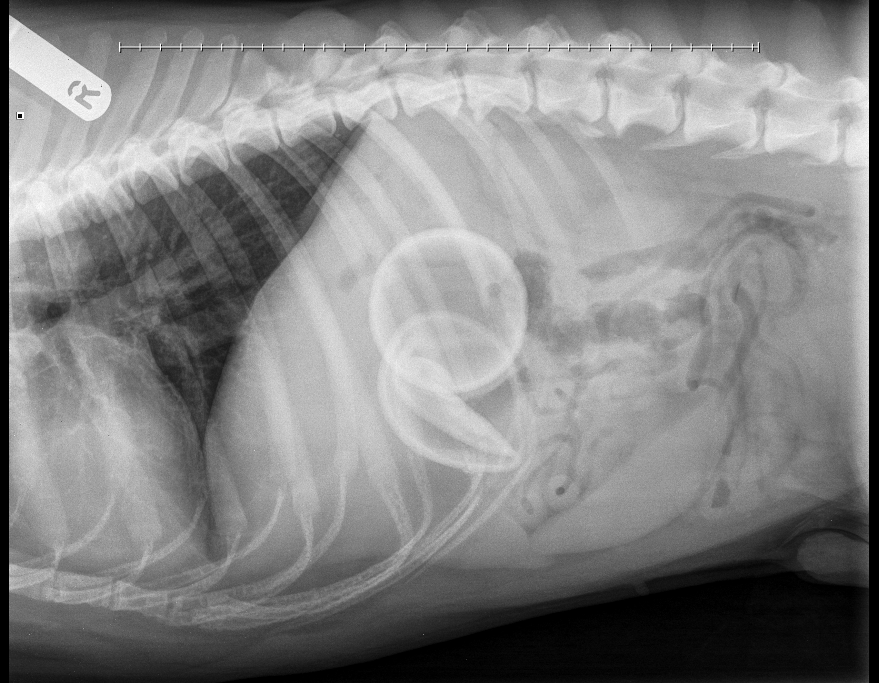
Luckily for Loki, the charity’s Wolverhampton team acted fast and an x-ray revealed the problem: two whole balls inside his stomach.
PDSA Vet Catherine Burke said: “Our vet teams treat ball related injuries every year, which can quickly turn into a life threatening situation. Loki’s situation was a case of life-or-death – without surgery, he would likely have died. One of the balls was lodged in his stomach, preventing him from keeping food down.
Loki was taken into theatre and his emergency operation was a success; PDSA’s vets managed to remove both balls intact.
But the charity is using Loki’s story to warn other owners that a bit of innocent fun with a tennis ball can quickly turn into a life-threatening situation. It’s best all round to trade out the tennis balls for safer toys.
Catherine added: “If your dog loves to chew, there is also the risk they could swallow chewed up parts of the tennis ball; which can still cause the same issues with gut blockage like in Loki’s case.”
Following the surgery, Loki is recovering well and, according to Amy, he is back to his fun, playful self.
It’s not unusual to see dogs running after and catching tennis balls. In particular at this time of year, with Wimbledon in full swing, tennis lovers may wish to play a game of fetch with their four-legged friends.
Catherine shares some of the dangers associated with tennis balls: “If your dog is a tennis ball enthusiast, they may not wish to part with their beloved toy, however there are a few important reasons they are not the best option for dogs, quite apart from the fact that they won’t last long under most dog’s jaws.
“The size of tennis balls, and the way they bounce, means that there is a risk the ball can get stuck at the back of your dog’s throat, causing them to choke. It can become wedged in position too far in for you to remove it, blocking your dog’s airway, which sadly can be fatal if the ball can’t be removed quickly.
“If this does happen, try to keep calm and if safe to do so, you can attempt to remove it from the back of the mouth. However it can be very slippery and difficult to remove. If you can’t remove it, contact your vet immediately for an emergency appointment.
“Tennis balls are covered in a felt layer; which has the appearance of yellow-green fuzz and is abrasive which means it has a sandpaper-like effect. Over time it can wear down your dog’s teeth and cause pain and difficulty chewing.”
Instead of tennis balls, PDSA recommends toys and balls specifically designed for dogs, as these are less likely to fall apart when chewed.
Make sure any ball you choose is the right size for your dog, to avoid potentially fatal choking incidents or intestinal blockage – they should be big enough to be grabbed with the teeth and carried, but not fit perfectly in the mouth.
Depending on the kind of activity your dog enjoys doing, here’s a guide to the best toy to match:
Tugging: rope toys and rubber rings are great for tugging games.
Retrieving: Balls of a safe size that they can’t choke on.
Searching: hide their kibble or treats in snuffle mats.
PDSA is the UK’s leading veterinary charity, through its 48 Pet Hospitals across the UK, the charity saves the lives of poorly pets whose owners would otherwise struggle to afford treatment.
In times of hardship pets like Loki will still fall ill or become injured and need emergency care. PDSA is appealing for donations so that the charity can continue to support owners who have nowhere else to turn by providing life-saving care to vulnerable pets.
Staff, residents, relatives and the local community came together at Strachan House to enjoy a Summer Fete that was held in the home’s grounds on Saturday (15th July).
Strachan House hosted a variety of activities throughout the day, including a BBQ prepared by the talented chefs, live entertainment, face painting and balloon artist which were enjoyed by everyone who came to the event.
The local community police officer even came along to enjoy the afternoon, whilst the children got to enjoy sitting in his car.
Staff at Strachan House made everyone feel welcome and were delighted to see different generations having fun together. Visitors enjoyed a summer BBQ, prepared by the catering team, who were hard at work making sure that a great time was had by all – it really was a team effort!
Resident, Betty Munro said, “I thoroughly enjoyed it. I was surrounded by lots of great people, and the refreshments kept flowing.
“The weather wasn’t on our side but we had a fabulous regardless. Staff did a great job, not just on the day, but organising the event and getting everyone together.”
Gordon Philp General Manager at the home, said: “Staff at Strachan House are dedicated to making sure that the home is a hub of the local community, and this event, along with all their hard work, has definitely paid off. It was a resounding success!”
Strachan House care home is run by Barchester Healthcare, one of the UK’s largest care providers, which is committed to delivering personalised care across its care homes and hospitals. Strachan House provides residential care, nursing care and dementia care for 83 beds residents from respite care to long term stays.
Scottish Fire and Rescue Service held a Commemoration Service at the James Braidwood statue in Parliament Square on Wednesday to remember Firefighter Ewan Williamson, who tragically lost his life during firefighting and rescue operations at the Balmoral Bar in Edinburgh in 2009.
Ewan’s existing and retired SFRS colleagues stood alongside family and close friends to remember him. The service included addresses from Ewan’s sister, Chief Officer Ross Haggart, the Depute Lord Provost, Watch Commander Robert Donaldson and readings from the SFRS Chaplains.
SFRS colleagues, representatives from the public sector and charity organisations from across the city were also in attendance at the event held on Wednesday (12 July) to remember the tragic circumstances at the Balmoral Bar.
To conclude the service a one minute silence was observed followed by a wreath laying ceremony involving members of Ewan’s family alongside the Scottish Fire and Rescue Service (SFRS) Chief Officer Ross Haggart.
At 00:38am, on 12 July 2009, Firefighter Williamson was a member of the first attending crews at a fire in the basement of the Balmoral Bar on Dalry Road in Edinburgh.
As the devastating fire spread, Ewan and his colleagues were deployed to tackle the fire in the basement and ground floor levels. This enabled other SFRS personnel to carry out multiple rescues of occupants from domestic flats in the three floors above, whose lives were endangered by the smoke and flames.
Firefighter Williamson, 35, who was a member of the Green Watch at Tollcross Fire Station, entered the building wearing breathing apparatus as part of the efforts to extinguish the fire. Tragically, he became trapped during firefighting operations and lost his life in the line of duty.
A total of 16 people, including a baby, were rescued that night, an outcome that could have been very different had it not been for the bravery of Ewan and his colleagues responding to the incident.
CO Haggart said: “My thoughts are with Firefighter Williamson’s family, friends and loved ones during this very difficult time of the year.
“Ewan’s ultimate sacrifice reminds us all of the extraordinary lengths our firefighters go to protect our communities.
“It’s of the utmost importance that our fallen colleagues are recognised and remembered for their courage and dedication to their role.”
Ewan’s family described him as having a “wonderful spirit, a smile that would light up a football field and a witty sense of humour that we miss deeply.
“He was a kind and giving person, always willing to help anyone. He was a loving son and not only a brother, but a best friend to his sisters, Rachel and Rebecca.”
Fire Brigades Union Regional Treasurer, Seona Hart, said: “Firefighter Ewan Williamson paid the ultimate sacrifice serving the public.
“We remember Ewan 14 years on from that fateful day on the 12th of July, 2009 and send our love and heartfelt thoughts to Ewan’s mum Linda, sisters Rachel and Rebecca, Ewan’s colleagues and all those that loved him.
“Ewan will never be forgotten and will always be in our thoughts.”
Crews from the Service all around the country also honoured Ewan’s courage, bravery and selflessness at 11am.
A team of students from Edinburgh Napier University have returned home after completing a world-first construction project in China – based around sustainable bamboo building material.
The first bamboo-timber composite grid shell structure of its kind has been built in Guangxi, with the help of thirteen students from ENU’s Department of Built Environment, who worked alongside colleagues from Guangxi University of Science and Technology and Inner Mongolia University of Science and Technology.
It is hoped the finished 12m x 12m construction, which was funded by the British Council and Turing Scheme UK, could help develop sustainable building methods in the effort to combat climate change.
Bamboo’s strength and flexibility, as well as its wide availability as a natural resource, make it a viable construction material for large-span roof structures in future.
Many of the students and staff involved have reunited at the University’s summer graduation ceremonies, where six of them, Onoh Nkiruka Patricia, Odutayo Olamide, Banke Olatunbosun, Mark Cawley, Olufemi Adeboye and Abisola Sarah Adeshina, collected their degrees.
Onoh Nkiruka Patricia, who took on the role of Project Safety Team Leader, spoke of her pride at taking part in the world-leading work. After leaving her home in Anambra, Nigeria, she worked in health and safety for 15 years, most recently in the UAE – and has now graduated with an MSc in Environmental Sustainability.
Onoh said: “To say I enjoyed it is an understatement! I didn’t want to leave. I worked with my heart – this has been my passion.
“That’s what I brought to the site, 101%. It was challenging – it certainly wasn’t easy – because of the climate we worked through the night at times. But when you make up your mind to do something, you do it.
“It was my responsibility to get everyone back safely, and I took that responsibility seriously.
“I am indebted to the team who all gave so much to this project.”
As well their ENU degrees, the student team have been given tiles, made from the same bamboo-based material as the grid shell, as a memento of their role in its creation.
Project lead Professor Johnson Zhang, from Edinburgh Napier University’s School of Computing, Engineering & the Built Environment, said: “This project showcased the pioneering research in bio-based construction at Edinburgh Napier University.
“It also serves as a testament to the immense potential of innovative sustainable construction technology in shaping a better future for the greener built environment we are creating.
“It was a privilege working with our Team BE-Napier and other two partner university student groups, together we formed a professional, dedicated and creative team. I enjoyed every moment of working with them.”
Alongside new graduates, Stephen Jideofor Onwunduba, Moses Okon Nseabasi, Mufthau Olawale Adebayo, Devika Vijayan, Konrad Zbyrowski, Alice June Davyson and Zara Anam Rafiq took part in the project. PhD student, Yanghao Pei, was its lead researcher, while Dr Ahmed Mohamed, Dr Daniel Barreto and Dr Suha Jaradat were on the project team.
The team are already making plans to carry out further research on the potential of bamboo-timber composite structures.
Edinburgh Leisure, the largest provider of sport and leisure facilities across the city, is launching an exciting competition next week, The Edinburgh Leisure Pin Drop, so that wherever you’re at in the city, you could be in with the chance to win a year’s membership with Edinburgh Leisure.
The Edinburgh Leisure Pin Drop competition runs from 17th – 28th July. They will be giving away six free Edinburgh Leisure memberships.
To be in with the chance of winning, all participants must do is to find the pin (a branded box featuring a pink geolocation), which will be ‘dropped’ somewhere in Edinburgh and take it to their nearest venue.
The first person to do this will win a year’s membership and can choose from Full Fitness, Climb, Golf or Single Child Soft Play membership.*
Over the duration of the competition, Edinburgh Leisure will be ‘dropping a pin’ in six different locations around the city and sharing some clues and photos on their social media channels, on Facebook, Instagram, and Twitter.
Pins will be dropped at 11am on the following days during the competition:
Monday, 17th July 2023
Wednesday, 19th July 2023
Friday, 21st July 2023
Monday 24th July 2023
Wednesday, 26th July 2023
Friday, 28th July 2023
Participants will have two hours to find the box from 11am when the clue is posted on social media. The person who finds the box then has until Edinburgh Leisure’s participating venues close on the same day to redeem their prize. Venue closing times vary, so people should check closing times of their closest venue.
Participants are encouraged to tag Edinburgh Leisure in their Edinburgh Leisure Pin Drop posts on social media and use the hashtag #WhereverYoureAt.
As the biggest club in town, wherever you’re at on the map or in life, Edinburgh Leisure is here to help the people of Edinburgh enjoy a healthier, happier, and more active life. In the heart of communities, they’re the largest provider of sports and leisure facilities across the city.
*Competition information, terms and conditions and participating Edinburgh Leisure venues can be found by visiting: rb.gy/qbh9o
Nearly half (44%) of older people in Scotland on a low income1 have struggled to keep up with their broadband bill in the last 6 months, according to new research from the older people’s charity Independent Age.
Of that number, 18% found it a constant struggle, and 26% struggled from time to time.
Independent Age says the findings from YouGov commissioned polling raise fears that the cost of living has deepened the ‘digital divide’ and warns that older people in financial hardship may become even more isolated and could face additional costs if they are forced to shut off their internet access.
The survey also found:
More than 1 in 3 (35%) older people in financial hardship said they are worried they will not be able to pay their broadband bill over the next 6 months.
36% are currently having to cut back their spending on their internet, phone or TV subscription services a great deal or a fair amount.
Almost 1 in 10 (9%) have already cancelled broadband and phone services over the winter in an effort to save money and 6% had already taken this action before the winter began, to save money.
The charity warns that not being able to go online could mean that older people on low incomes are unable to access information about financial entitlements or services, miss out on savings by not being able to search for the best deals and lose vital social connections.
It’s calling on broadband providers to further promote their social tariffs so that older people in financial hardship are aware that support for their internet costs is available. The charity also believes the Government has a role to play in promoting social tariffs as part of the support available during the cost of living crisis.
Social tariffs are cheaper broadband contracts for those receiving means tested benefits, such as Pension Credit (the State Pension top-up for those on a low income). However, current take-up is low, with just 5.1% of eligible households using them2,and Independent Age say that eligible older people are going without as a result.
Morgan Vine, Head of Policy and Influencing at Independent Age, said:“The choice to engage online shouldn’t be taken away due to cost. We’re hearing from people in later life who are struggling to pay their broadband bills, cancelling their services, or making considerable sacrifices to afford this expense, such as going without fresh food.
“Cancelling broadband can mean someone misses out on the best deals, social connections with friends and family or on finding information about financial support they could be entitled to, such as Pension Credit or Attendance Allowance.
“Independent Age is calling on broadband providers to do all they can to support vulnerable customers. We also think the Government has a role to play when promoting the options available now and thinking about consistency in the longer term. At the moment it’s a confusing picture for older people on low income, with each provider offering different options.
“While broadband social tariffs are available from most major providers, and can be a great help for those in financial hardship, take up is extremely low. Independent Age wants providers to proactively promote their social tariffs and target their activity at all eligible groups, including ensuring older people on a low income are not missed out.”
“There’s a growing assumption that we can all do everything online now, but because of my financial situation, I’ve had to cancel my phone and Internet contracts. So now if I want to do anything that involves being on the Internet, I need to get hold of a library that’s open at certain times.
“I don’t know what’s happened in other parts of the country, but we used to have access to Wi-Fi on Greater Manchester’s buses and trams. That disappeared during COVID. I’m assuming it was taken off as a cost-saving thing because people weren’t traveling on the buses, but they’ve never put it back.
“And that doesn’t just impact older people who don’t have Wi-Fi — it impacts young families who are trying to do stuff whilst they’re out and about because they can’t afford to pay for the subscription at home.”