Heart of Newhaven: August newsletter


Welcome to your August newsletter
Visitors from Singapore

The Heart was delighted to be able to host a visiting delegation from Singapore last month. The visitors, around 20 researchers from the Lee Kuan Yew School of Public Policy at the National University of Singapore, were on a fact-finding trip hosted by DTAS (Development Trusts Association Scotland) and requested that the Heart be part of their itinerary.

Around two dozen visitors therefore enjoyed a delightful lunch at the Heart, followed by guided tours of the site with some of our trustees, and ending with an informal question and answer session before leaving for their next port of call.

They wanted to know about the community right to buy such assets as the Heart and how we are now funding and running it for the community and what they learned will feed in to their Future Ready Society Conference in Singapore.

First Dementia Tea & Blether

Our dementia worker Valeria hosted her first official Meeting Centre event last month with a good-sized turnout of interested adults, carers and volunteer helpers. Tea, coffee, biscuits and a delicious home-made cake were happily consumed over discussions of old photographs from the Heart’s heritage collection and a few intriguing items from the Victorian Schoolroom.

Attendees had an informal tour of the ground-floor heritage displays and the event finished with much laughter as participants tried their hand at quoits or beanbag throwing – both much more difficult than they would appear to be!
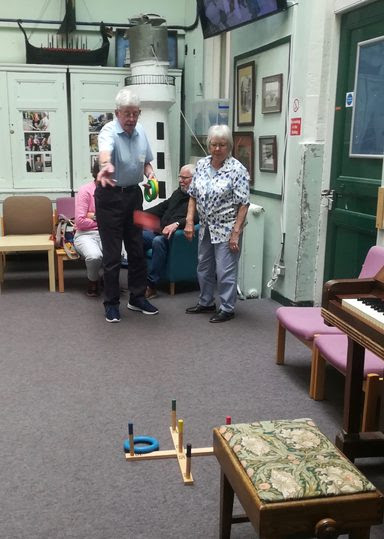


There will be further monthly meetings and the next one is scheduled for Wednesday 30th August. Contact valeria.lembo@heartofnewhaven.co.uk if you’d like to attend.

Local glass artist

Juli Bolanos-Durman  paid a visit to the Heart recently, when she was thrilled to be able to claim many of the excess scientific glass objects from the History of Education Centre.

She will use the old test tubes, flasks and rods to create new glass sculptures.  HEC was equally thrilled that their old glass would be saved from landfill and used to produce new artwork. Watch this space for photos of the finished pieces.

Coming up soon

The Heart will be hosting an exhibition for Edinburgh Shoreline next month.
This will be a week-long exhibition, open to the public from Saturday September 16th and running until the 24th.

The 16th is the date for the deployment of oysters in the Forth, an historic event.

AGM

Important date

The Heart of Newhaven Community’s AGM will be held this year on Saturday 9th September, at 2pm.  

Please check whether you are a member or not as we must update our records every year.

You may be signed up to receive the newsletter, but not be a member.

If you are a member, you will receive your official notice next week
and be told what the next steps are. 

The AGM would be an ideal time to step up and join the Board.

We need new volunteers to join us, particularly if they have financial experience of any kind. If you would be interested in helping, contact Judy,Crabb@heartfnewhaven.co.uk or andrew.waldie@heartofnewhaven.co.uk

You can also find more details at https://reachvolunteering.org.uk/opp/heart-newhaven-community-trustees or https://reachvolunteering.org.uk/opp/heart-newhaven-community-treasurer

The AGM would also be a great time to start getting more involved with the running of the Heart. We’re always on the look-out for more volunteers on the ground and there are many ways of lending a hand, whether it’s by manning the welcome desk at specific times, providing IT or comms support, stepping forward to help organise events or sharing your own particular skills or expertise in so many ways.

Do say hello to one of our Trustees and offer to help in whatever way you can.

Work with Us.

We have a vacancy for another part-time staff member.  This is a part-time (16hrs per week), fixed-term role for six months but it could evolve into a permanent position. Check out the specifications on the website –

New Teaching Kitchen

Watch out for big changes in the Victoria Building, coming up soon.

There have been delays to the installation of the promised new teaching kitchen, the hold-up being unexpected additional costs having to be met, but the work will begin in the next couple of weeks.

We apologise in advance for any disruption caused, but rest assured the finished amenity will meet all sorts of community demands.

More changes

You’ll be seeing lots of young faces around the Heart from now on, with the new childcare facilities starting in the Anchor Building this month.

As we explained in the last newsletter, Daddy DayCare are moving in, so welcome to our new young users. Have fun!

New partner NEECS

Finally, welcome to our new partner, NEECS, North East Edinburgh Counselling Service. NEECS was established in 1995 and provides free one-to-one professional counselling for young people and adults who are experiencing poor mental health.

You’re invited to their upcoming AGM and the ‘house warming’ of their new premises on the first floor of the Victoria Building on Thursday 24th August.

This will be their first in-person AGM since the pandemic and an opportunity to see their new room at The Heart. The day will start with coffee & cake from 9am, then starting the AGM at 9.30am in one of the meeting rooms in the Anchor Building in the playground.

WHAT’S ON AT THE HEART


Edinburgh Festival Fringe 2023 begins: Fill Yer Boots!

YESTERDAY (Friday 4 August 2023), marked the official start of the 76th Edinburgh Festival Fringe, which will run until Monday 28 August 2023.  Artists from 72 countries will be represented at the Fringe this August, with 973 shows from Scotland and 469 from Edinburgh itself!

The vision of the Fringe is to give anyone a stage and everyone a seat, and this year the average ticket price is less than £12, allowing audiences to experience a variety of work at a relatively low cost.  There are also 439 free shows at this year’s Fringe,and another 614 using the ‘pay what you want’ or ‘pay what you can’ model. 

Following its launch last month, the new Fringe app has received over 36,000 downloads across the app stores.  From today, the ‘nearby now’ functionality will encourage audiences to try something new near them, when between shows; with the Shake it Up feature also providing a random show selection to take a chance on.

This August there are 3,535* shows registered, who will undertake over 52,000 performances during the month.  The world-famous Fringe Street Events will start tomorrow and will run from 11:00 till 19:00 every day from 05 – 26 August with events free to attend and open to all. 

Supporting artists by facilitating a range of services via the Fringe Society, so far this year the Media Office has accredited over 700 reviewers, editors, journalists and broadcasters, who will be instrumental in boosting artists’ profile. In addition, to date, some 950 arts industry professionals from 45 countries have accredited, and will be on the lookout for shows at the Fringe to offer onward touring or TV and film adaptation opportunities.

Shona McCarthy, Chief Executive, Edinburgh Festival Fringe Society, said: “I love this time of year, when Edinburgh becomes this melting pot of creativity and global connection, it is just brilliant to be off and running with the Edinburgh Festival Fringe 2023!

“There are so many who have worked so hard to get to this point – artists, producers, venues, all the behind the scenes workers and Fringe supporters, too many more to mention – I want to say a massive thank you to all of you, and hope you get a chance to enjoy this amazing thing you’ve created over the next three-and-a-bit weeks!

“The Fringe Society exists to support artists come to the Fringe and our team will be within the Fringe Central Artist Hub throughout August with on the ground help and advice. 

“There is a great programme of events taking place there, to support artists with their future career ambitions.  For our Fringe audience, please dive into this wonderful festival with its incredible mix of genres and imagination; from established names to thousands of first-time or emerging performers. 

“I urge you now more than ever, to support the artists by going to see shows, and then more shows, and then see even more! Get out there and Fill Yer Boots!”

Uniquely Scottish Silver

Uniquely Scottish Silver  
5 August 2023 to 26 May 2024 
National Museum of Scotland, Chambers Street, Edinburgh

#UniquelyScottishSilver 

A new display at the National Museum of Scotland, Uniquely Scottish Silver (5 August 2023 to 26 May 2024), will showcase a range of objects highlighting Scottish designs and provide an insight into how people used them.  

The display will bring together five distinctively Scottish designs: mazers, quaichs, thistle cups, ovoid urns and heart brooches. While some of these objects survive in plentiful numbers, others are amongst the earliest and rarest survivals within the Scottish silver smiths’ craft. 

 Lyndsay McGill, Curator of Renaissance and Early Modern Scottish History said:  “During the Renaissance and Early Modern period (about 1450-1750) Scottish craftsmen designed and produced a wealth of silver artefacts.

“While most designs were influenced by contemporary British and European fashions, the country’s silversmiths also created a number of forms unique to Scotland, and that’s what the display is about.

“These items were owned and used by people from many walks of life. Some objects were sentimental and held meaning, while others signified the latest styles.” 

Highlights of the display include thistle cups which were a relatively short-lived phenomenon from the 1680s to 1720s, but a distinctively Scottish one, with their inverted bell-shape and prominent lobes to the bottom half of the cup giving the impression of a thistle head.

These designs reveal that Scottish silversmiths were innovative in their work and that they added their own twist to create a remarkable Scottish form of silverware. 

The display includes pieces from the 16th to the early 20th centuries, some of which are instantly recognizable as Scottish including quaichs and heart brooches, as well as rarer items such as thistle cups and mazers – only nine Scottish mazers are known to survive. 

Also on display will be a futuristic looking ovoid urn, which, thanks to some detective work by researchers, is now believed to have been used for serving coffee rather than tea, as had previously been thought.  

Of the 43 items in the display, Lyndsay says that a particular favourite is a quaich made by William Scott in Aberdeen around 1681:  “It’s a tiny quaich that fits in the palm of your hand and is engraved with parrots and flowers.

“Scott presumably took inspiration from pattern books or books on the natural world. It’s a wonderful example of his delicate craftsmanship and creativity – it’s quite beautiful and I look forward to visitors getting the rare chance to see it.”  

Uniquely Scottish Silver runs from 5 August 2023 until 26 May 2024. Admission is free.  

The Bell, the bell … Granton gas holder work progresses

The bell that floated up as water filled the historic gasholder in Granton Waterfront has been taken apart to make way for work to begin to restore the original 76 x 46 metre frame to look like new.

The City of Edinburgh Council plan to open up the area to create a new and exciting multifunctional public space as part of their wider £1.3bn regeneration project to create a new sustainable coastal town at Granton Waterfront.

McLaughlin & Harvey began work on the site in January of this year on behalf of the Council using £16.4m from the UK Government’s Levelling Up Fund. The Scottish Government has also provided an additional £1.2m to provide a high quality public park within the gasholder frame.  

The space within the restored gasholder is to have multi-sensory play zones, a dedicated space for permanent and temporary public art, a relaxation area, outdoor trails and tracks for exercise as well as a large outdoor space for sports, markets, seasonal events, community use, festivals, performance arts, exhibitions and play.

Work will also be carried out to plant trees, shrubs and wildflowers improving biodiversity and local habitat in the area.

Council Leader Cammy Day said:It was really dramatic to see the bell being ripped apart by the machinery. It marked a historic moment as this iconic structure will be transformed now to move on with the times to serve a completely different purpose for the local community to enjoy arts, sports and culture for future generations to come.

“Now the bell has gone the contractor can get on with the exciting work to transform the frame back to its original glory which will be seen for miles around.

“The scale and ambition of the gasholder nicely mirrors that of this £1.3bn regeneration project where we are using brownfield land to build a new sustainable 20-minute neighbourhood which is well linked to surrounding communities and is somewhere residents will be proud to live.

“We’ve already started building some of the thousands of environmentally friendly affordable homes planned and active travel routes, along with recently completing the restoration of the former Granton Station building to become a modern workplace and cultural hub, with public square.”

UK Government Minister for Levelling Up, Dehenna Davison, said:The Granton gasholder has been part of Edinburgh’s skyline for over 120 years, and will soon be brought back to life as a real community asset.

“The bell’s removal will ensure the structure can be restored to its former glory, whilst the space will be brought into the 21st Century by becoming a destination for families, residents, and future generations to enjoy.

“We’re delighted to have supported this project through £16.4 million from the UK Government’s Levelling Up Fund which will ensure this iconic structure will serve as a beacon to people in the area for many years to come.”

Seamus Devlin, McLaughlin & Harvey Civil Engineering Director, said: “McLaughlin & Harvey is delighted to be main contractor for the restoration works at Granton gasholder.

“We bring with us a wealth of experience in the civil engineering sector, and look forward to completing the deconstruction of the bell this week and the removal of the walls in the upcoming weeks.”

Fascinating gasholder facts

  • Over 100K rivets holding the structure together
  • Total cost of original construction £18,968.
  • Was opened in 1901, making it 122 years old.
  • It’s since been painted 72 times.
  • 26 columns in total with a height of 42m. each column is 9.3m apart.
  • Granton was one of 12 gas storage tanks for the greater Edinburgh area. These 12 tanks had a combined capacity of 175,000 cubic meters of storage. At the time they were in operation the demand was around 28,000 cubic meters an hour (at its peak).
  • The lowest tier was erected with the use of a steam locomotive crane.

The Granton Gas Holder is unique as the umbrella which supports the tank roof when the system is not pressurised, was made from timber as opposed to cast iron. These timbers were in remarkably great condition when demolition began.

Funding to improve digital inclusion in mental health and housing

Supporting access to online services

Projects across Scotland have been awarded funding as part of the Scottish Government’s Digital Inclusion Programme aimed at helping people to access online support services, initially in mental health and housing services.

The thirteen projects, which bid to be one of the ‘Digital Pioneers’, will develop, test and implement programmes to help people access the services they need  online  to support their health and wellbeing.

The £600,000 first phase of the programme is being delivered in partnership with the Scottish Council for Voluntary Organisations. It will benefit more than 1,500 people by building skills and confidence, as well as devices to support access to digital services in mental health and housing.

It is expected that following the programme, which will run for two years, a shared understanding and learning of how best to support digital inclusion in mental health and housing will be created.

Cabinet Secretary for NHS Recovery, Health and Social Care, Michael Matheson said: “Supporting people to feel more digitally confident so they can access the services they need online is absolutely vital and it is one of our long-standing commitments.

“This programme will see models tested that will help so many people gain the skills they need to improve their own health and know how to access the support that is available to them.”

The Digital Inclusion Programme launched in March 2023, is led by the Digital Health and Care directorate and delivered in partnership with the Scottish Council for Voluntary Organisations and Connecting Scotland.

The programme, backed by £2 million of funding, focuses on two areas: digital inclusion in Mental Health (supporting people with a mental health condition (s)) and digital inclusion in Housing (supporting customers or tenants in social housing, the private rented sector or owner-occupied housing who are most at risk of digital exclusion).

List of organisations awarded funding with overview of their project:

OrganisationAmountProject OverviewAnticipated number of direct beneficiaries
Aberdeen Foyer£54,867Aberdeen Foyers Housing Digital Support project will work with young people in Aberdeenshire at risk of experiencing homelessness. Funding will allow them to expand their current services to provide devices, connectivity and digital inclusion support to improve access to supports and services and to reduce isolation. The project will support 22 staff and volunteers and 75 young people.75
Blackwood Homes and Care£55,000Blackwoods Digital Buddies project will work with older people in supported living accomodation, in rural areas in Scotland. Funding will allow them to expand their current digital inclusion model across newly acquired supported living accomodation. The project will provide digital training to upskill 76 staff and volunteers and provide connectivity, devices and digital skills support to 130 older residents. 130
Simon Community Scotland£54,982Simon Community Scotland’s Get Connected Housing project will work with people experiencing homelessness. Funding will allow them to embed their existing digital inclusion approach within their Housing First & Housing Support Services within Edinburgh. The project will provide devices, connectivity and one to one digital support to work with people transitioning from homelessness and temporary accommodation to sustained tenancies. The project will work with 65 staff and 130 participants to build digital skills and confidence and improve access to services.130
Prospect Community Housing Limited£31,310Prospect Community Housing’s Link Up project works with people with a disability or long term health condition in Wester Hailes. Funding will allow them to continue to work in partnership with WHALE arts to deliver digital drop-ins and one to one support to improve digital skills and confidence. The project will support 5 staff and volunteers and 70 participants.70
Shettleston Housing Association Limited£54,980Shettleston Housing Association’s Shettleston Does Digital project works with older adults who are not in work or are retired. Funding will allow them to expand their existing digital inclusion work in partnership with Fuse Youth Cafe to deliver digital drop-ins and digital skills training to improve digital confidence and increase access to services and support. The project will work with 10 staff and volunteers and 160 participants160
Link living£50,268Link Living’s Digital support service supports young people and people with moderate to severe mental health conditions across Edinburgh to improve digital skills. Funding will allow them to continue delivery of their Digital Support Service providing connectivity, devices and one to one support to improve digital skills and confidence. The project will support 1 staff member and 130 participants130
Queens Cross Housing Association Limited£42,753Queens Cross Housing Association’s Digital Spaces in Community Places works with mutiple digitally excluded groups across communities in Glasgow. Funding will allow them to continue delivering digital sessions inlcuding coding for young people, digital cafes for older people and structured course content across 4 community facilities in Glasgow.The project will work with 50 staff and volunteers and 190 participants to build digital skills, confidence and increase access to support services.190
Carr Gomm£54,677Carr Gomm’s Connected Lives project builds on the learning from their previous Digital Inclusion Research Project (DIRP). Funding will allow them to expand their digital inclusion support across Glasgow’s Integrated Services and enhance support through establishing a safe, online peer network to facilitate improved wellbeing through meaningful community connections. The project will support 40 staff and 60 service users to build their digital skills and confidence.60
Saheliya£54,773Saheliya Digital Pioneers project works with marginalised New Scots women in Edinburgh and Glasgow to increase their digital skills and confidence. Funding will allow them to continue to deliver digital inclusion and language sessions to improve skills and confidence to access further supports and services to improve mental health and wellbeing. The project will support will support 10 staff and 72 New Scots women.72
Moray Wellbeing Hub£54,982Moray Wellbeing Hub’s Digital Mental Health Capacity Building project aims to establish a digital mental health hub in to improve digital skills and access to services in Moray. Funding will allow them to build on current work with Health and Social Care Partnership Moray to offer online and in person digital support to improve digital skills and confidence and social connections. The project will work with 30 staff and 300 participants to reduce digital exclusion.300
Scottish Association for Mental Health£51,270The Scottish Association for Mental Health’s Enduring Digital Accessibility project works with people in supported living settings to enhance their digital skills and confidence. Funding will allow them to expand and formalise their existing digital inclusion activities in Edinburgh, Perth and Glasgow and increase access to online supports and services. The project will also enhance staff and participants access with their care management system to improve peoples engagement within their individual care plans.  The project will support 25 staff and 100 people in supported living settings.100
Cyrenians£36,244Cyrenians Digital Inclusion project works with people facing long term unemployment, transitioning from hospital care and living in residential care. Funding will allow them to expand their current digital inclusion activities and provide a digital hub at their Farm, one to one support and indepth digital skills support in Edinburgh and West Lothian. The project will support 37 people.37
Just Bee Productions£54,229Just Bee’s Just Breath project works with people to reduce mental health inequalities, assessments and waiting times to access services. Funding will allow them to deliver a variety of digital inclusion activities with people in crisis to improve their digital skills and confidence to access services and supports to support their mental Health. The project will support 4 staff and 80  participants experiencing moderate to severe mental health conditions.

More animals killed on M9 than any other road in Scotland

Almost 6,000 roadkills have been reported across England, Scotland and Wales since 2022

  • New data reveals how England accounted for 68% of all reported roadkill incidents.
  • The animals most likely to be hit by drivers were deer, badgers and foxes. Domestic animals like cats and dogs were also high on the list, accounting for 591 reports.
  • Over 1 in 3 (36%) UK drivers say they’ve hit an animal while driving in the past. But only 1 in 7 (15%) have reported it.
  • And hitting an animal could cost more than you might think. On average, roadkill is costing motorists £291 for damages to their vehicle.
  • Louise Thomas, motor expert at Confused.com car insurance explains what drivers should do if they hit an animal when behind the wheel.

More animals were killed on the M5 motorway than any other road in the UK last year, new data reveals.

Since 2022, there were 5,976 roadkill reports across England, Scotland and Wales. But the M5, which stretches 162m miles from West Bromwich to Exeter, accounted for 345 (6%) on its own. This makes it the most notorious road for roadkill incidents by vehicles across all 3 countries.

The data was obtained by Confused.com through a Freedom of Information request to Highways England, Transport Scotland and Transport Wales. The request asked each authority to state the number of dead animals found on roads between January 2022 and June 2023.

In England, the total number of animals reported dead to Highways England was 4,122. This makes up 68% of all roadkill reports in comparison to Scotland and Wales.

In Scotland, there were 1,521 reports of dead animals, while Wales accounted for 333.

But although England may seem the most notorious, its drivers in Scotland that could be most likely to hit an animal when driving.

That’s as Scotland has around 2.5 million registered vehicles(2), so around 1 animal is hit every 1,600 cars. In Wales, this is 1 animal in every 4,800 cars. And with around 28 million cars in England, 1 animal is hit in every 6,800 cars.

When looking at the particular roads that had the most reports, those topping the list were all found in England. In particular, the M1 and M6 had 282 and 273 reports, respectively.

In Scotland, the M9 was the worst for roadkill with reports showing 162 animals were found dead on this road last year.

But in Wales, figures were much lower. The worst road in Wales was the A55, most famously known as the North Wales Expressway, which had 105 reports.

When looking at the types of animals that are most common to be killed on roads, deer topped the list. Since 2022, there have been 1,924 reports of deer being killed. This was most common in England, with 1,084 reports.

In Scotland, 820 were reported and in Wales, just 20.

Badgers were second most commonly reported, with 846 reports in total, followed by foxes with 846 reports. Domestic animals were also among some of the most killed animals. That’s as 382 cats were reported dead last year and 209 dogs. This accounts for almost 10% of the overall figures.

The totals for domestic animals may be surprising for some, as they may expect to see higher roadkill numbers in residential areas. But the data collected from the Highways agencies primarily look after motorways and other large roads. This could be a reason why some reported animals are bigger than others.

And further research gathered by Confused.com backs this theory. The latest data suggests that there could be many other animals that actually top the list instead. In a recent survey of 2,000 drivers, 1 in 3 (36%) admit to previously hitting an animal when driving.

And when asked which animal they hit, the most common answers were:

  • Birds (35%)
  • Pheasants (23%)
  • Rabbits (21%)
  • Cats (15%)
  • Dogs (12%)

The difference in findings could be surprising, but this could be down to the legalities around reporting roadkill.

The UK law states that drivers have a legal obligation to call the police if they hit the following when driving:

  • Dogs
  • Horses
  • Cattle
  • Pigs
  • Goats
  • Sheep
  • Donkeys and mules

For animals like badgers, foxes and otters, they should be reported to the council rather than the police. But for other animals, such as cats and birds, these don’t need to be legally reported.

This could be why data reports for these animals are lower than expected. Although no matter the animal, it’s still recommended to report any that are hit when on the road. This is because they could cause obstruction and danger to other drivers.

But rules around reporting roadkill seems to be a confusing matter for drivers. That’s as almost 9 in 10 (87%) drivers admitted to not reporting an animal after they’d hit it with their car.

When asked why, more than half (52%) said they either thought or knew that they didn’t have to report it. But almost 1 in 5 (17%) said they either didn’t know how to report it, or they weren’t aware that they had to report that type of animal. A further quarter (26%) said they weren’t sure what to do if they hit an animal. So it’s clear that there’s some confusion among motorists around the best action to take.

Although the M5 motorway was the most common road for roadkill based on reports, it seems country roads are actually the most notorious for collisions.

That’s as almost 7 in 10 (68%) drivers said they’d come into contact with an animal on a country road or residential area (26%). But these types of roads are also where animals such as birds, pheasants and domesticated pets are most likely found.

And although country and residential roads could be most common for roadkill accidents, they could also be seen as less of an obstruction than motorways. So this could be the reason why roadkills are less likely reported on these types of roads.

But one thing that all roadkill incidents have in common is that the end result could be pricey. That’s as 1 in 5 drivers said their vehicle has been damaged after hitting an animal. And this left them out of pocket by £291, on average.

Hitting an animal when driving isn’t pleasant. And while it might feel like a sensible idea to swerve when danger is in sight, it’s not always possible. And 2 in 5 (44%) admitted that they wouldn’t swerve for an animal if it put other road users at risk. But that’s up for debate, as around 3 in 10 (29%) said drivers should try to avoid hitting an animal at all costs.

So it’s clear that there could be some confusion on what to do if you hit an animal while driving. But no matter if they’re a legal requirement or not, it’s always a good idea to report it to the appropriate authority anyway. This means the animal can either be treated or removed from the road correctly, and roads are kept clear for other road users.

Louise Thomas, motor insurance expert at Confused.com car insurance comments: “It isn’t nice for any drivers to hit an animal when on the road. It can be a shocking experience for yourself, your passengers and other road users. But sometimes contact can’t always be avoided.

“Whether you’re obliged to legally report it or not, you should always inform the police or your local council. That’s because it could cause an obstruction for other drivers. That way, the road can be cleared and the animal can be disposed of correctly. Unless absolutely necessary, you should avoid moving the animal yourself as this could risk your own safety.

“If you’ve hit an animal and your vehicle is damaged, it’s always worth getting a quote and having the damage assessed. In some instances, you might feel it’s worth making a claim on your car insurance.

“But for smaller claims, sometimes it’s also worth seeing if you can cover the costs yourself, rather than going through your insurer. Making a claim of any size could impact your premiums in future, with claims a common reason for increased cost.

“If you do hit an animal when driving, our guide on common motoring myths  explains what to do.”

New Annual Police Plan 2023-24

Police Scotland’s Annual Police Plan (APP) has now been launched.

Chief Constable Sir Iain Livingstone QPM presented the plan to the Scottish Police Authority Board in March. It was then laid in the Scottish Parliament as required under the Police and Fire Reform (Scotland) Act 2012.

Our APP uses strategic outcomes and objectives to describe the impact that Police Scotland aims to make to the lives of people across Scotland. This aligns with the Joint Strategy for Policing, Policing for a Safe, Protected and Resilient Scotland, and our strategic planning framework.

It was developed with colleagues from across the service and describes how we will prioritise our resources towards the issues that cause the most harm to people and communities.

Progress will be reported across all the activities featured to describe and demonstrate the impact of policing  on Scotland’s communities. Police Scotland’s Performance Framework is being refreshed and as in previous years, will fully align to the strategic outcomes and objectives set out in the Joint Strategy and the APP.

You can also download a PDF version here.

Policing for a Safe, Protected and Resilient Scotland

In 2020, the Scottish Police Authority and Police Scotland agreed and published our Joint Strategy for Policing (2020), Policing for a Safe Protected and Resilient Scotland. This strategy describes our ambitions for the future of policing in Scotland framed around five strategic outcomes.

Good progress has been made in developing our service since that point and the time is right to review our strategy. The Vision for Justice was published in 2022, and Scottish Government has recently reviewed and confirmed their Strategic Police Priorities for the next three years.

We are now keen to engage with our partners, stakeholders and members of the public to gain feedback on the draft document before we finalise it later this Spring.

The Scottish Police Authority and Police Scotland have now launched a public engagement exercise on the draft Joint Strategy for Policing 2023-26.

The engagement exercise launched on 11 March 2023 and will run until 23 April 2023.

To find out more and to give us your feedback, please click here.

Aldi recruiting in Edinburgh

Aldi is currently looking to recruit over 20 new store colleagues across Edinburgh.  

In a welcome boost to the local economy, the UK’s fourth largest supermarket is looking for people of all levels of experience to fill roles at its stores across the region including Hermiston Gate, Gilmerton Road, Oxgangs, Commercial Street, and Portobello.  

This includes both full-time and part-time positions including Store Management Apprentice, Stock Assistant, and Store Assistant, all the way up to Deputy Managers.  

The recruitment push forms part of Aldi’s nationwide expansion drive, with the supermarket set to open an average of one new store a week across the UK between now and Christmas. 

Kelly Stokes, Recruitment Director at Aldi UK, said: “As we continue to invest in new stores, we’re looking for more colleagues to join our incredible teams across Edinburgh.   

“Working at Aldi means a great working environment and real opportunities to progress within the business and we look forward to welcoming even more people to be a part of our success in the future.” 

Starting pay for Store Assistants at Aldi is £11.40 per hour with the supermarket also paying for breaks.  

Those interested in applying for jobs can visit www.aldirecruitment.co.uk.   

Sashay your way to Virgin Hotels Edinburgh for a Drag Brunch at Eve

EVE, Virgin Hotels Edinburgh’s all day dining destination, is hosting a showstopping Drag Brunch tomorrow, Saturday, 5th of August, with Queens from RuPaul’s Drag Race fame. 

Kicking off at 12pm, guests will be able to enjoy death-drop worthy brunch classics that will satisfy every craving, from tasty crispy chicken burgers to sweet treats including wholesome granola bowls and pancakes, fabulously paired with pick-me-up martinis and mimosa cocktails, all accompanied by a live DJ set. 

In partnership with Gilded Balloon and Klub Kids, legendary Queens Anita Wigl’it and Baga Chipz will have guests voguing like Madonna as they take to the stage to give a fierce preview of their respective Fringe shows, which are running from 4th – 9th August at Gilded Balloon Teviot. 

The spectacular brunch event is free to attend, with guests only required to book a table to enjoy the experience in the glamourous surroundings of Eve – that are fit for a Queen. 

David Moth, Virgin Hotels Vice President of Operations and Interim General Manager of Virgin Hotels Edinburgh said, “As part of an exciting new collaboration, we are thrilled to be working alongside Gilded Balloon and Klub Kids to start the Edinburgh Fringe Festival off right, with laugh-out-loud performances, live music and delicious brunch classics at Eve. 

“Virgin Hotels is no stranger to fabulous live performances but we’re ready to raise the bar with two icons of the international Drag scene. The Fringe is all about bringing communities together and what better way to do so than with two of RuPaul’s most loved divas, hailing all the way from Australia and the UK. 

“To mark our first year of being an official Fringe venue, we’re ready to get Cowgate up and dancing with this special Drag Brunch. For the rest of August, guests can expect top-notch entertainment up on our spectacular roof terrace as well as show-stopping performances in our classically restored Greyfriars Kirk.” 

Brunch reservations are available to book from 12pm with the entertainment starting at 1pm. For more information and to reserve a table please visit:
https://virginhotels.com/edinburgh/event/drag-brunch/ 

The Drag Brunch is just one of many events hosted at Virgin Hotels Edinburgh. To stay up to date with the latest news and events, follow along on social media here:  

  • Instagram @eveedinburgh @virginhotelsedi 
  • Twitter @virginhotelsedi 

SEPA urges businesses using water to stay vigilant after swing in weather conditions

New statistics highlight the contrasting conditions impacting Scotland’s water environment this summer, prompting a plea from the Scottish Environment Protection Agency (SEPA) for businesses to stay vigilant.

Some areas that were experiencing significant water scarcity at the end of June, including the Rivers Annan and Nith, have now recovered in just a few weeks after nearly double the normal amount of rainfall for July according to new figures from the Met Office. Scotland as a whole received around 50% more rain than average for the month.

This is in contrast to a very dry April, May and June for Scotland, with May in particular only recording less than half (44%) of the average rainfall.

The latest water scarcity report, published today by SEPA, shows a positive picture with most of the country now experiencing normal river and groundwater levels.

However, parts of the north-east around Morayshire and northern Aberdeenshire are recovering more slowly, with just average or below average rainfall for the previous month. This means a possibility remains of conditions worsening in these areas if August isn’t wetter than usual.

Kenny Boag, Head of Environmental Performance at SEPA, said: “I’m sure many would agree it feels like we often experience all seasons in a single day in Scotland, and the country is in fact famed for its unpredictable weather. The difference between the situation facing Scotland’s water environment in June compared to July is stark.

“While this keeps locals and tourists alike on their toes, there’s no doubt it proves challenging for industries that rely on the environment to operate. Farms, whisky distilleries and golf courses are all examples of businesses that need a consistent supply of water.

“That’s why it’s crucial they’re aware of the conditions impacting sources like rivers and burns and reduce their reliance on them. We’re asking businesses to monitor how much they’re using, review techniques and best practice, and invest in improvements where needed. They should adopt a longer-term view to prepare for these dynamic conditions, rather than waiting until levels reach a critical state.

“SEPA works all year round, not just in summer, to support users and foster a culture of sustainable water management. This will not only reduce environmental impacts during dry periods but can also lead to cost savings and improved efficiency for businesses.”

At the end of June this year, SEPA varied water abstraction licences, requiring a number of farmers to reduce the amount of water they were taking from the environment to allow levels to recover.

Water abstractors and irrigators in all parts of Scotland are advised to manage water wisely to minimise the need for future restrictions:

  • Check SEPA’s water scarcity reports regularly to keep up to date with the water situation in your area. 
  • Regularly check abstraction equipment to make sure it’s in good condition and fix any leaks straight away.
  • Where possible, reduce the volume and rate of your abstractions.
  • Have a contingency plan for if restrictions or suspensions are put in place

More information, guidance and advice can be found at 

www.sepa.org.uk/waterscarcity.