Cut unemployment by unlocking public service jobs, says TUC

  • NEW TUC REPORT identifies 600,000 existing public service vacancies and staff gaps that government could unlock quickly to cut jobless rate  
  • The more people in work, the faster we will work our way out of recession, says TUC 

A new TUC report has set out proposals for a public sector jobs drive to stave off mass unemployment and help the UK quickly recover from the Covid-19 recession. 

The UK entered the Covid-19 crisis with our public services weakened by a decade of cuts. But public service workers gave their all to keep essential services going. 

As we move out of the public health crisis, we are moving towards an economic crisis, with the Bank of England warning of mass unemployment with 2.5 million people out of work by the end of the year. 

Creating decent jobs 

The TUC’s report sets out a plan for public sector jobs to contribute to the fast employment growth the UK now needs. 

It identifies the additional staff required across the public sector to fill vacancies, address shortfalls in provision and meet future need. 

The union body is calling for government to urgently unlock the 600,000 jobs identified, including: 

  • 135,000 in health  
  • 220,000 in adult social care   
  • 110,000 in local government   
  • 80,000 in education  
  • 50,000 in civil service / public administration   

Taken together with proposals published by the TUC in June to create 1.25 million jobs by fast-tracking green infrastructure investment, this plan could deliver a total of 1.85 million new jobs in the next two years. 

Powering recovery 

The TUC says that the government-led jobs drive would help support a stronger and faster private sector recovery too, with opportunities in supply chains and from the boost to spending power across the economy. 

And it would help protect the Treasury from the revenue shortfall arising from the downside recovery scenario set out by the Office for Budget Responsibility (OBR). 

Under the OBR’s downside  scenario, peak unemployment would be two million higher than for the upside scenario. TUC analysis of OBR data finds that the Treasury would lose out on £520bn in revenue over the next five years on the downside scenario relative to the upside. 

The TUC says that the government must invest now to put the UK on the upside path – by preventing mass unemployment.  

Otherwise the nation will suffer the high costs of mass unemployment, weak revenue and slow growth for many years ahead. 

TUC General Secretary Frances O’Grady said:  “Working people carried the burden of the pandemic. They must not bear the brunt of the recession. The government must go all out to protect and create jobs and prevent the misery of mass unemployment. 

“The more people we have in work, the faster the recovery will be. But ministers are sitting on their hands. It’s absurd to leave unfilled vacancies and unmet need in public services when unemployment is rising. Ministers should urgently provide the funding that will unlock existing public services vacancies and create good new jobs.  

“Our plan to invest in good public services jobs will help workers avoid unemployment. It will strengthen the vital services that we all rely on. And it will get people out spending in local business and services. That’s how to drive the recovery forward.” 

– TUC Congress 2020: The TUC’s 152nd annual Congress takes place today and tomorrow (Monday 14 and Tuesday 15 September).

For full details of the programme, how to watch debates and how to participate in digital fringe meetings, go to: https://www.tuc.org.uk/Congress2020  

Heart of Newhaven’s on the box!

An STV item about our plans went out on the 6 O’Clock news bulletin on Friday (11th September).  It included an on-site interview filmed outside Victoria primary School and was very upbeat.

Please pass the word around so that those who haven’t seen it can watch it on whatever catch-up services they have available.

We need you! Now the Hard Work Begins !

Anyone under the impression that it’s all over bar the shouting must think again. We’ve barely started!

In my last Update I was delighted to confirm that the City of Edinburgh Council had agreed to our request for the Community Asset Transfer of Victoria Primary School. But that word request is crucial. Without the Council’s agreement under the Community Empowerment (2015) Scotland Act no one could do anything.

Now no one can prevent us succeeding unless we ourselves fail – and we certainly don’t intend to fail. The important word here is WE because that includes YOU.

Why has the Council granted our request? The official statement on their website says:The community benefit is substantial compared to the value of the asset.The request will make a significant positive contribution to The City of Edinburgh Council’s aspirations and values.

We can now reveal “the value of the asset” – £785,000. But the Council can’t give it away. They need money from its sale to build the new school in Western Harbour. However, before they could put it on the open market they were required by the 2015 Act to offer it first to “the community”.

If we could show we would use it to meet their aims they would give us a discount. So they reduced the price by £85,000. 

The £700,000 we will pay will help build the best Primary School in the Edinburgh whilst we go on to create Scotland’s first specifically dedicated Multigenerational Community Hub. That should make YOU feel very proudand very determined to succeed in the huge challenge ahead. 
We’ve already started fundraising. We had to begin our Business Plan long before we succeeded in our CAT application – and before the challenge of a global pandemic.

Our charity, The Heart of Newhaven Community SCIO, has already applied to the Scottish Land Fund for the entire cost of purchase and fees. This Fund is provided by the Scottish Government to make grants for exactly the kind of thing we are doing.

But it is not a bottomless purse and there are many applications. We will know the degree of our success before the end of November but in addition to buying the site we need money for changes – including a lift to make the imaginative Heritage Suite more accessible. 

We are working NOW so that if by next March the purchase is complete, an arrangement can be made for the children to continue to use it until their new school is ready.

Every stage needs planning, so we are preparing ways for the Heart of Newhaven Community to grow together, supporting each other to create that Better Normal that is going to characterise life after Covid19.

You will shortly receive a personal invitation to become closely associated as a MEMBER of our dedicated SCIO SC04419.  But you needn’t even wait for that.
A growing number of people are volunteering and asking “Is there anything I can do now?” You won’t be left waiting for long for an answer!

In fact, you could answer the question for yourself and tell us what you would like to do. Look at our developing website heartofnewhaven.co.uk to get a bright idea and tell us what you think.

Rodney Matthews

Chair and Vision Facilitator, The Heart of Newhaven Community

More support for school staff

Package will include help with mental health

School staff will be offered new support as part of a £1.5 million funding package to help manage additional pressures as a direct result of the COVID-19 pandemic.

Barnardo’s Scotland and mental health charity Place2Be will offer new mental health support for staff with the intention this will be available after the October break.

Education Scotland and the General Teaching Council for Scotland will also offer new professional learning opportunities for post-probation teachers and develop a new coaching and mentoring offer for teachers who need it most.

The funding package also includes the continuation of the Scottish Government’s commitment, in partnership with the Hunter Foundation, to the values-based leadership programmes delivered by social enterprise and charity Columba 1400.

The package of support for school staff has been developed in partnership with organisations represented on the Education Recovery Group. 

Education Secretary John Swinney said: “Supporting the health and wellbeing of teachers and other staff is of paramount importance.

“This was true before COVID-19, but it is of crucial importance as school staff support our children and young people to recover from the pandemic. This additional package of measures will complement the excellent practice which is already taking place to support the wellbeing of staff in schools across Scotland.”

Ken Muir, Chief Executive, of the General Teaching Council for Scotland, said: “GTC Scotland is pleased to deliver this important support to hard-working teachers in collaboration with our partners in education.

“GTC Scotland has invested heavily in supporting the mental health and wellbeing of education professionals and we look forward to continuing to do so.”

Gillian Hamilton, Strategic Director at Education Scotland, said: “Ensuring school staff feel well supported, particularly at this time, is essential. 

“This new support package, designed collaboratively with partners in the Education Recovery Group, provides direct access to a range of focused supports including coaching, reflective supervision and opportunities for school staff to learn together through the challenges presented by COVID-19.”

Laurence Findlay, Aberdeenshire Council Director of Education and Children’s Services, said: “I am delighted with the support package being put forward as part of ongoing efforts to support the education workforce. I hope as many practitioners as possible make use of these resources.”

Building Back Better: Edinburgh Leisure reopens venues

Edinburgh Leisure reopens six of its leisure venues

Edinburgh Leisure, the city’s largest sports and leisure operator, will be reopening its doors at six of its venues, today, Monday, 14 September 2020.

The venues reopening on 14 September are:  Ainslie Park Leisure Centre (badminton, fitness, gym, swim), Craiglockhart Leisure and Tennis Centre (badminton, fitness, gym and indoor and outdoor tennis and squash), Drumbrae Leisure Centre (badminton, fitness, gym, swim), The Royal Commonwealth Pool (fitness, gym, swim) Leith Victoria (fitness, gym, swim), and Gracemount Leisure Centre (badminton, fitness, gym, swim).

They will initially be reopening their gyms, fitness classes, tennis, badminton and squash courts, and lane swimming in these centres. Bookings went live for members at 9pm on Thursday, 10 September and for non-members on Friday, 11 September.

Their six golf courses have been open since 4 June, and there has been a big upturn in demand for tee times.  Their outdoor tennis courts have also been open since June and have been free to play.

Whilst First Minister, Nicola Sturgeon brought forward the date that indoor leisure venues could reopen to 31 August 2020, Edinburgh Leisure has always been working towards the original date that was indicated of 14 September.

An Edinburgh Leisure spokesperson explained:  “We’re delighted to be re-opening the doors at six of our venues on 14 September and have been busy preparing for our customers return. We’ve missed them, as I know, many of them us.

“As you can imagine, bringing Edinburgh Leisure’s diverse range of venues and services ‘back to life’ in a COVID-19 environment is a big and complex task.  We had over 900 staff on furlough, and it’s been necessary to check and refresh/update relevant compliance training before we could reopen, for example. Our number one goal is to provide our customers with a clean, safe and enjoyable Edinburgh Leisure experience.”

The Edinburgh Leisure experience will be different from before but customers will still receive the warm, Edinburgh Leisure welcome.

The main changes that customers will see are:

  • All activities must be pre booked via the Edinburgh Leisure app or website;
  • They will be operating in a cashless environment, accepting contactless payments;
  • Safety guidance will be on display throughout the venues;
  • Additional sanitisation stations have been installed throughout the venues for use before and after each visit;
  • All activities are timetabled with staggered session start times to reduce congestion;
  • Customers will be encouraged to wear face coverings in communal areas, but not for their activities.

Edinburgh Leisure has produced a series of videos and guidelines to virtually help customers through their first visit, and have a new ‘Ask Us’ section, which is available on their website, advising and supporting customers to make a booking and answering any questions they may have.

Edinburgh Leisure, like every leisure trust in Scotland, is facing huge financial challenges.  They continue to lobby the Government for financial support for the sector to ensure the sector survives and can continue to contribute to the country’s health and wellbeing.

June Peebles, CEO of Edinburgh Leisure said:  “Edinburgh Leisure is committed to ‘building back better’ to a sustainable Edinburgh Leisure and to continue making a positive impact to the citizens of Edinburgh’s health and wellbeing – as we have done for the last 22 years.

“Never before has health and wellbeing been so important. And Edinburgh Leisure remain committed to supporting the people of Edinburgh to be active and enjoy good health.”

Edinburgh Leisure is a charity dedicated to creating opportunities for everyone to lead more active, healthy lives.  They do this by running over 30+ sports and leisure facilities across the city and deliver their Active Communities programme, which helps improve the lives of people affected by health conditions, poverty, inequalities and disabilities. 

For more information:   www.edinburghleisure.co.uk

Walk to victory plan for pensioners deprived of exercise

Alzheimer’s Month sees get-fit challenge issued at Cramond Residence

Lisa Sohn is one of the lifestyle coordinators at Edinburgh’s most exclusive care homes, Cramond Residence.

PENSIONERS deprived of proper exercise during the lockdown are now being coaxed back into action at Edinburgh’s most exclusive care home – by the lure of raising cash to battle dementia.

Canny staff at Cramond Residence in Edinburgh have set a challenge for residents, giving them the month to get in the best possible shape for a major fundraising push.

Care and clinical workers hope the attraction of doing their bit for Alzheimer’s Month will also help the residents shake off the potentially debilitating effects of five months in lockdown.

Lisa Sohn (above), Lifestyle Coordinator at the purpose-built, 74-room care home, pointed out that extensive research has shown how older people are adversely affected by periods of inactivity, suffering accelerated muscle loss.

Lisa said: “It’s a vicious circle. The more inactive an older person it is, the harder it becomes to get them back into a good place. We’ve done everything we can to keep our residents active here, but we’re hoping this new challenge will really make a difference.

“We are lucky to have beautiful gardens at Cramond Residence so we’ve come up with a plan to mark Alzheimer’s Month throughout September, encouraging our residents to walk as often as possible.

“We’re going to build up to a big fundraising day on September 30. That will see our residents doing as many laps of the garden as possible, while asking their family and friends to make a pledge to Alzheimer Scotland.

“Everyone here has a vested interest in this. Not only is it a great way to keep our people in tip-top condition, but we all know residents who have Alzheimer’s or other forms of dementia. This lets us all do our bit to fight this terrible condition.”

Reopening of Cramond Residence’s beautiful garden has been the main impetus for the challenge. However, it has also been partly inspired by the story of former British Army Captain Tom Moore.

His garden walks during lockdown and in the run up to his 100th birthday turned him into a national celebrity. He also raised more than £32m for the NHS – and earned a knighthood as a result.

Lisa added: “All of our residents followed the story of Captain Tom during lockdown, so we’re hoping that will also help inspire them.

“Happily, most of them are champing at the bit to get back out walking outside and the garden walks will be one of our major focuses throughout September.”

Cramond Residence is a purpose-built care home created at a cost of £12.5m and opened in October 2018. It combines luxury, five-star accommodation with outstanding clinical standards. Each resident enjoys a luxury room with en-suite bathroom facilities – with places available from £1850 per week.

It can care for up to 74 older people, with specialised self-contained houses for those residents living with an advanced stage of cognitive impairment induced by conditions such as Alzheimer’s.

It maintains a care staff to resident ratio of at least 1:4 at all times and promotes a small-group living philosophy. That means groups of eight rooms form distinct “houses”, where residents are encouraged to eat and socialise together. This is believed to have played a major role in successful infection control during the Coronavirus pandemic to date.

Places in the care home start from £1850 a week. To find out more, call 0131 341 4037 or visit https://cramondresidence.co.uk/

Post-lockdown housing market suggests an escape to the country

Property professionals are warning that major changes in the housing market in Scotland are afoot as the Covid-19 pandemic significantly alters the way people think about their working environment and the nature of the work-life balance.

The nine-to-five office routine, with a couple of hours of unproductive commute on top each day, is becoming increasingly unattractive and office workers are asking themselves if they actually really need to return to their desks.

It is a question which is being posed too, by some of the most astute names in global business, such as Schroders, JP Morgan and Google, who are all allowing employees to work from home for the foreseeable future.

If businesses such as these are suggesting that the mass movement of people to fixed locations to do their work is no longer necessary, the argument gains strength that it is likely to change the WFH game for everybody.

In Scotland, the opportunity to re-think lifestyle choices has been catalysed by an extraordinary alignment of supply and demand, which has been the traditional, tried-and-tested market driver.

While there has been pent-up demand in cities such as Edinburgh for a number of years now, there has suddenly – since lockdown ended on June 29 – been an unprecedented increase in supply.

This has confounded experts who consistently have emphasised negative aspects and predicted a market crash, ignoring the present, confident market sentiment.

The market “has gone from zero to full ahead in the blink of an eye”, according to Andrew Milne, residential partner in the Edinburgh office of DM Hall, one of Scotland’s largest firms of Chartered Surveyors.

He said: “The flood of supply stems from a number of factors: people who were ready to move in March but were prevented; people who have reflected on their lifestyles and have been emboldened by lockdown and WFH; and those who want more space than is available in cities.

“One of the idiosyncrasies of this market is the disproportionate number of households without children who are keen to move. Parents, of course, are more constrained by schooling considerations. And, unfortunately, lockdown-related relationship breakdowns mean more demand for housing.

“It is clear that having been confined to city flats for several months has loosened people’s ties to their geographical location and, especially if they have been encouraged to work from home, they are seeking a more fulfilling home environment.”

Mr Milne said that there was an abundance of attractive properties in outlying locations such as East and West Lothian and Fife which, while not cheap, have significant benefits if the commute is reduced to one or two days a week.

He said there was also a noticeable uptake of high-end properties in the capital fuelled by returning global Scots unsettled by the pandemic and seeking a sense of home. They have also been swayed, he said, by the technology and comms revolution which means that they can operate effectively from anywhere.

“A lot of activity,” said Mr Milne, “is being driven by people who now do not wish to wait until they are close to retirement to achieve a better work-life balance, when WFH means that they are halfway there now.”

Alasdair Seaton, partner in DM Hall’s Dunfermline office, said: “The activity in the market at the moment is certainly not normal. We are seeing moves which are clearly driven by lockdown-related considerations.

“These include people needing bigger homes if they are going to be working there indefinitely; people who have missed their relatives and grandchildren and who want to be nearer to them; and a substantial movement of people from Edinburgh who want more space, a rural environment or just a bigger property for their money.

“The vast majority of sales are going to a closing date and achieving prices well in excess of their Home Report values. Many are selling without inspection, and very quickly. Again, many of the transactions involve households without children.”

Jennifer Campbell, Head of Rural Agency at Baird Lumsden, agreed that a move to the country was under way, with people looking to establish “the good life” in good time.

She said: “Plot sales have been very popular as many people are finally undertaking their dream of building their own home. Purchasers are generally seeking rural locations on the outskirts of villages offering peace and privacy and a garden office, or the capacity to put one in. Properties with land have always remained in high demand.

“Our lettings department has also been extremely busy and we have a number of registered applicants from the rest of the UK and overseas wishing to return to Scotland to let a prime rural property to provide a suitable environment for home working.

“Purchasers are generally impatient. They want into their dream home now, trepidatious and fearful of another lockdown. The uncertainty has pushed buyers and sellers to be a bit braver and get on with it. It’s a great time to sell.”

High street footfall increases but big cities struggle as people continue to work from home

  • Visitor numbers recovered to pre-lockdown levels in many places
  • But latest tracker data shows no increase in people returning to the office since June
  • Centre for Cities call for Government to offer further help to impacted retail and hospitality workers if footfall remains low at a time of continued uncertainty

New data from the Centre for Cities’ Street Recovery Tracker, in partnership with Nationwide Building Society, reveals that while footfall in many of the UK’s town and city centres recovered to pre-lockdown levels this summer the share of people returning to the workplace has not increased since late June, despite the UK Government’s campaign to get people back into offices.

Centre for Cities and Nationwide are working together to better understand how large cities and towns continue to be impacted by Covid-19, particularly if the recent rise in cases is sustained.

Overall city centre footfall up by 7% in August

According to mobile phone tracking data, despite the continued reluctance of people to return to their places of work, overall town and city centre footfall increased by seven-percentage points to 63% of pre-lockdown levels since the beginning of August.

In 14 of the UK’s 63 largest cities and towns, city centre footfall in August exceeded pre-lockdown levels. Seaside towns such as Blackpool, Bournemouth and Southend and smaller cities such as Birkenhead and Chatham proved particularly popular with visitors.

Again, overall footfall in larger cities remains well below the national average. In Central London footfall is still at just 31% of pre-lockdown levels, in Manchester it is 49% and in Birmingham it is 52%.

Where has overall city centre visitor footfall recovered the most?
RankCity or town centreTotal city-centre footfall as a percentage of pre-lockdown levels (HIGHEST)RankCity or townTotal city-centre footfall as a percentage of pre-lockdown levels (LOWEST)
1Blackpool1411London31
2Bournemouth1332Manchester49
3Birkenhead1243Birmingham52
4Southend1164Oxford57
5Chatham1155Leeds57
6Burnley1116Nottingham59
7Basildon1107Cardiff61
8Doncaster1108Sheffield63
9Portsmouth1069Bristol63
10Telford10610Leicester64
UK city average: Total visitor footfall is now at 63%, compared to pre-lockdown. Week commencing 24 August. Source: Locomizer
Where is city and town centre footfall back to pre-lockdown levels? 
BlackpoolBournemouthBirkenheadSouthendChathamBurnleyBasildonDoncasterPortsmouthTelfordWarringtonWiganSunderlandHull
Cities with a footfall score at or above 100% of pre-lockdown levels week commencing 24 August. Source: Locomizer

But levels of people returning to their workplace remains flat

The data shows weekday worker footfall in the centres of the UK’s largest cities and towns remains at just 17% of pre-lockdown levels on average – exactly the same as it was at the end of June.

The share of people returning to their places of work is even lower in many of the largest and most economically prosperous cities with London, Leeds, Birmingham, Manchester and Cardiff all still below the UK city average.

Recovery has been stronger in smaller cities and large towns where weekday worker footfall is on average 27% of pre-lockdown levels. In Mansfield the share of people back at their place of work is now at 42% of what it was in February. However, nowhere has yet reached even half of pre-lockdown levels, so the UK has a long way to go if office life is to ever return to ‘normal’.

Where are people back in the office?
RankCity or town centrePlaces with the LARGEST share of people back in their place of work, compared to pre-lockdown (%)RankCity or townPlaces with the SMALLEST share of people back in their place of work, compared to pre-lockdown (%)
1Mansfield421Oxford9
2Basildon382Leeds13
3Newport363London13
4Birkenhead354Birmingham14
5Blackburn355Manchester14
6Northampton346Cardiff15
7Stoke347Reading16
8Derby318Sheffield16
9Chatham319Liverpool16
10Wigan3110Portsmouth16
UK city average: 17% of people back in their place of work, compared to pre-lockdown. Week commencing 24 August. Source: Locomizer

The persistently low numbers of people going back to work in city centres, particularly in big cities, reinforces the concerns for the future of shops, cafes, restaurants and bars that depend on office workers for custom.      

Centre for Cities’ Chief Executive Andrew Carter said: “Good weather, Eat Out To Help Out and a boost to domestic tourism have helped increase visitor numbers to the UK’s seaside towns, but we should not celebrate too soon.

We do not know yet whether this will continue into autumn and our biggest cities, which we rely on to power the UK’s economy, are still struggling in the wake of lockdown.

“There is little indication that workers are heeding the Government’s call to return to their offices and city centre restaurants, pubs and shops face an uncertain future while they remain at home. So, unless we see a big increase in people returning to the office, the Chancellor must set out how he will support the people working in retail and hospitality who could soon find themselves out of a job.”

Mandy Beech, Nationwide’s Director of Branches, said: “This latest research tells us Britain’s city and town centres continue to see significantly reduced footfall despite the nation having emerged from lockdown some time ago.

“However, there are positive signs that visitor numbers are picking up in many regional areas. While we can all hope life returns to normal quickly, the reality is that progress will be both uncertain and slow as workers look to return to their offices over the coming months.

“As an organisation rooted in the UK’s cities and towns, we want to do what we can to serve our members as the nation rebalances itself.

“During lockdown we challenged ourselves to keep 90 per cent of our branches open and today that stands at 98 per cent. While our own footfall has fluctuated, our branch employees have been able to support call-centre colleagues to help meet demand.

“As a vital service, we will continue to work in this way as we understand and respond to the needs of our members at this time.”

Edinburgh’s Eloise Nutbrown selected to join first group of UK Acumen Fellows

Eloise Nutbrown is one of 22 bold and generous leaders selected to be part of Acumen’s inaugural UK-wide Fellowship. Fellows have been selected based on their commitment to bridging societal divides and tackling injustice across the UK.

Eloise Nutbrown is a Policy Manager at the Scottish Convention of Local Authorities (COSLA), where she leads work to tackle migrant destitution and protect the human rights of marginalised communities.

Her role supports the development of local government policy and political leadership. Nutbrown oversees partnerships with the Scottish Government and civil society organisations and is currently managing a programme of work in response to the Coronavirus pandemic.

Prior to working within the public sector, she was a policy, advocacy and campaigns lead within a global children’s charity focused on reducing UK child poverty. Her goal is to deliver inclusive public policy changes that can improve the lives of children and deliver cohesive communities. She holds a Master’s degree in Childhood Studies from the University of Edinburgh.

The UK Acumen Fellowship equips Fellows with the knowledge, skills and community to accelerate and sustain their impact tackling poverty and injustice. The Fellowship begins with a year-long immersive leadership programme, where Nutbrown will take part in a series of residentials and virtual seminars connected by group practice.

The programme is designed to increase her capacity to lead through complexity, walk across lines of difference, and mobilise action in order to solve long-standing problems of injustice. The Fellowship is grounded in 20 years of Acumen’s work tackling poverty across the world.

For the first time in 2020, a UK cohort will join Acumen’s growing global community of social innovators and builders accompanying each other to create a world based on dignity.

Eloise said: “The social challenges of our time demand committed and passionate leadership from those of us working with government, plus the bravery to be creative in our efforts.

“It’s a real privilege to be an Acumen Fellow and to have the backing of such an inspiring organisation as we forge new ways of tackling destitution and injustice in Scotland.”

The Programme Lead of Acumen Academy UK, Benjamin Lane, said: “Fellows such as Eloise Nutbrown are redefining how we measure success across the UK; they are building bold solutions, connecting our communities, empowering our youth, standing with our vulnerable, protecting our environment, and serving us all.

“The Fellows understand that the challenges they are committed to solving are far too large and complex to be dealt with by any one individual, therefore are invested in solving these challenges collectively.”

As part of Acumen’s commitment to invest in the global ecosystem of social leaders, they have taken many elements of the Fellowship programme and made them available online and for free, through Acumen Academy – the online school for social change. More information on Acumen’s online courses can be found at https://www.acumenacademy.org/learn/.

To find out more about Acumen Academy in the UK and the Fellows Programme, visit https://www.acumenacademy.org/fellowship/uk and read more about the UK 2020 Fellows at https://acumenacademy.org/blog/united-kingdom-2020-fellows.

Sign up to keep updated on the Fellows and Acumen’s leadership work at http://bit.ly/ukfellows

Flooding outlook update

Sunday 13 September: 11:00am

75mm OF RAINFALL OVERNIGHT AT REST AND BE THANKFUL AS REGIONAL FLOOD ALERTS REMAIN IN FORCE FOR NORTH WEST SCOTLAND

75mm of rain fell in a 24 hour period at the Rest and Be Thankful,  Argyll as Scotland faced a weekend of wet weather. 

On Saturday and overnight, Scotland’s flood forecasting and warning service had 10 Regional Flood Alerts and 7 Local Flood Warnings in force.  In total, the Scottish Environment Protection Agency said that between 70mm – 80mm fell across the day yesterday and overnight, with further rain and flooding impacts predicted across the North West of Sunday.

Mark Franklin, SEPA’s Duty Flood Manager, said: “Yet again we’ve seen Scotland battered by another weekend of wet weather, with flooding impacts across West, Central, North and Southern Scotland. 

“At the Rest and Be Thankful in Argyll, the subject of a second landslip in a matter of weeks, we saw 75mm of rain in a 24 hour period and across the country we saw rainfall of between 70-80mm. 

“Our 24/7 flood forecasting and warning centre saw people responding well to our 10 Regional Flood Alerts and 7 Local Flood Warnings and we want to thank those who signed-up overnight for our free Floodline service.

“Whilst Sunday see’s an improving picture for Central and Southern Scotland, we’ll see continued heavy rainfall across the day for the North West.  This is likely to result in further localised flooding of land and roads, as well as some transport disruption before improving on Monday.  People living, working and travelling in these areas are advised to ensure they have signed up to Floodline and are prepared to take action to protect property. Advice on what you can do to prepare can be found at floodlinescotland.org.uk.”

Rainfall Data:

Staying informed

Be prepared and stay safe

  • Check Floodline – visit sepa.org.uk/floodupdates
  • Don’t walk through flood water – 15cm of fast flowing water could be enough to knock you off your feet and hazards can be hidden under the water.
  • On the road or on public transport we can expect difficult conditions.
  • Drive with care, and do not travel through deep fast flowing water. It only takes 30cm of fast flowing water to move an average family sized car.
  • If you are walking beside rivers be extra careful of wet footpaths and possibly small watercourses in spate.

What’s the difference between a Flood Alert and a Flood Warning?

We use forecast weather information provided by the Met Office combined with our own observation of rainfall and river levels and advanced hydrological modelling to provide advance warning of flooding.

  • Regional Flood Alerts are early advice that flooding is possible across a wider geographical area. The purpose of the Alerts is to make people aware of the risk of flooding and be prepared. We normally issue them 12 to 24 hours in advance of the possibility of flooding.
  • Flood Warnings are more locally specific and are issued for areas where we have gauges on rivers to measure the exact river height. They are issued at shorter notice when we are more certain that a specific area will be affected.

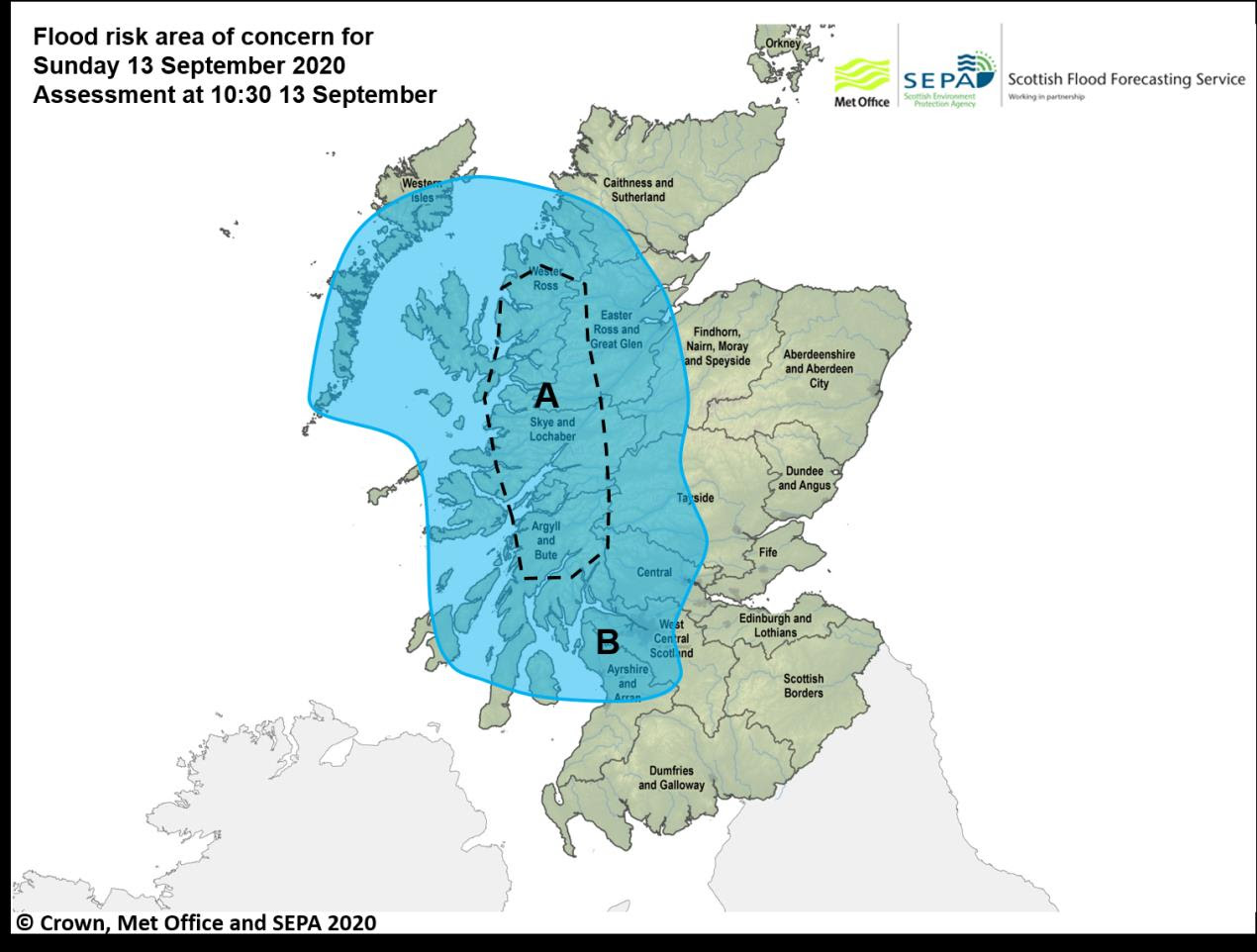
Today’s Area of Concern Map

  • Area A Area of most significant rainfall for Sunday – people living, working and travelling in these areas are advised to ensure they have signed up to Floodline and are prepared to take action to protect property. Advice on what you can do to prepare can be found at floodlinescotland.org.uk/
  • Area B Area of further rainfall.
MediaAOC13Sep

Man charged over illegal COVID gatherings

A man has been arrested and charged by Police Scotland in connection with culpable and reckless conduct after two unlawful gatherings were held in Edinburgh.

The first was held during the afternoon of Saturday, 5 September, and the second on Thursday, 10 September, outside the Scottish Parliament and in the surrounding areas.

A 60-year-old man has now been charged in connection with both gatherings, which were held in opposition to the Covid-19 restrictions, and a report will be submitted to the Procurator Fiscal.

Superintendent David Robertson of Edinburgh Division said: “Officers attended both of these gatherings to help ensure the safety of the public and to remind those attending to adhere to the current guidelines.

“We engaged with a number of people and encouraged them to comply with the law. As we have routinely said, enforcement will be a last resort but we will use the powers at our disposal where required to do so.

“We are asking people to take personal responsibility and remember that the purpose of these measures is to aid the collective effort to stay safe, protect others and save lives by preventing the virus from spreading.”