Virgin Hotels Edinburgh is turning up the heat this New Year’s Eve with its Red Hot Hogmanay celebration, which is set to be the hottest party in town.
Taking place in Eve, the hotel’s all-day dining venue, party goers will be able to celebrate in style with a drop red gorgeous scarlet dress code and entertainment from live bands and world-renowned DJs, including Funkwild, Buckwild, Eclair Fifi and Rebecca Vasmant, playing until the small hours of 2023.
Celebrations kick off at 9pm where guests will be greeted with a welcome fit for a VVVIP including a glass of fizz on arrival. Whether you’re looking for an unforgettable dinner experience or a place to dance the night away, there is a selection of packages available at Eve to suit all guests, from ‘Dinner Only’ to the ‘Pimp My Party’ package which provides the ultimate VIP experience with no queues, your own table for the night and table service, ensuring you always have your glass topped up.
Situated at ground floor level, with an entrance from Cowgate, Eve opened its doors in October and boasts a luxurious interior with unique floor-to-ceiling murals and a vibrant, lively atmosphere, making it the place to be seen in Edinburgh’s The Old Town.
There’s something for everyone at Virgin Hotels Edinburgh and those who are seeking a more relaxed and refined evening can enjoy a specially curated 5-star menu with champagne to accompany at Commons Club – Virgin Hotel’s iconic flagship restaurant.
From 7pm onwards, Commons Club will be welcoming guests to enjoy a sophisticated evening filled with show-stopping entertainment from performers, Laura Wilkie, and Fergus McCreadie, on keys and fiddle. Guests will also have access to the hotel’s rooftop for an exclusive experience, viewing Edinburgh’s iconic Hogmanay firework display from a never-before-seen viewpoint. With one of the best views of Edinburgh Castle and a special rooftop fiddle performance, it’s sure to be an unforgettable experience.
Scott McArdle, General Manager at Virgin Hotels Edinburgh, said: “Virgin Hotels Edinburgh is ready to show the Capital how to celebrate the new year in style with our first Red Hot Hogmanay.
“With lots of exciting plans in store – there’s something for everyone at Virgin Hotels Edinburgh from the vibrant, lively atmosphere of Eve which is perfect for those looking to dance the night away to the more relaxed and refined experience of our flagship restaurant – Commons Club.
“Edinburgh is synonymous with New Year’s Eve, and we are really excited to join in the celebrations at the home of Hogmanay, offering locals and our jet-setting guests an evening they’ll never forget.”
Whatever your preference for the evening, make this New Year’s Eve RED HOT and join Virgin Hotels Edinburgh for a night to remember.
On average, 96 people lose their lives to a water-related fatality each year in Scotland.
Scotland’s Drowning Prevention Strategy aims to reduce accidental drowning deaths by 50 per cent by 2026 and reduce risk among the highest-risk populations, groups and communities.
These aims are addressed by the collective efforts of the organisation Water Safety Scotland (WSS), and one of the major achievements of WSS is the concept of Partnership Approach to Water Safety (PAWS) groups.
PAWS is a multi-agency approach to raising water safety awareness at a local level. The strength of PAWS is that members have the required knowledge and experience to enable them to best understand water-based risks present in a certain locality.
Written in 2021 by James Sullivan of the Scottish Fire & Rescue Service, PAWS is recognised by subject matter experts as making meaningful contributions to drowning prevention and is WSS’s preferred method for formulating a local water safety group.
PAWS recently won the National Fire Chief’s Council (NFCC) Partnership Award and WSS would like to extend enormous gratitude to SFRS and everyone involved in PAWS who contribute to improving water safety and achieving the outcomes of Scotland’s Drowning Prevention Strategy.
A Water Safety Scotland spokesperson said: “WSS fully support the PAWS process and are very encouraged by the commitment shown by partners throughout Scotland to become involved and contribute to jointly improving water safety.
“Throughout 2021 and 2022 there has been a growing momentum and willingness from partners to work together and PAWS has played a vital part in coordinating these efforts and maintaining consistency and information exchange.
“With the forthcoming launch of the WSS Drowning & Incident Review (DIR), PAWS Groups will play a vital role in delivering comprehensive and consistent reviews of accidental drowning deaths in Scotland.”
WSS actively promotes and supports the establishment of PAWS groups in all 32 of
Scotland’s local authorities. If you wish to enquire about a PAWS group in your local area
Aldi supported local charities, community groups and food banks in Edinburgh and The Lothians on Christmas Eve by donating 14,530 meals to those in need.
Working with Neighbourly, the supermarket paired up its stores with local charity partners in the area to collect unsold fresh and chilled food when stores closed early on 24th December, with stores repeating the initiative on 31st December.
To further support local communities this year, Aldi’s Emergency Winter Foodbank Fund saw the supermarket also commit to donating £250,000 to charitable organisations throughout the winter season.
Both the festive food donations and fund are part of Aldi’s successful partnership with Neighbourly, a community giving platform that links businesses to charitable organisations.
All of Aldi’s 980 UK stores donate surplus food to good causes, all year round, with over 27 million meals donated to good causes since its partnership with Neighbourly began back in 2019.
Liz Fox, Corporate Responsibility Director at Aldi UK, said: “We are incredibly proud to have supported so many amazing charities and community groups in Edinburgh and The Lothians this Christmas, helping them to provide warm and healthy festive meals to those in need.
“We know that the festive period will have been a particularly challenging time for so many this year which is why we also launched our Emergency Foodbank Fund – allowing us to support even more organisations at a time of heightened demand.”
Steve Butterworth, from Neighbourly, added: “Christmas is always a busy time for charities and food banks, but this year was, without doubt, one of the busiest. The donations from Aldi are vital for so many people and we are really pleased to be working together to help those in need again this year.”
Spray and flooding probably leading to difficult driving conditions and some road closures
Delays and some cancellations to train and bus services are likely
Homes and businesses are likely to be flooded, causing damage to some buildings
A good chance some communities will be cut off by flooded roads
Fast flowing or deep floodwater is likely, causing danger to life
Marc Becker, Flood Duty Manager for the Scottish Environment Protection Agency (SEPA), said: “Heavy rain from around midnight on Thursday into Friday morning could cause flooding from rivers and surface water in central and southern Scotland.
“Impacts may include flooding in communities, properties and agricultural land. Disruption to the transport network is also likely, including difficult driving conditions. Parts of Dumfries and Galloway and the Borders in particular could experience significant impacts.
“Regional Flood Alerts and local Flood Warnings are in place. People living and working in affected areas are advised to plan their essential journeys and consider the steps they need to take now to be prepared and to stay safe. Anyone out walking is urged to be extra cautious, even around small watercourses. They can also keep updated on floodline.sepa.org.uk.
“SEPA works 24/7 to monitor conditions and is in close contact with the Met Office and other partners to understand and communicate the flooding risk.”
Staying informed
Check the latest information on SEPA’s regional Flood Alerts and local Flood Warnings at sepa.org.uk/floodupdates.
Check the latest advice on what to do to prepare for flooding at floodlinescotland.org.uk
Register for SEPA’s free Floodline alert service by calling 0345 988 1188 or by clicking floodlinescotland.org.uk
After much needed time to relax with family and friends over Christmas, getting back into your routine in the new year can be quite the challenge, specifically when it comes to working out. In fact, research shows that one third of Brits admit to doing no exercise at all in December, so it’s vital to start the preparation early.
However, it doesn’t need to be so difficult – experts at Fitness Volt have highlighted five tips to ease yourself back into a workout routine after the festivities.
Set specific times
Scheduling your workout time is a simple yet effective step. Getting back into the right frame of mind after the Christmas buzz is just one of the ways you will have to readjust, and it can certainly take its toll on you. So, without a gym schedule, it’s likely that you will make plenty of excuses to not partake in any exercise. Consider your day-to-day schedule and choose your workout slot based on where you have the most free time – this way, you can mentally prepare yourself as well as avoid any excuses that you are too busy. Plus, a planned exercise slot will ensure that your workload won’t take over, as it’s a given that you will be getting back into a busy work routine, too.
Don’t overexert yourself
While pushing yourself is usually encouraged in fitness, it’s sensible to not push yourself to the extreme, particularly after some time away from exercise. Whether it’s weightlifting or cardio, doing too much exercise can lead to overuse injuries including muscle strains and tendon injuries, thus making you a lot less capable of meeting your fitness goals. After some time off, it’s natural to not be able to lift as heavy or run as far – so it’s crucial to not let it discourage you, as you will soon gain your ability if you stay consistent with your exercise. As well as this, overdoing it can lead to a burnout in the early stages and make you dread a workout as opposed to enjoy it. If you feel yourself giving up, try to commit to five minutes and finish your workout if you don’t feel capable of doing anymore; but with this five-minute rule, it will likely motivate you to do more.
Personalise your workout
Fitness lovers aren’t necessarily all gym-goers. In fact, there’s plenty of ways to workout which don’t involve the gym – and this is key for making it an enjoyable part of your routine again. If you’re a nature enthusiast and wish to do more cardio exercises, go for a run – or even a walk – at your local beach, local park, or even around your neighbourhood. Alternatively, if you’re into strength training but don’t enjoy the gym atmosphere, invest in equipment such as dumbbells and kettlebells to work out from the comfort of your own home.
Partner up
Finding a friend with similar fitness goals is beneficial for many reasons, one being that it acts as motivation after some time away. For the days that you don’t feel like exercising, a fitness partner can motivate you to get ready and get it done – plus, during a workout, your partner can even push you to take it to the next level, such as lifting a slightly heavier weight or increasing the incline setting on the treadmill. Having a partner can also keep you accountable to stay on track of your fitness plan, and recognise any goals that are yet to be met. Better yet, it makes it a time to socialise so that you look forward to it more, not to mention your partner can spot you to make your workout safer.
Set short term goals too
It’s always important to think of the long-term result; doing so allows you to plan your workout and figure out which exercises are best suited to your needs. However, having only a long-term goal can become frustrating when you aren’t seeing progress straight away, and can even result in you to give up completely – which is especially easy to do when you’re trying to get back into your routine. Therefore, it’s vital to set goals over shorter timeframes that are manageable, as well as not just focusing on your appearance. For example, you may wish to become stronger, so a short-term goal for the end of a month could be to increase your squat load by 20 kilograms.
A spokesperson from Fitness Volt has commented: “When it comes to Christmas, the last thing that needs to be on our minds is working out – it’s a time that we wish to be spending with family and friends, and it’s important to make the most of that. However, it can be difficult to find our motivation to get back into it from some time off.
Thankfully, there are simple steps that can increase your ambition again as well as make your workout more enjoyable to ensure that you can stick to your fitness routine in the new year and, as a result, enjoy the Christmas festivities without feeling guilty.”
The research was conducted by Fitness Volt which is a comprehensive online resource dedicated to Strength Sports, from healthy eating to exercise and everything in between.
As millions of people enjoyed Christmas festivities this year, for 3,275 people Christmas Day was the perfect time to file their Self Assessment tax return, HM Revenue and Customs (HMRC) has revealed.
A total of 22,060 customers went online to submit their form for the 2021 to 2022 tax year between 24 and 26 December, and 141 opted to file between 23:00 and 23:59 on Christmas eve, meaning they could enjoy celebrations knowing their tax return was complete.
The breakdown of figures for those who opted to file during the festive period are:
Christmas Eve: 8,474 tax returns were filed. The peak time for filing was between 11:00 and 11:59, when 888 returns were received.
Christmas Day: 3,275 tax returns were filed. The peak time for filing was between 12:00 and 12:59, when 319 returns were received.
Boxing Day: 10,311 tax returns were filed. The peak time for filing was between 12:00 and 12:59, when 953 returns were received.
The deadline to file and pay any tax owed for the 2021 to 2022 tax year is 31 January 2023, and HMRC is urging customers to submit their tax return on time or they may face a penalty.
Myrtle Lloyd, HMRC’s Director General for Customer Services, said: “We are grateful to those customers who have already filed their tax returns. For anyone who is yet to make a start, help is available on GOV.UK, just search ‘Self Assessment’ to find out more.”
Once customers complete their tax return, if they owe tax, they can find out about the different ways to pay including via the HMRC app at GOV.UK.
Those who are unable to pay their tax bill in full can access support and advice on GOV.UK. HMRC may be able to help by arranging an affordable payment plan, known as Time to Pay. Customers should try to do this online; go to GOV.UK for more information. Alternatively, they can contact the helpline.
HMRC has a wide range of resources to help customers complete their tax return, including guidance, webinars and YouTube videos.
People need to be aware of the risk of falling victim to scams and must never share their login details which can be used to make fraudulent claims. Check HMRC scams advice on GOV.UK.
Drivers are being warned about the worsening condition of roads across the UK as recent data reveals that 90% of insurance claims come from potholes.
Experts from leading price comparison website Quotezone.co.uk are calling on the government and local councils to not let the pothole problem get even worse.
With a long winter of bad weather ahead motorists will run an increased risk of damaging vehicles by driving over potholes if UK roads are not properly maintained.
Spending on road maintenance has almost halved since the financial crisis just over a decade ago, and the recent cost-of-living crisis has further reduced potholes on the priority list.
Even temporary pothole fixtures – which involves filling the hole with a form of asphalt treatment – have also decreased by almost half in some counties.
There are also claims from members of the public that councils are not properly inspecting potholes that have been reported online.
Several county councils have admitted that filling in potholes is no longer a priority as a result of the rising cost of living, with less funding for UK highways.
And with an expected bad weather spell to last well into the New Year with rising levels of snow, ice and rain – it will no doubt make potholes even worse.
With a combination of bad weather and lack of funding, the UK is likely sitting on a disaster waiting to happen and the pothole problem may soon get out of hand.
With nine in 10 insurance claims coming from pothole incidents, Quotezone.co.uk are calling for councils and the government to urgently act on what is a UK-wide problem.
Data shows that the worst pothole affected area in the UK by far is Northumberland, with over 180,000 potholes reported over four years, followed by Cornwall and Kirklees in West Yorkshire.
Newcastle, Liverpool and Suffolk also have some of the worst potholed roads in the UK as well as Fife and Glasgow in Scotland, and Newry, Mourne & Down joined by Armagh City, Banbridge & Craigavon in Northern Ireland.
Greg Wilson, Founder and CEO of Quotezone.co.uk said: “We all know how bad it can be to drive down roads which are full of potholes, and unfortunately the problem does not seem to be going away.
“With a massive 90% of insurance claims coming from pothole related incidents, most of us have had damage caused by a pothole, or know someone that has.
“We are expecting a winter of extreme weather and with spending on road maintenance on the decline, we could expect to see a significant increase in pothole related claims.
“This will make UK roads more dangerous for all road users, so we’d encourage local authorities and the government to act now ahead of the worsening weather and make a start on fixing the UK’s pothole problem.”
Retailers are hiking up the cost of their cheapest food items as the cost of living crisis bites the UK.
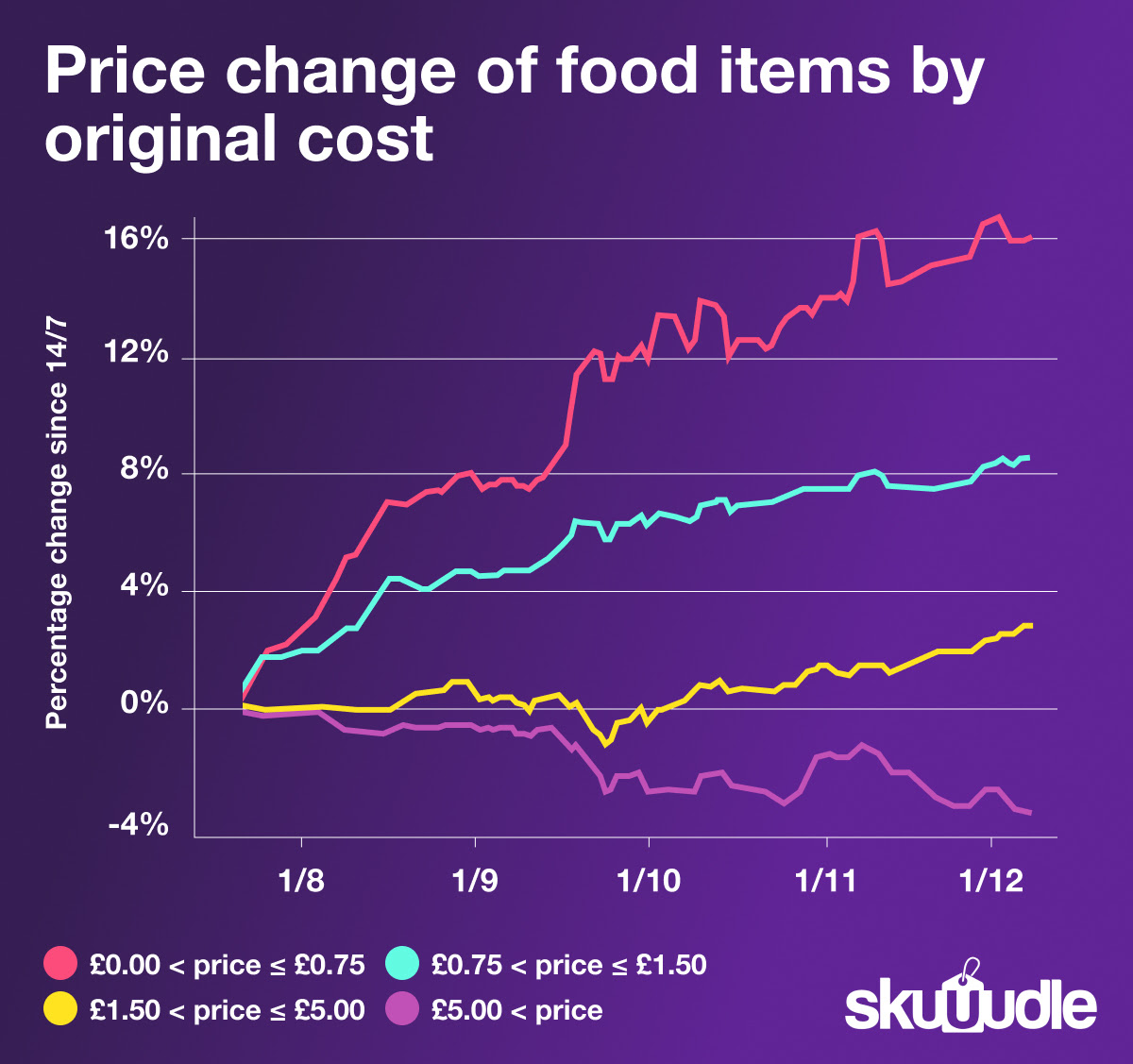
Supermarkets are increasing the price of their value items more quickly than more expensive items, according to an analysis by price intelligence company Skuuudle.
In the biggest study of its kind Skuuudle tracked the cost of almost 19,000 items in UK supermarkets on a daily basis from July to December and found that items originally below 75p accelerated at the fastest rate.
These items include many supermarket value range products including biscuits, chocolate, snacks, oils, rice, pasta, cans and packets of food.
Yet items priced above £5 in July have actually fallen in price, possibly as a result of reduced demand for high cost items.
Food staples selling for under 75p have risen by 16% while items selling for over five pounds have decreased in price up to nearly four percent according to the data.
Experts from Skuuudle tracked the price of 18,790 supermarket food products from sauces to cereals.
The figures show a direct correlation between original cost and rate of increase with cheaper items increasing in price at a higher rate than more expensive alternatives.
Items priced between 75p and £1.50 back in July increased by eight percent while items priced from £1.50 to £5 went up by almost four percent.
Skuuudle generates market-leading data analytics to help retailers understand the markets they are operating in, to continue to provide optimum prices for consumers – in the face of rising inflation.
This allows retailers to compare like for like products and accurately track changes in price of the same items across different retailers.
This level of insight is critical when accurately tracking the price of a large number of food products with many small variables differentiating one product from another.
A Skuuudle spokesman said that retailers have an unenviable ‘balancing act’ to perform when it comes to pricing, having to consider the needs of the customer, their suppliers and the supply chain.
He said: “The changes make difficult reading for those on low incomes who are seeing the cost of many value items increase but who may not be able to benefit at all from the reduction in price of more expensive items.
“This change could well be driven by a reduced demand for more expensive items as more people turn to value products during the cost of living crisis.
“Supermarkets are having to contend with increasing costs associated with production and shipping, while issues of supply are driving costs up further.
“What is interesting is how supermarkets are choosing to pass increased costs onto consumers.
“Our data reveals that it’s the prices of the cheapest food items which are rising at the highest rate while many expensive items have actually become cheaper.
“It is often the cheapest items in our baskets that we pay the least attention to so understanding that some of these staples might be increasing at a faster rate will help the most value conscious shoppers stay in control of their weekly food shop bills.”
One in seven (17%) UK adults – estimated as 8.8 million people – plan to go alcohol-free for 31 days in January, with three in 10 looking to cut down generally in 2023
One in four say they have drunk more in 2022 than 2021, while for one in six the cost of living crisis was a reason for the increase in their drinking
Of those planning to go alcohol-free, one in three said they would prefer to take part in Dry January with Alcohol Change UK
Those who take on Dry January using the charity Alcohol Change UK’s free Try Dry app and/or daily motivational emails are twice as likely to have a month totally alcohol-free and experience many more benefits
New research1 published by Alcohol Change UK, the charity behind Dry January®, shows that almost 9 million people in the UK are planning to have a month off drinking in January 2023 – up from an estimated 8 million UK adults last year.
Of those, one in three (33%) said they would prefer to take part in Dry January® with Alcohol Change UK, rather than trying to go alcohol-free in January on their own.
The survey, commissioned by Alcohol Change UK, shows that the cost of living crisis has impacted on drinking habits over the last six months. One in six (16%) people who drink alcohol said this had led to them drinking more to cope with worries around the crisis, and one in seven (14%) have prioritised purchasing alcohol over essential items, such as groceries.
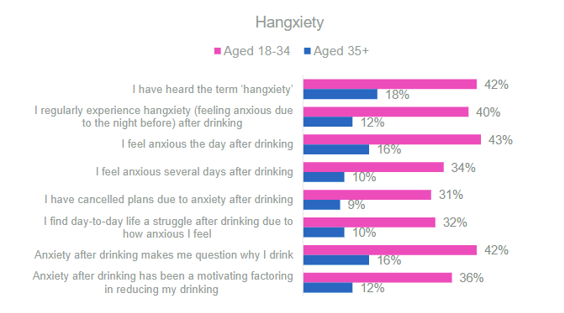
For one in three young adults who drink (36%), anxiety after drinking has also been a factor in them deciding to reduce their alcohol consumption.
Hangxiety – a term used to describe the experience of feeling anxious the day after drinking – appears more prevalent amongst drinkers aged 34 and under, with two in five (40%) experiencing it regularly, compared to a tenth (12%) of those aged 35 and over. For those aged 18-34, over a third (36%) said it was a contributing factor in their decision to reduce their drinking.
Over the course of a typical week, British drinkers, on average, drink 13.7 units of alcohol. However, one in three (30%) drinkers typically drink more than the 14 units a week maximum recommended by the UK’s Chief Medical Officers, with twice as many men doing so compared to women (39% versus 22%).
Three in 10 (30%) drinkers said they would like to reduce how much they drink in 2023 (compared to 25% a year ago). Across all drinkers, half claim to already have taken measures to manage their drinking. The most common being having alcohol-free days (25%), drinking less on occasions where they are drinking alcohol (16%), having alcohol-free weeks or months (15%), or an alcohol-free night out (10%).
January 2023 marks the 10th anniversary since the launch of Dry January. Dry January® offers the perfect opportunity to manage your drinking for the longer term and a chance to get some amazing benefits along the way.
Research shows that those who do Dry January® with Alcohol Change UK double their chances of success, and have more energy, improved concentration, boosted mood, save money and so much more. A month off alcohol also leads to lower blood pressure, cholesterol and diabetes risk, as well as lower cancer-related proteins in the blood.
Over the past 10 years, Dry January® has continued to grow in popularity with record numbers of drinkers signing up to take part both in the UK and elsewhere.
First launched in 2013, Dry January® was the brainchild of Emily Robinson from Alcohol Change UK (formerly known as Alcohol Concern).
Speaking about its launch, Emily Robinson, now CEO of London Sport, said: “The idea of the Dry January® campaign first came to me after I decided to sign up for my first half-marathon.
“I wanted to be fitter and healthier, and I knew that alcohol makes it harder to get up every day and train. So I decided, just for one month, to give up alcohol in January.
“The mental and physical results were amazing. I slept better, had more energy, lost weight, and saved money.
“I also found that friends and colleagues were completely fascinated by my experiment, and more and more people wanted to speak to me about it. So, when I joined Alcohol Change UK (formerly Alcohol Concern) in 2012, I shared the idea with colleagues asking everyone to join in with taking a month off booze in January.
“Ten years on, it’s wonderful to see how Dry January® has become the huge phenomenon it is today. I’m incredibly proud of the campaign and would encourage anyone who’s interested in feeling happier and healthier to give it a try.”
Dry January® officially launched in January 2013. For that first year, 4,000 people signed up to take part. Since then, Dry January® has grown in popularity with over 130,000 people signing up to take part with Alcohol Change UK in 2022.
Evidence shows that Dry January® is an effective and lasting way to cut down. Research by the University of Sussex2 published in 2020 found that those signing up to take part in Dry January® using Alcohol Change UK’s free Try Dry app and/or coaching emails are twice as likely to have a completely alcohol-free month, compared to those who try to avoid alcohol on their own in January, and have significantly improved wellbeing and healthier drinking six months later.
Ailar Hashemzadeh, Director of Research and Public Affairs at Alcohol Change UK, said: “Over the past few years, things have been incredibly tough for so many people and the cost of living crisis is making things even tougher. This has led to more and more of us finding our drinking creeping up, particularly for those of us who were drinking more heavily to start with.
“Since its launch 10 years ago, Dry January® has provided a brilliant opportunity for hundreds of thousands of people to take a break from drinking and have a total reset.
“It helps you break habits you’ve fallen into and make long-term changes for the better. It can help to relieve anxiety and helps you remember that you don’t need alcohol to have fun, relax, celebrate, unwind or anything else. It puts you back in control of your drinking.
“If you’d like to reset your relationship with alcohol, give Dry January® a try by downloading the free Try Dry® app or sign up at dryjanuary.org.uk. It could be the spark you need for a happier and healthier 2023.”
Those taking part in Dry January® get access to all of the free tools and resources from Alcohol Change UK, from its Try Dry app to its daily motivational emails.
We’d encourage anyone who’s interested in resetting their relationship with alcohol to download the free Try Dry® app. You can use it year-round to check your units, calories and money saved, and earn badges as you go.
Alcohol Change UK is proud to be partnering with Lyre’s, Mocktails and Lucky Saint for Dry January 2023.
How to take part in Dry January®
Download the free Try Dry® app via the App Store or Google Play. Via Try Dry® you will be able to receive optional daily coaching emails. Alternatively, you can sign up for just the email coaching programme at dryjanuary.org.uk.
Try Dry® allows people to track their units, calories and money saved not drinking, plus set personalised goals and earn badges year-round. People who take part in Dry January®, whether online or via Try Dry®, are twice as likely to spend the whole the month alcohol-free, despite being heavier drinkers to start with (de Visser and Nicholls, 2020).