RAF airdrops over 10 tonnes of food supplies to civilians in Gaza

The Royal Air Force airdropped over 10 tonnes of food supplies into Gaza for the first time yesterday (Monday 25 March 2024), as part of international efforts to provide life-saving assistance to civilians. 

The aid consists of water, rice, cooking oil, flour, tinned goods and baby formula.

The Defence Secretary authorised the airdrop following an assessed reduction in threat to the military mission and risk to civilians.

An RAF A400M flew from Amman, Jordan to airdrop this aid along the northern coastline of Gaza, as part of the Jordanian-led international aid mission. UK personnel worked closely with the Royal Jordanian Air Force to plan and conduct this mission. 

Defence Secretary Grant Shapps said: “The UK has already tripled our aid budget to Gaza, but we want to go further in order to reduce human suffering. Today’s airdrop has provided a further way to deliver humanitarian support and I thank the RAF personnel involved in this essential mission, as well as our Jordanian partners for their leadership.

“The hell that was unleashed by the October 7th Hamas attack has led to wide-scale innocent loss of life. The UK’s goal is to use every route possible to deliver life-saving aid, whether that is by road, air or new routes via the sea. 

“We also continue to call on Israel to provide port access and open more land crossings in order to increase incoming aid deliveries to Gaza.”

The A400M is a highly capable tactical and strategic airlift platform and today’s airdrop was its first ever mission delivering humanitarian aid by parachute. Both RAF and British Army personnel participated in the mission. The drop zones were surveyed before and during the airdrop to ensure aid was delivered directly to civilians. 

This airdrop is part of ongoing UK efforts to provide life-saving humanitarian assistance to the people of Gaza and follows recent land deliveries of 2,000 tonnes of UK food aid to feed more than 275,000 people and thousands of UK-funded blankets, tents and other relief items, as well as the establishment of a full UK-funded field hospital in Gaza run by British charity UK-Med.

The UK remains committed to ensuring aid reaches those who need it most, as Palestinians continue to face a devastating and growing humanitarian crisis in Gaza.

The UK has previously supported international airdrops, providing around 600 parachutes at the request of Jordan and Bahrain and supplying critical aid for a Jordanian airdrop to Tal Al-Hawa Hospital in northern Gaza.

Between October and November 2023, the RAF also delivered aid and humanitarian supplies to Egypt for distribution by the Egyptian Red Crescent and UNRWA. 

The UK continues to work with allies, including Cyprus, the United States, European Union and United Arab Emirates, to open a direct maritime corridor to Gaza.

UK defence planning teams are deployed in the United States and Cyprus to support this international effort and the Foreign, Commonwealth and Development Office is prepositioning aid in Cyprus.

The UK Hydrographic Office has also shared analysis of the Gazan shore with US planners to help establish a temporary aid pier. In January, the UK worked with Cypriot partners to pre-screen 87 tonnes of aid that was delivered by Royal Fleet Auxiliary ship RFA Lyme Bay to the Egyptian Red Cross for the people of Gaza.

The UK is also focused on ensuring more aid can enter Gaza by land, working closely with Jordan who have been instrumental in facilitating the UK’s humanitarian response. Last week, more than 2,000 tonnes of food aid was distributed by the World Food Programme on the ground. This adds to the 150 tonnes of UK-funded relief items, including blankets and tents, which arrived earlier this month, distributed by UNICEF.

Alongside the latest deliveries of aid, the UK has announced a further £10 million in aid funding for the Occupied Palestinian Territories (OPTs), bringing the total spend to over £100 million this financial year. This funding will support UN agencies on the ground to deliver lifesaving aid and will also provide core relief items, such as tents, for the most vulnerable.

£30 million more funding to support mental health services

Further community support for adults, children and young people

Two funds to support projects aimed at improving mental health and wellbeing in adults, children and young people have been awarded a further £30 million.

The Communities Mental Health and Wellbeing Fund for Adults, and the Children and Young People’s Community Mental Health and Wellbeing Supports, have been awarded £15 million each for 2024-25.

Launched in 2021, the fund for adults has supported grass roots community groups to deliver programmes for adults which build resilience and tackle social isolation, loneliness and mental health inequalities. Projects focused on connecting people and providing peer support were delivered through activities such as sport, outdoor activities and the arts.

Funding for the children and young people’s support began in 2020 to help with the mental health impact of the pandemic and its restrictions.

The new funding means more than £65 million has been made available to local authorities since then to deliver community-based mental health and wellbeing support for five to 24 year-olds and their families.

Support delivered includes mentoring, art-based therapies, digital services, whole-family support, counselling and sport or physical activities.

First Minister Humza Yousaf, who today visited Edinburgh Community Performing Arts Re-connect project for older people, said: “On becoming First Minister I reiterated my personal commitment to supporting those living with mental health challenges.

“We know how important it is for our society to have access to mental health and wellbeing support. That is why my government is committed to ensuring we fund vital services in our health service and in community settings to ensure we try, as much as possible, to provide a national network of community support for adults, children and young people.

“This further £30 million will fund community based projects which are focused on prevention and early intervention, and this is a significant step forward in supporting people’s mental health and wellbeing by making sure they can easily access the help they need, when and where they need it.

“Since 2020 the Scottish Government has invested over £100 million in community-based mental health support. An independent evaluation published last year shows that projects for adults have lowered social isolation thereby alleviating some of the negative mental and physical health impacts from the pandemic, as well as providing support and self-help for individuals with ill mental health issues.

“More than 300 children and young people’s supports and services are in now in place across the country, and evaluation published by the Scottish Youth Parliament found that nearly three-quarters of young people agreed or strongly agreed that they received support when they needed it.”

Fundraiser and Project Manager at Edinburgh Community Performing Arts Emma Stewart-Jones said: “We are delighted to have funding from the Communities Mental Health and Wellbeing Fund.

“The difference that these community arts projects can have on individual’s health, sociability and well-being can be profound.”

‘Circle of good’ making a difference for Leith-based community bank

2023 has been a year of exceptional growth for Castle Community Bank headquartered in Leith. At the AGM it was reported that total membership has grown to over 46,000 at September 2023.

Chief Executive Adrian Sargent said: “I’m proud of our team, and the growth that we have achieved this year. We remain focussed on our social purpose of supporting communities, whilst helping our members to maximise their savings and manage debt as effectively as possible.

At the same time, our overall current Trustpilot rating of 4.8/5 shows we are getting the day-to-day experience right for our membership.”

Castle Community Bank aims to achieve sustainability through scale and is on track to do so with total assets now equal to £283m, making them one of the largest credit unions in the UK. Deposits have grown to £247m in 2023 and the loan book has increased to £225m in 2023.

Castle Community Bank Chair, Stephen Pearson said: “I like to think of our operating model as a ‘circle of good’.

“Savers like our top quartile interest rates and easy online joining process. Many of them also like the fact that we make their money go further by funding our affordable loan products, enabling people who struggle to access loans from mainstream banks to borrow what they need at affordable rates.

“In turn, prudent, commercial success enables us to grow our community programmes in Edinburgh and beyond: including providing debt advice support, sustainable food bank funding and ethical investment for charities and churches.

“Castle Community Bank is leading the way in expanding the credit union movement in the UK, delivering strong and sustainable growth, underpinned by sound risk management.”

The Scottish credit union was established in 2015 following the merger of two long established credit unions: Castle and North Edinburgh (above), along with the members of the Water of Leith Credit Union Study Group.

The study group was set up with the aim of establishing a Credit Union in Leith.

The difference between credit unions or mutuals and high street banks is they are owned and run by members, instead of shareholders, creating a shared financial community across the UK, which is accessible to everyone.

Discovery exhibition opens at granton:hub this weekend

There’s just days to go before Bronwen Winter Phoenix unveils her artwork in a solo debut exhibition at granton:hub – based in Madelvic House – over Easter weekend, with opening night on Friday (29th March), 6pm – 9pm

The Edinburgh-based artist will also deliver live demonstrations for visitors who will be able to watch her paint within the gallery space throughout the day on Saturday 30th and Sunday 31st from 10am – 4pm.

Although this is Bronwen’s first solo exhibition, she recently had four pieces of work displayed at Edinburgh Palette as part of an open call exhibition from Awright Projects. DISCOVERY will showcase new works, along with some pivotal pieces for Bronwen. 

An ex-journalist and Galaxy Award-nominated fiction author, Bronwen is currently studying contemporary art practice (CAP) at Edinburgh College’s Granton campus, and is involved in the local art community there – including being on the committee of student-run hubCAP Gallery.

Bronwen said: “I’m really excited to be showcasing my work in the welcoming setting of granton:hub. It definitely feels like I’ve been on a bit of a journey with my art the past couple of years, and this exhibition is the culmination of that, really.” 

She continued: “Since I started painting again, I’ve been the happiest I’ve felt in my life, and I never want to stop. I feel like this is exactly where I need to be right now, but I’ve only managed to get here with the support of everyone around me, which I’m incredibly grateful for.” 

Having been discouraged at a young age from pursuing her art dreams, Bronwen turned to writing instead, and until more recently, it’s how she had earned a living with journalism and her marketing agency. 

Bronwen said: “It just goes to show, you should never let ANYONE discourage you from following your dreams. I feel incredibly lucky to have the opportunities I do now to pursue an art career, and I’m only just getting started.” 

Since she first started painting and working with both traditional and digital media, Bronwen has worked with two national charities. 

Official description via granton:hub: 

Ever since she picked up a paintbrush for the first time in roughly 20 years, Edinburgh-based artist Bronwen Winter Phoenix has been on a journey of realisation and uncensored passion.

DISCOVERY is Bronwen’s solo debut exhibition in which she shares many of her major pictorial and sculptural artworks created on that journey of realisation, predominantly exploring the human condition. The way we’re fuelled, moulded, twisted and pulled by connection, love, and loss, as well mental health and inner demons. Her work highlights the physical, the moral, and the psychological, with even a bit of whimsy thrown in at times.

Bronwen has so far been commissioned by two national charities, and four pieces of her work were recently displayed at Edinburgh Palette as part of an open call exhibition, where they were well received.

Meet the artist herself, discuss the work at the preview evening or come along over the Easter weekend where Bronwen Winter Phoenix will be hosting a live painting demonstration during the day within the granton:hub gallery space at Madelvic House.

Boyack: SNP government’s ‘neglect’ of Edinburgh’s housing emergency

Labour Lothian MSP Sarah Boyack has today challenged the Scottish Government to finally intervene in Edinburgh’s housing emergency.

This comes after recent ONS figures illustrated the scale of Edinburgh’s crisis.

The figures revealed that the average rent in Edinburgh had an annual increase of 14.9%, almost 5% higher than the 10.9% increase across the whole of Scotland.

This is despite the Scottish Government having introduced a rent cap.

The average house price has also risen faster in Edinburgh, compared to the country as a whole.

The average price jumped 5.4% compared to last year, whereas it only rose 4.8% across all of Scotland.

These figures come after Edinburgh Council unanimously declared a housing emergency at the tail end of last year.

However, the Scottish Government refused to follow suit and voted down plans to declare a nationwide housing emergency.

Commenting on the ONS figures, Ms Boyack said: “These latest ONS figures have merely illustrate what we in Edinburgh have known all along – there is a serious housing emergency.

“The only Edinburgh resident who doesn’t recognise this crisis is the one living in Bute House.

“The decision by the SNP, not to intervene to alleviate this situation shows their neglect for our capital city.

“Myself and other Scottish Labour MSPs will continue to push the Scottish Government to act.

“It is vital that Edinburgh gets the help it urgently needs, before this emergency escalates any further.”

Greenpeace bring Project Climate Vote to Edinburgh

LOCAL Greenpeace volunteers were door-knocking in Bruntsfield yesterday to spread the word about Greenpeace’s current UK-wide campaign Project Climate Vote.

Project Climate Vote aims to recruit one million climate voters ahead of the next general election, in order to pressure all political parties to commit to bolder action on climate change. Climate voters pledge to show visible support for climate policies and vote with the planet in mind.

Edinburgh volunteers went door to door in Bruntsfield having conversations with residents about their concerns about the climate crisis and wider connected issues. As climate voters, locals were asked to place a poster in their window and to voice their concerns about the climate crisis should local candidates come to their door in the run-up to the election.

Sue, a volunteer from Bruntsfield said: “The conversations we’re having show that the climate crisis is a key concern for the majority of people and they want bolder action from our leaders. It’s encouraging that so many people want to sign up…the hardest part is finding folk in on a sunny afternoon!”

Today follows numerous other door-knocking sessions Greenpeace volunteers have carried out in Edinburgh since September 2023, including in Pilton in North Edinburgh in February. The group will be out canvassing again during future weekends, right up until the general election, which is currently expected to take place in the latter half of this year.

Zoë, a volunteer from Newington said: “Project Climate Vote is a very exciting and crucial campaign aiming to hold politicians to account on delivering the action that we need in order to ensure a liveable future.

The climate crisis is already happening up and down the country. People can see it with their own eyes and are playing their part to mitigate their own impact on the environment. What we need now are our leaders to step up to the plate.”

Greenpeace UK are hosting weekly online training sessions for those interested in taking part in the canvassing campaigns in their local areas. Anyone is welcome to join a canvassing team, regardless of if they have any past experience with Greenpeace.

UK voters can sign up to be a Climate Voters and order their posters on the Greenpeace website.

SEPA launch consultation on review of areas most at risk of flooding

The Scottish Environment Protection Agency (SEPA) is consulting on a review of Potentially Vulnerable Areas (PVAs) to protect communities from future impacts of flooding, as the number of homes, businesses and services at risk across Scotland is projected to increase by around 40% by the 2080s due to climate change.

PVAs are areas where significant flood risk exists now or is likely to occur in the future and are used to identify locations where a partnership approach may be required to resolve widespread and often complex flooding issues.

They inform Scotland’s Flood Risk Management (FRM) Plans and Local Flood Risk Management Plans and become the focus of FRM actions, helping responsible authorities to prioritise investment and coordinate actions to reduce the impacts of flooding on communities.

Identifying PVAs is an essential part of protecting people, properties, businesses, communities, infrastructure, and our environment, with an estimated 284,000 homes, businesses and services across Scotland currently identified as at risk of flooding.

This winter, SEPA issued a record number of regional Flood Alerts and local Flood Warnings to the public. A total of 720 messages were sent between 1st September 2023 and 16th February 2024. The previous record of 714 was set over autumn and winter 2015/16.

Siobhan McNulty, Flood Risk Planning Manager at SEPA, said: “Scotland is witnessing an increasing number of extreme weather events and flooding presents a growing threat to our communities.

“It is vital we work together with partners and communities to identify the areas most at risk so we can work together to increase Scotland’s resilience to flooding. PVAs are the first step in this process.”

Informing Scotland’s flood risk management process

Since PVAs were first identified in 2011, SEPA have worked together with partners including local authorities and Scottish Water to plan and deliver actions to manage flood risk in the places where it is needed most.

Based on the National Flood Risk Assessment, PVAs are updated and published by SEPA every six years as required by the Flood Risk Management (Scotland) Act 2009. The designation of PVAs takes into consideration past, current and future flood risk from rivers, the sea and surface water using recorded events, observations and strategic flood modelling.

SEPA are now consulting on proposed updates to PVAs for 2024. The review will focus on smaller, community-based target areas set within wider zones of influence to provide clearer information on how flood risk is tackled in Scotland.

Once the PVAs are formally designated by Scottish Ministers, SEPA will then prepare FRM plans to set objectives and actions for reducing flood risk. The local FRM plans published by each lead local authority will then provide more detail, including timescales and funding.

Cabinet Secretary for Wellbeing Economy, Net Zero and Energy Màiri McAllan said: “Managing our exposure to floods and their impacts is a significant and growing challenge as climate change brings more severe and frequent flood events.

“Improving resilience to flooding is a priority for the Scottish Government, so I welcome the launch of this consultation and I encourage all parties with a potential interest to engage with it.”

Helping communities at greatest flood risk

One community that has historically suffered from flooding is Stonehaven, which has been designated a PVA since the first cycle in 2011.

Several actions have since been identified and delivered through flood risk management plans developed by SEPA and Aberdeenshire Council, with input from the Stonehaven Flood Action Group and the wider community.

These include the completion of the Stonehaven Flood Protection Scheme which is designed to protect against flooding from the Glaslaw Burn and the River Carron, and benefits around 370 homes and businesses by reducing fluvial flooding. Other actions that have been delivered for Stonehaven are a new coastal flood warning system, updated coastal flood hazard maps and the completion of the Stonehaven Bay coastal flood study.

Cllr Alan Turner, Chair of Aberdeenshire Council’s Infrastructure Services Committee, said: “I was delighted to see the completion of the Stonehaven Flood Protection Scheme. This demonstrates real progress being made to mitigate flooding impacts in the town.

“The scheme was built following consultation and engagement with the residents, businesses, and the Stonehaven Flood Action Group. That entire process started with a PVA assessment, where coordinated actions were established through PVA recommendations.”

“A PVA designation is an invaluable aid – firstly in the understanding of potential impacts of flooding and secondly through the implementation of tangible solutions which will provide reassurance to communities.”

Have your say on PVAs

While the designation of PVAs is a science and evidence-led process, feedback from public partners and local communities is key to making sure all relevant impacts are taken into consideration.

Siobhan McNulty said: “Whether you have previously been affected by flooding or have concerns about potential future impacts for your home, business or community, we want to hear from you.

“Your views on the proposed PVAs will inform essential future flood risk management work so we can improve flooding resilience together and best prepare for a changing climate.”

You can respond to the consultation on PVAs via Citizen Space until 24 June 2024.

Islamic Relief UK distributes food this Ramadan

TODAY AT BLACKHALL MOSQUE

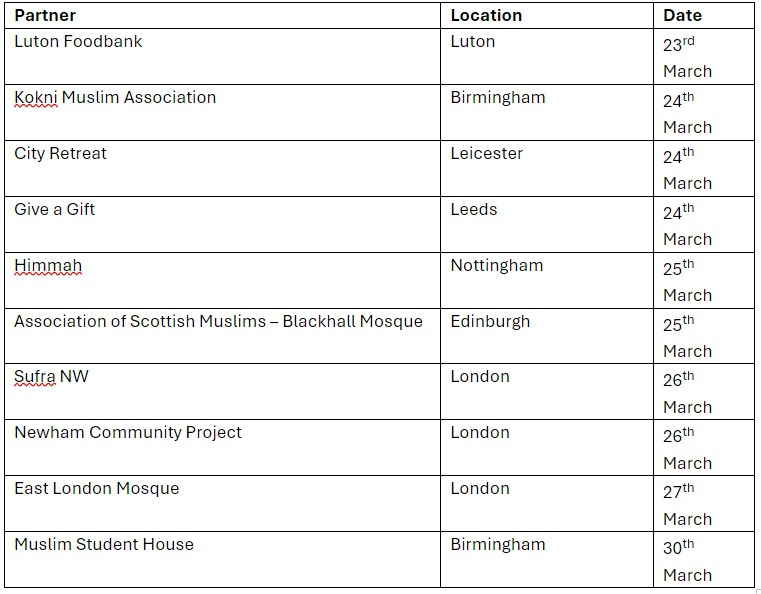
The charity, Islamic Relief UK, has launched its annual Ramadan food drive for 2024, to help the UK’s vulnerable communities who have been affected by rising poverty levels and the cost-of-living crisis.  

The food distribution will take places across the UK, in cities such as London, Birmingham, Leicester, Edinburgh, Liverpool, Luton and Nottingham, as the need is widespread. Islamic Relief will be working in collaboration with 18 of its local partners, such as food banks, mosques, football clubs, and local charities.  

According to research undertaken by Islamic Relief, and polling company Savanta (1), over half of people in the UK are struggling more with their bills and food prices than they were a year ago, and 30% of Brits are worried about having to use a food bank in the near future. The data points that almost all people in the UK, across all strata of society, have been negatively affected by the cost-of-living crisis and are concerned about the future.  

Tufail Hussain, director of Islamic Relief UK, adds: “Poverty in the UK has been exacerbated by years of the cost-of-living crisis, and families are struggling more than ever to put food on the table. It is imperative more than ever to come together as a community and support one another.” 

“The research we conducted spells a worrying outlook for the UK, with no community of social group spared from the tough reality of the cost-of-living crisis. But for the already vulnerable, the homeless, refugees and asylum seekers, the poor, it is catastrophic. Now more than ever we are so grateful for the outpouring of support that allows us to provide food distributions such as this one.” 

Locations and dates for the food distributions are as follows: 


-ENDS- 

Butcher reveals ‘world’s largest’ square sausage slice to mark first National Square Sausage Day

Ayrshire butcher We hae meat has created the ‘world’s largest’ square sausage slice to mark the inaugural National Square Sausage Day on 25 March. 

The giant square sausage slice – believed to be the largest ever produced – spans an impressive 30cm x 40cm, 25 times bigger than an average slice, and weighs in at 2.275KG. We hae meat teamed up with the Edinburgh-based Breadwinner Bakery who produced a colossal morning roll to fit the enormous sausage. 

Jamie (aged 8), Daisy (aged 8) and Leo (aged 9) from Dailly Primary School’s P4/5 class lent helping hands for the finishing touches, adding dollops of tomato and brown sauce.

Craig Chalmers, Commercial Manager, We hae meat said: “We produce more than 21 million slices of square sausage every year, but we wanted to challenge ourselves to do something really special to commemorate the first ever National Square Sausage Day.

“It’s been fantastic to see the enthusiasm for Scotland’s beloved square sausage since we announced the national day. Today, we’re inviting square sausage lovers in Scotland and beyond to join in the festivities by enjoying a square sausage breakfast, lunch or dinner.”

Pupil Jamie described the experience as “amazing,” saying, “The square sausage and the roll were huge – it was so much fun getting to be here to see it, and I know my friends at school are going to be really jealous!”

Established in 2007, We hae meat is a leading producer of premium meat products, operating from its Ayrshire farm and factory. The family business prides itself with a commitment to quality and traditional flavours, producing more than 21 million slices of square sausage a year. 

The farm-to-fork business is inviting families across Scotland to join in the celebration of the square sausage which, because it is thinner than a link sausage, takes less time and energy to cook, making it a more convenient and less energy-intensive alternative.

To mark the national day, We hae meat is also donating square sausage meals to the Dailly Community Pantry and all pupils and staff at Dailly Primary School, as well as sharing tips on social media on the best ways to cook and serve a slice.

We hae meat offers a skinny range, containing up to 75 per cent less fat and 45 per cent fewer calories than its standard range, offering a healthier alternative. For chippy lovers it also offers a ‘chippy-style’ range.

The company recently claimed the Green Family Business of the Year and Scottish Family Business of the Year awards at The Herald Scottish Family Business Awards, with the judges praising its sustainable practices.

We hae meat’s full range is available in major grocery retailers across Scotland, including Tesco, Morrisons, Asda, Co-Op and Iceland. 

Fact file

  • Ingredients included: beef, bread rusk, water and seasoning.
  • The average square sausage slice weighs 65g; We hae meat’s ‘world’s largest’ slice weighs 35 times that at 2.275kg.
  • We hae meat produces more than 21 million square sausage slices a year.

To find out more, go to https://wehaemeat.com/ and follow We hae meat on Instagram or Facebook.